

Close Menu
Meteorological Technology International
  • News
    • A-E
      • Agriculture
      • Automated Weather Stations
      • Aviation
      • Climate Measurement
      • Data
      • Developing Countries
      • Digital Applications
      • Early Warning Systems
      • Extreme Weather
    • G-P
      • Hydrology
      • Lidar
      • Lightning Detection
      • New Appointments
      • Nowcasting
      • Numerical Weather Prediction
      • Polar Weather
    • R-S
      • Radar
      • Rainfall
      • Remote Sensing
      • Renewable Energy
      • Satellites
      • Solar
      • Space Weather
      • Supercomputers
    • T-Z
      • Training
      • Transport
      • Weather Instruments
      • Wind
      • World Meteorological Organization
      • Meteorological Technology World Expo
  • Features
  • Online Magazines
    • January 2026
    • April 2025
    • January 2025
    • September 2024
    • April 2024
    • Archive Issues
    • Subscribe Free!
  • Opinion
  • Videos
  • Supplier Spotlight
  • Expo
LinkedIn X (Twitter) Facebook
  • Sign-up for Free Weekly E-Newsletter
  • Meet the Editors
  • Contact Us
  • Media Pack
LinkedIn Facebook
Subscribe
Meteorological Technology International
  • News
      • Agriculture
      • Automated Weather Stations
      • Aviation
      • Climate Measurement
      • Data
      • Developing Countries
      • Digital Applications
      • Early Warning Systems
      • Extreme Weather
      • Hydrology
      • Lidar
      • Lightning Detection
      • New Appointments
      • Nowcasting
      • Numerical Weather Prediction
      • Polar Weather
      • Radar
      • Rainfall
      • Remote Sensing
      • Renewable Energy
      • Satellites
      • Solar
      • Space Weather
      • Supercomputers
      • Training
      • Transport
      • Weather Instruments
      • Wind
      • World Meteorological Organization
      • Meteorological Technology World Expo
  • Features
  • Online Magazines
    1. April 2026
    2. January 2026
    3. September 2025
    4. April 2025
    5. January 2025
    6. September 2024
    7. April 2024
    8. January 2024
    9. Archive Issues
    10. Subscribe Free!
    Featured
    May 5, 2026

    In this Issue – April 2026

    By Web TeamMay 5, 2026
    Recent

    In this Issue – April 2026

    May 5, 2026

    In this Issue – January 2026

    November 27, 2025

    In this Issue – September 2025

    August 11, 2025
  • Opinion
  • Videos
  • Supplier Spotlight
  • Expo
Facebook LinkedIn
Subscribe
Meteorological Technology International
Climate Measurement

Climate change could trigger more landslides in the Himalayas, according to NASA

Paul WillisBy Paul WillisFebruary 19, 20202 Mins Read
Share LinkedIn Facebook Twitter Email
Credit: NASA's Scientific Visualization Studio/Helen Nicole Kostis
Share
LinkedIn Facebook Twitter Email

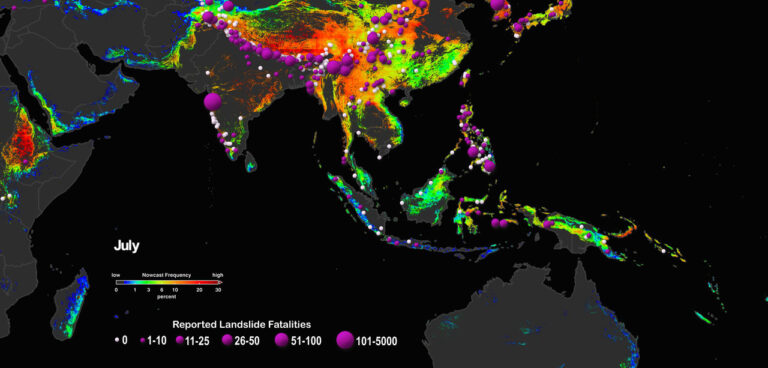
An increase in the frequency and intensity of rainfall events as a result of climate change could lead to more landslides in the Himalayas, a new study has found.

The NASA-led study looked at satellite estimates and computer modeling of precipitation data to project the impact of changing rainfall patterns on landslide frequency in the High Mountain Asia region of China, Tibet and Nepal.

The region, which includes the Himalayas, stores more freshwater in its snow and glaciers than anywhere outside the polar regions.

According to the researchers the impact of increased landslides could be severe, especially in areas currently covered by glaciers and glacial lakes where cascading disasters like floods could impact communities hundreds of miles downstream.

The study, a collaboration between scientists from NASA’s Goddard Space Flight Center in Maryland, NOAA and Stanford University, used a NASA model to help estimate landslide risk.

Known as the Landslide Hazard Assessment for Situational Awareness (LHASA), the model assesses risk by first evaluating data on roadways, the proximity of tectonic faults, the geology of the bedrock, change in tree cover and the gradient of slopes. This data is then correlated against current precipitation data to provide a risk assessment.

To test the model, the study team ran NASA precipitation data for the region for the last 20 years and NOAA climate model data dating back to 1982.

These datasets were compared with landslide data for the region from a global database stored by NASA. After finding that LHASA was able to accurately predict past landslides they projected the model into the future – assessing precipitation and landslide trends up until 2100.

They found that the border region between Nepal and China was the most vulnerable, with landslide activity predicted to increase between 30% and 70%.

Stretching tens of thousands of miles from the Himalayas in the east to the Hindu Kush and Tian Shan mountain ranges in the west, High Mountain Asia’s water cycle is changing as Earth heats up.

Changes in the annual monsoon patterns are already having an adverse impact on millions of people in the region. Last summer, for example, monsoon flooding and landslides in Nepal, India and Bangladesh displaced more than seven million people.

Previous ArticleNASA flight mission to investigate aerosols’ role in sea cloud formation
Next Article Ball Aerospace built air quality instrument goes into space

Read Similar Stories

Oceans

VIDEO: Sentinel-6 satellite detects El Niño precursor in Pacific

June 4, 20262 Mins Read
Nowcasting

Colorado State University and Nvidia partner to extend severe storm prediction lead times

June 2, 20262 Mins Read
Climate Measurement

WMO warns El Niño is developing with 80% certainty, urges preparation

June 2, 20263 Mins Read
Latest News

VIDEO: Sentinel-6 satellite detects El Niño precursor in Pacific

June 4, 2026

New forecasting framework targets solar-limb flare blind spot

June 4, 2026

Colorado State University and Nvidia partner to extend severe storm prediction lead times

June 2, 2026

Receive breaking stories and features in your inbox each week, for free


Enter your email address:


Supplier Spotlights
  • Senseca
Getting in Touch
  • Contact Us / Advertise
  • Meet the Editors
  • Media Pack
  • Free Weekly E-Newsletter
Our Social Channels
  • Facebook
  • LinkedIn
© 2026 UKi Media & Events a division of UKIP Media & Events Ltd
  • Cookie Policy
  • Privacy Policy
  • Terms and Conditions
  • Notice and Takedown Policy

Type above and press Enter to search. Press Esc to cancel.