


NOAA’s 2022 Arctic Report Card provides a detailed breakdown of how climate change is reshaping the region and how it is heating up faster than any other part of the world.
This year’s Arctic Report Card also features a chapter about how these environmental changes are felt by Arctic indigenous people, and how their communities are working to address them.
The 15th chapter of the report card describes how warming air temperatures, shrinking sea ice, shorter periods of snow cover, increased wildfire, rising levels of precipitation and changes in animal migration patterns and their abundance profoundly affect the safety, food security, health, economic well-being and cultural traditions of indigenous people.
Jackie Qatalina Schaeffer, a co-author of the chapter, director of climate initiatives for the Alaska Native Tribal Health Consortium and an Inupiaq from Kotzebue, Alaska, said, “Living and innovating in Arctic environments over millennia, indigenous peoples have evolved holistic knowledge that provides resilience and sustainability. Addressing the unprecedented environmental change requires listening to one another, aligning values and collaborating together as communities, businesses, governments, Indigenous and non-Indigenous scientists and decision-makers.”
Rick Spinrad, NOAA Administrator, said, “With this important new chapter and other timely additions, the 2022 Arctic Report Card underscores the urgency to confront the climate crisis by reducing greenhouse gasses and taking steps to be more resilient. The report provides observations and analysis to help build a climate-ready nation in a region on the front lines of climate change.”
Compiled by 147 experts from 11 nations, the report card includes three sections: Vital Signs, Indicators and Frostbites. Vital Signs provides annual updates on key topics. This year, a chapter on precipitation has been added, reflecting an improvement in available data and showing the dramatic increase in precipitation across the Arctic in recent decades. Indicators explores topics that are periodically updated, and the Frostbites section reports on new and emerging issues.
 Major findings in this year’s report include:
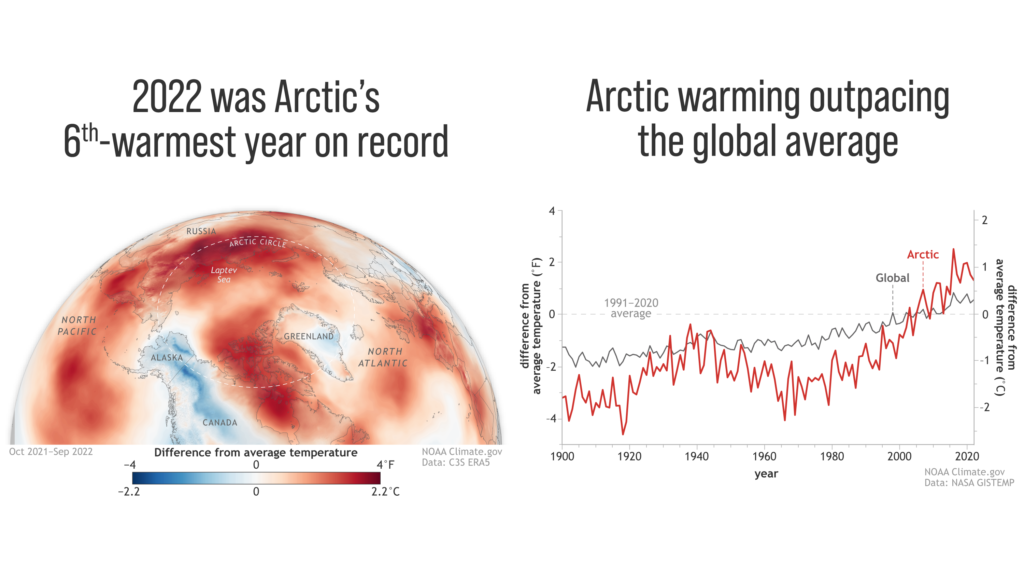
Arctic annual air temperatures from October 2021 to September 2022 were the sixth warmest dating back to 1900, continuing a decades-long trend in which Arctic air temperatures have warmed faster than the global average. The Arctic’s seven warmest years since 1900 have been the last seven years.
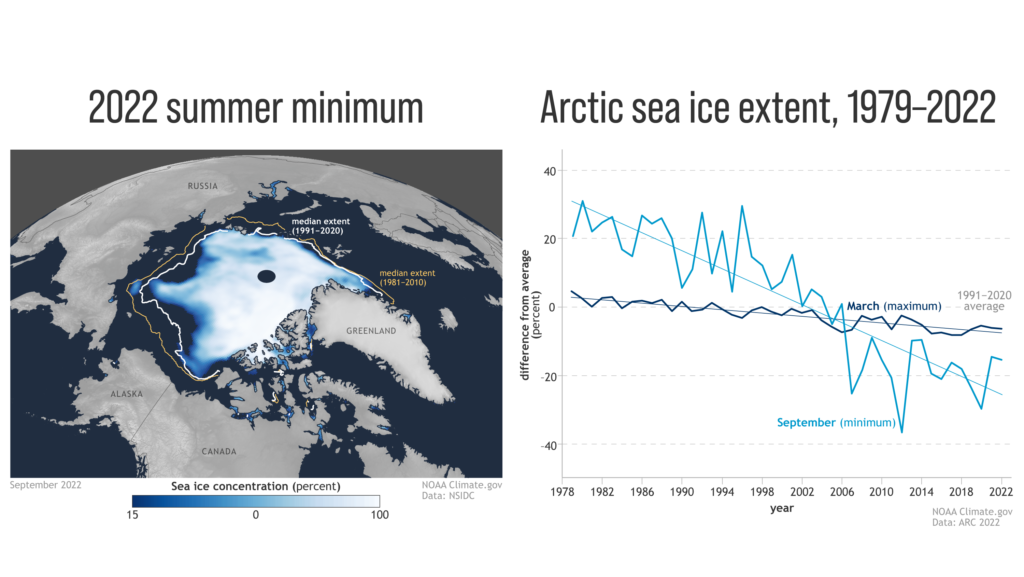
Arctic sea ice extent (coverage) was higher than many recent years, but much lower than the long-term average. Multiyear ice extent, sea-ice thickness and volume rebounded after a near-record low in 2021, but was below conditions in the 1980s and 1990s, with older ice extremely rare. Open water developed near the North Pole for much of the summer, allowing polar-class tourist and research vessels easy access. The Northern Sea Route and Northwest Passage were also largely open.
Satellite records from 2009 to 2018 show increasing maritime ship traffic in the Arctic as sea ice declines. The most significant increases in traffic are occurring among ships traveling from the Pacific Ocean through the Bering Strait and Beaufort Sea.
The 2021-2022 Arctic snow season saw a combination of above-average snow accumulation but early snowmelt, consistent with long-term trends of shortening snow seasons in several areas.
Wetter-than-normal conditions predominated over much of the Arctic from October 2021 to September 2022. Precipitation has increased significantly since the 1950s across all seasons and data sets. Heavy precipitation events are more common in the North Atlantic subarctic, while much of the central Arctic shows increases in consecutive wet days and decreases in consecutive dry days.
Typhoon Merbok, which was fueled by unusually warm water in the north Pacific, dramatically shaped 2022 in the Bering Sea region. Merbok struck the west coast of Alaska in mid-September, bringing a destructive storm surge that caused homes to break loose from foundations and damaged infrastructure in several coastal and river communities.
The Greenland ice sheet lost ice in 2022, the 25th consecutive year of ice loss. In September 2022, the Greenland ice sheet had unprecedented late-season warming, creating surface melt conditions over 36% of the ice sheet on September 3, including the Greenland ice sheet’s summit at 10,500ft. This followed a July 18 large surface melt event observed across 42% of the Greenland ice sheet surface.
August 2022 sea surface temperatures continued to show a warming trend that has been observed since 1982 for much of the ice-free Arctic Ocean. In the Barents and Laptev seas, August 2022 mean sea surface temperatures were 3.5°F to 5.5°F (2°C to 3°C) warmer than 1991–2020 August mean values, while unusually cool August sea surface temperatures of 5.4°F (3°C) below the trend occurred in the Chukchi Sea, likely driven by late-summer sea ice in the region that was kept in place by the winds.
 Matthew Druckenmiller, a research scientist with the National Snow and Ice Data Center and the lead editor of the 2022 Arctic Report Card, said, “The Arctic remains a varied and expansive region to monitor, especially as widespread disturbances unfold and seasons shift. To understand its transition, we need local to international partnerships, especially with Arctic peoples and Indigenous communities, who are vital to the use of diverse observations and knowledge, as well as to identifying solutions to long-term climate impacts and abrupt disturbances.”
To read the complete Arctic Report Card, click here.