

Close Menu
Meteorological Technology International
  • News
    • A-E
      • Agriculture
      • Automated Weather Stations
      • Aviation
      • Climate Measurement
      • Data
      • Developing Countries
      • Digital Applications
      • Early Warning Systems
      • Extreme Weather
    • G-P
      • Hydrology
      • Lidar
      • Lightning Detection
      • New Appointments
      • Nowcasting
      • Numerical Weather Prediction
      • Polar Weather
    • R-S
      • Radar
      • Rainfall
      • Remote Sensing
      • Renewable Energy
      • Satellites
      • Solar
      • Space Weather
      • Supercomputers
    • T-Z
      • Training
      • Transport
      • Weather Instruments
      • Wind
      • World Meteorological Organization
      • Meteorological Technology World Expo
  • Features
  • Online Magazines
    • January 2026
    • April 2025
    • January 2025
    • September 2024
    • April 2024
    • Archive Issues
    • Subscribe Free!
  • Opinion
  • Videos
  • Supplier Spotlight
  • Expo
LinkedIn X (Twitter) Facebook
  • Sign-up for Free Weekly E-Newsletter
  • Meet the Editors
  • Contact Us
  • Media Pack
LinkedIn Facebook
Subscribe
Meteorological Technology International
  • News
      • Agriculture
      • Automated Weather Stations
      • Aviation
      • Climate Measurement
      • Data
      • Developing Countries
      • Digital Applications
      • Early Warning Systems
      • Extreme Weather
      • Hydrology
      • Lidar
      • Lightning Detection
      • New Appointments
      • Nowcasting
      • Numerical Weather Prediction
      • Polar Weather
      • Radar
      • Rainfall
      • Remote Sensing
      • Renewable Energy
      • Satellites
      • Solar
      • Space Weather
      • Supercomputers
      • Training
      • Transport
      • Weather Instruments
      • Wind
      • World Meteorological Organization
      • Meteorological Technology World Expo
  • Features
  • Online Magazines
    1. April 2026
    2. January 2026
    3. September 2025
    4. April 2025
    5. January 2025
    6. September 2024
    7. April 2024
    8. January 2024
    9. Archive Issues
    10. Subscribe Free!
    Featured
    May 5, 2026

    In this Issue – April 2026

    By Web TeamMay 5, 2026
    Recent

    In this Issue – April 2026

    May 5, 2026

    In this Issue – January 2026

    November 27, 2025

    In this Issue – September 2025

    August 11, 2025
  • Opinion
  • Videos
  • Supplier Spotlight
  • Expo
Facebook LinkedIn
Subscribe
Meteorological Technology International
Climate Measurement

Solar Orbiter sends first measurements

James MuirBy James MuirFebruary 21, 20202 Mins Read
Share LinkedIn Facebook Twitter Email
Share
LinkedIn Facebook Twitter Email

The European Space Agency’s sun exploring spacecraft, Solar Orbiter, has sent its first measurements, confirming to scientists that its magnetometer is in good shape.

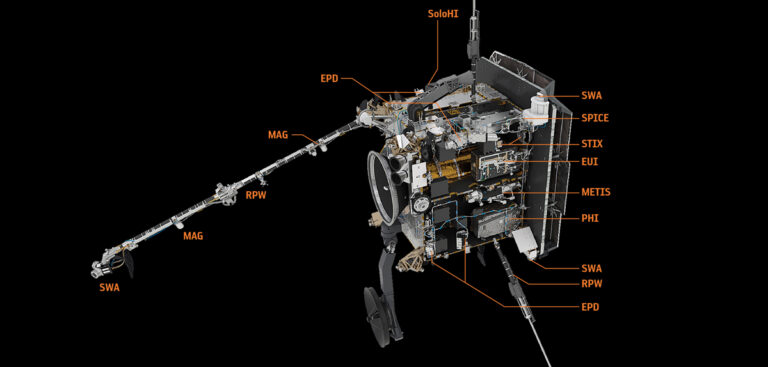
The UK-built Solar Orbiter was launched on Monday 10th February carrying 10 scientific instruments, four of which measure properties of the environment around the spacecraft, especially electromagnetic characteristics of the solar wind.

Ground controllers at the European Space Operations Centre in Darmstadt, Germany, switched on the magnetometer’s two sensors 21 hours after lift-off.

The instrument recorded data before, during and after the boom’s deployment, allowing scientists to understand the influence of the spacecraft on measurements in space.

Tim Horbury of Imperial College London and principal investigator for the magnetometer instrument, said, “The data we received shows how the magnetic field decreases from the vicinity of the spacecraft to where the instruments are actually deployed. This is an independent confirmation that the boom actually deployed and that the instruments will indeed provide accurate scientific measurements in the future.”

The titanium/carbon fiber boom was stretched out over a 30-minute period on Wednesday, almost three days after lift-off, and the scientists could observe the level of magnetic field decrease by about one order of magnitude.

At the beginning they saw mostly the magnetic field of the spacecraft, but at the end they got their first glimpse of the significantly weaker magnetic field in the surrounding environment.

Matthieu Kretzschmar of Laboratoire de Physique et Chimie de l’Environnement et de l’Espace in Orleans, France, said, “Measuring before, during, and after the boom deployment helps us to identify and characterize signals that are not linked to the solar wind, such as perturbations coming from the spacecraft platform and other instruments.”

Previous ArticleUSA on track to experience warmest ever winter
Next Article Vocus doubles Bureau of Meteorology contract

Read Similar Stories

Oceans

VIDEO: Sentinel-6 satellite detects El Niño precursor in Pacific

June 4, 20262 Mins Read
Solar

New forecasting framework targets solar-limb flare blind spot

June 4, 20262 Mins Read
Nowcasting

Colorado State University and Nvidia partner to extend severe storm prediction lead times

June 2, 20262 Mins Read
Latest News

VIDEO: Sentinel-6 satellite detects El Niño precursor in Pacific

June 4, 2026

New forecasting framework targets solar-limb flare blind spot

June 4, 2026

Colorado State University and Nvidia partner to extend severe storm prediction lead times

June 2, 2026

Receive breaking stories and features in your inbox each week, for free


Enter your email address:


Supplier Spotlights
  • Meteomatics AG
Getting in Touch
  • Contact Us / Advertise
  • Meet the Editors
  • Media Pack
  • Free Weekly E-Newsletter
Our Social Channels
  • Facebook
  • LinkedIn
© 2026 UKi Media & Events a division of UKIP Media & Events Ltd
  • Cookie Policy
  • Privacy Policy
  • Terms and Conditions
  • Notice and Takedown Policy

Type above and press Enter to search. Press Esc to cancel.