


Close Menu
Meteorological Technology International
  • News
    • A-E
      • Agriculture
      • Automated Weather Stations
      • Aviation
      • Climate Measurement
      • Data
      • Developing Countries
      • Digital Applications
      • Early Warning Systems
      • Extreme Weather
    • G-P
      • Hydrology
      • Lidar
      • Lightning Detection
      • New Appointments
      • Nowcasting
      • Numerical Weather Prediction
      • Polar Weather
    • R-S
      • Radar
      • Rainfall
      • Remote Sensing
      • Renewable Energy
      • Satellites
      • Solar
      • Space Weather
      • Supercomputers
    • T-Z
      • Training
      • Transport
      • Weather Instruments
      • Wind
      • World Meteorological Organization
      • Meteorological Technology World Expo
  • Features
  • Online Magazines
    • January 2026
    • April 2025
    • January 2025
    • September 2024
    • April 2024
    • Archive Issues
    • Subscribe Free!
  • Opinion
  • Videos
  • Supplier Spotlight
  • Expo
LinkedIn X (Twitter) Facebook
  • Sign-up for Free Weekly E-Newsletter
  • Meet the Editors
  • Contact Us
  • Media Pack
LinkedIn Facebook
Subscribe
Meteorological Technology International
  • News
      • Agriculture
      • Automated Weather Stations
      • Aviation
      • Climate Measurement
      • Data
      • Developing Countries
      • Digital Applications
      • Early Warning Systems
      • Extreme Weather
      • Hydrology
      • Lidar
      • Lightning Detection
      • New Appointments
      • Nowcasting
      • Numerical Weather Prediction
      • Polar Weather
      • Radar
      • Rainfall
      • Remote Sensing
      • Renewable Energy
      • Satellites
      • Solar
      • Space Weather
      • Supercomputers
      • Training
      • Transport
      • Weather Instruments
      • Wind
      • World Meteorological Organization
      • Meteorological Technology World Expo
  • Features
  • Online Magazines
    1. January 2026
    2. September 2025
    3. April 2025
    4. January 2025
    5. September 2024
    6. April 2024
    7. January 2024
    8. September 2023
    9. April 2023
    10. Archive Issues
    11. Subscribe Free!
    Featured
    November 27, 2025

    In this Issue – January 2026

    By Hazel KingNovember 27, 2025
    Recent

    In this Issue – January 2026

    November 27, 2025

    In this Issue – September 2025

    August 11, 2025

    In this Issue – April 2025

    April 15, 2025
  • Opinion
  • Videos
  • Supplier Spotlight
  • Expo
Facebook LinkedIn
Subscribe
Meteorological Technology International
News

New Earth satellite to track disasters and climate change taking shape

Helen NormanBy Helen NormanMarch 25, 20213 Mins Read
Share LinkedIn Facebook Twitter Email
NASA
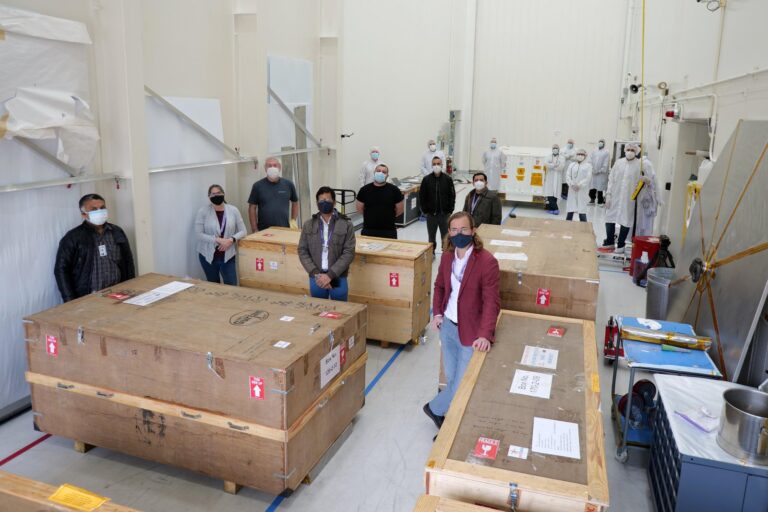
Members of the NISAR mission at NASA's Jet Propulsion Laboratory receiving the S-band synthetic aperture radar. Credit: NASA/JPL-Caltech
Share
LinkedIn Facebook Twitter Email

A key milestone in the development of the NISAR spacecraft has recently been reached thanks to the delivery of an important piece of equipment – the S-band synthetic aperture radar (SAR).

NISAR is a joint mission between NASA and the Indian Space Research Organization (ISRO). The spacecraft is currently taking shape at NASA’s Jet Propulsion Laboratory in Southern California, USA.

On March 19, NISAR’s assembly, test, and launch team at JPL received the S-band SAR from its partner in India. The spacecraft will use the S-band SAR along with an L-band SAR provided by JPL to measure changes in Earth’s surface.

The “S” and “L” denote the wavelength of their signal, with “S” at about 4in and “L” around 10in. Both can see through objects like clouds and the leaves of a forest canopy that obstruct other types of instruments, although L-band SAR can penetrate further into dense vegetation than S-band. This ability will enable the mission to track changes in Earth’s surface day or night, rain or shine.

The satellite will use a wire mesh radar reflector antenna nearly 40ft in diameter – the largest reflector antenna ever launched by NASA­ – at the end of a 30ft-long boom to send and receive radar signals to and from Earth’s surface.

This animation shows how the NISAR spacecraft will deploy its radar reflector antenna after launch (credit: NASA/JPL-Caltech):

By tracking subtle changes in Earth’s surface, NISAR will spot warning signs of imminent volcanic eruptions, help to monitor groundwater supplies, track the melt rate of ice sheets tied to sea level rise, and observe shifts in the distribution of vegetation around the world.

According to NASA, monitoring these kinds of changes in the planet’s surface over nearly the entire globe hasn’t been done before with the high resolution in space and time that NISAR will deliver.

NISAR will detect movements of the planet’s surface as small as 0.4in over areas about the size of half a tennis court. Launching no earlier than 2022, the satellite will scan the entire globe every 12 days over the course of its three-year primary mission, imaging the Earth’s land, ice sheets, and sea ice on every orbit.

“NISAR is an all-weather satellite that’s going to give us an unprecedented ability to look at how Earth’s surface is changing,” said Paul Rosen, NISAR project scientist at JPL. “It’ll be especially important for scientists who have been waiting for this kind of measurement reliability and consistency to really understand what drives Earth’s natural systems – and for people who deal with natural hazards and disasters like volcanoes or landslides.”

Engineers and technicians from JPL and ISRO will spend the next couple of weeks performing a health check on the radar before confirming that the L-band and S-band SARs work together as intended. Then they’ll integrate the S-SAR into part of the satellite structure.


Previous ArticleNOAA’s GOES-T satellite completes tests ahead of December launch
Next Article University of Reading study predicts danger of wildfires to increase in UK

Read Similar Stories

Space Weather

Northumbria University secures £4m to study Earth’s radiation belts

April 16, 20262 Mins Read
Extreme Weather

AI model improves real-time prediction of wildfire spread

April 16, 20263 Mins Read
Satellites

AI tool uses weather satellite data to map ocean currents in near real time

April 14, 20263 Mins Read
Latest News

WMO signals increasing likelihood of El Niño developing in 2026

April 24, 2026

Alabama partners with Climavision to expand weather radar coverage statewide

April 24, 2026

Extreme heat posing significant risks to ecosystems and agriculture, FAO-WMO report warns

April 22, 2026

Receive breaking stories and features in your inbox each week, for free


Enter your email address:


Supplier Spotlights
  • ZX Lidars
Getting in Touch
  • Contact Us / Advertise
  • Meet the Editors
  • Media Pack
  • Free Weekly E-Newsletter
Our Social Channels
  • Facebook
  • LinkedIn
© 2026 UKi Media & Events a division of UKIP Media & Events Ltd
  • Cookie Policy
  • Privacy Policy
  • Terms and Conditions
  • Notice and Takedown Policy

Type above and press Enter to search. Press Esc to cancel.