


Close Menu
Meteorological Technology International
  • News
    • A-E
      • Agriculture
      • Automated Weather Stations
      • Aviation
      • Climate Measurement
      • Data
      • Developing Countries
      • Digital Applications
      • Early Warning Systems
      • Extreme Weather
    • G-P
      • Hydrology
      • Lidar
      • Lightning Detection
      • New Appointments
      • Nowcasting
      • Numerical Weather Prediction
      • Polar Weather
    • R-S
      • Radar
      • Rainfall
      • Remote Sensing
      • Renewable Energy
      • Satellites
      • Solar
      • Space Weather
      • Supercomputers
    • T-Z
      • Training
      • Transport
      • Weather Instruments
      • Wind
      • World Meteorological Organization
      • Meteorological Technology World Expo
  • Features
  • Online Magazines
    • January 2026
    • April 2025
    • January 2025
    • September 2024
    • April 2024
    • Archive Issues
    • Subscribe Free!
  • Opinion
  • Videos
  • Supplier Spotlight
  • Expo
LinkedIn X (Twitter) Facebook
  • Sign-up for Free Weekly E-Newsletter
  • Meet the Editors
  • Contact Us
  • Media Pack
LinkedIn Facebook
Subscribe
Meteorological Technology International
  • News
      • Agriculture
      • Automated Weather Stations
      • Aviation
      • Climate Measurement
      • Data
      • Developing Countries
      • Digital Applications
      • Early Warning Systems
      • Extreme Weather
      • Hydrology
      • Lidar
      • Lightning Detection
      • New Appointments
      • Nowcasting
      • Numerical Weather Prediction
      • Polar Weather
      • Radar
      • Rainfall
      • Remote Sensing
      • Renewable Energy
      • Satellites
      • Solar
      • Space Weather
      • Supercomputers
      • Training
      • Transport
      • Weather Instruments
      • Wind
      • World Meteorological Organization
      • Meteorological Technology World Expo
  • Features
  • Online Magazines
    1. April 2026
    2. January 2026
    3. September 2025
    4. April 2025
    5. January 2025
    6. September 2024
    7. April 2024
    8. January 2024
    9. Archive Issues
    10. Subscribe Free!
    Featured
    May 5, 2026

    In this Issue – April 2026

    By Web TeamMay 5, 2026
    Recent

    In this Issue – April 2026

    May 5, 2026

    In this Issue – January 2026

    November 27, 2025

    In this Issue – September 2025

    August 11, 2025
  • Opinion
  • Videos
  • Supplier Spotlight
  • Expo
Facebook LinkedIn
Subscribe
Meteorological Technology International
Climate Measurement

EUMETSAT and Royal Netherlands Meteorological Institute study demonstrates shipping pollution’s effect on clouds

Elizabeth BakerBy Elizabeth BakerMarch 21, 20243 Mins Read
Share LinkedIn Facebook Twitter Email
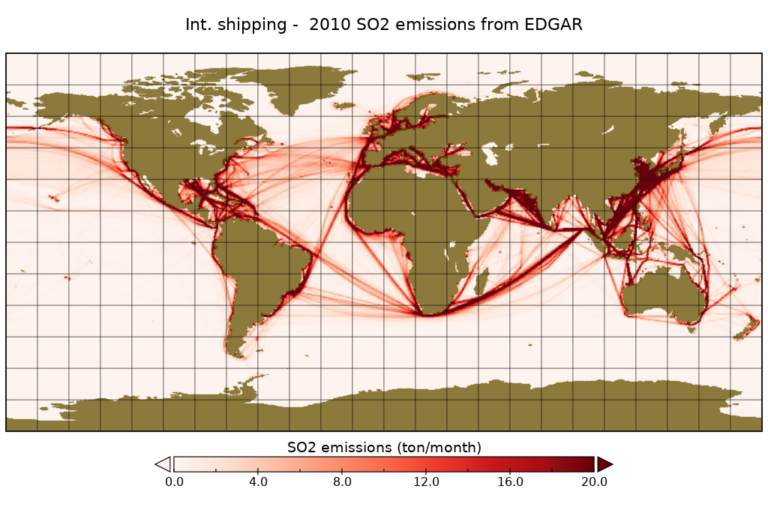
A EUMETSAT diagram of Earth, with red lines across popular shipping routes to depict shipping pollution hotspots.
Credit EUMETSAT
Share
LinkedIn Facebook Twitter Email

Dr Nikos Benas and Dr Jan Fokke Meirink of the Royal Netherlands Meteorological Institute and Dr Rob Roebeling of EUMETSAT’s User Support & Climate Services published a case study exploring the impact of maritime shipping pollution on clouds.

When ships emit aerosols – tiny particles of sulfur dioxide and black carbon – via their exhaust, this causes changes in the clouds above which has far-reaching impacts on the global climate, according to the researchers.

Satellite observations

Satellite observations make it possible to study the relationship between shipping pollution and clouds. The researchers set out to see if satellite observations can be used to detect changes in cloud properties as a result of shipping pollution and assessed how new regulations to limit the sulfur content of fuel oil in ships – imposed by the International Maritime Organization (IMO) at the beginning of 2020 – affected cloud properties.

The authors analyzed satellite data from 2004-2023 for a 700km-wide section off the western Atlantic coast of Southern Africa through which a shipping route passes and found that the number of cloud droplets was highest near the shipping track and decreased with distance. They also observed that the size of the droplets was smallest near the shipping track and increased with distance.

“For cloud droplets to form, there need to be particles for water vapor to condense onto and polluted air has a greater number of these particles,” said Roebeling. “Because there is only a certain amount of vapor in a cloud, the water then becomes distributed over more particles. So, in polluted areas, you find clouds containing more but smaller droplets. Our work confirms this known effect. What we want to show people through our case study is that satellite data sets can be used to see this.”

Analyzing the data

By comparing data records for this same area from before and after the IMO 2020 regulation – limiting sulfur emissions from fuel oil in ships – was put into effect, the team was also able to see that the regulation substantially reduced these effects of pollution on clouds.

“It is too early to quantify the effects that changes in low-level clouds may have on Earth’s climate,” said Roebeling. “However, we clearly see that clouds above shipping tracks are different than those above nearby unpolluted areas and that clouds in the region we investigated became more transparent since the new IMO regulations were introduced.”  

To find out more about how pollution is affecting how cloud formation, read Meteorological Technology International‘s exclusive feature, “How are microplastics affecting how cloud formation?”, here.
Previous ArticleUniversity of California San Diego’s AI fire-detection tool receives CENIC innovation award
Next Article INTERVIEW: Dr Sue Barrell, science leader, independent chair, director, mentor

Read Similar Stories

Oceans

VIDEO: Sentinel-6 satellite detects El Niño precursor in Pacific

June 4, 20262 Mins Read
Solar

New forecasting framework targets solar-limb flare blind spot

June 4, 20262 Mins Read
Nowcasting

Colorado State University and Nvidia partner to extend severe storm prediction lead times

June 2, 20262 Mins Read
Latest News

VIDEO: Sentinel-6 satellite detects El Niño precursor in Pacific

June 4, 2026

New forecasting framework targets solar-limb flare blind spot

June 4, 2026

Colorado State University and Nvidia partner to extend severe storm prediction lead times

June 2, 2026

Receive breaking stories and features in your inbox each week, for free


Enter your email address:


Supplier Spotlights
  • MicroStep-MIS
Getting in Touch
  • Contact Us / Advertise
  • Meet the Editors
  • Media Pack
  • Free Weekly E-Newsletter
Our Social Channels
  • Facebook
  • LinkedIn
© 2026 UKi Media & Events a division of UKIP Media & Events Ltd
  • Cookie Policy
  • Privacy Policy
  • Terms and Conditions
  • Notice and Takedown Policy

Type above and press Enter to search. Press Esc to cancel.