


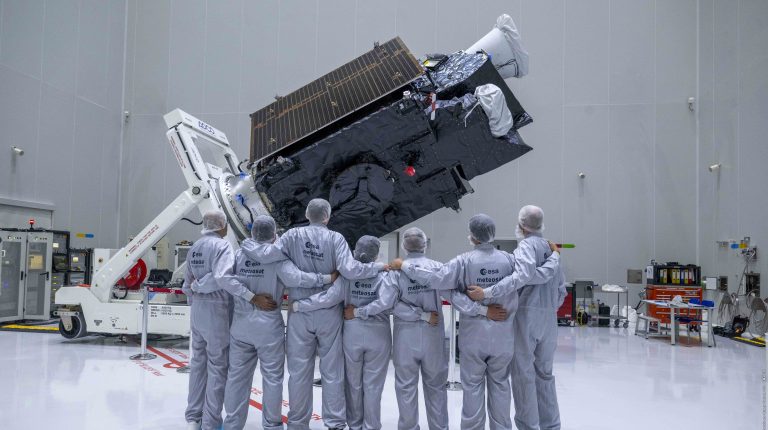
EUMETSAT’s Meteosat Third Generation – Imager 2 (MTG-I2) satellite is scheduled to launch on August 27 aboard an Ariane 6 rocket from Europe’s Spaceport in Kourou, French Guiana. The launch will complete the first family of MTG satellites, adding rapid-scan imagery over Europe every 2.5 minutes – significantly improving the detection and nowcasting of severe weather events.
MTG-I2 will join the already-orbiting MTG-I1 imager and MTG-S1 sounder, giving EUMETSAT two imagers and one sounder operating together for the first time. Speaking at a pre-launch media briefing on August 19, James Champion, MTG project manager at ESA, said the milestone had been years in the making. “We’ll finally get the full dataset from the full power of the third-generation satellites,” he stated.
MTG-I2 brings notable upgrades over the Meteosat Second Generation fleet: visible-channel spatial resolution improves from 1km to 0.5km, channel count rises from 12 to 16, and full-disk scanning time drops from 15 to 10 minutes. The three-axis stabilized satellite weighs 3.8 metric tons at launch, unfolds to 11.2 x 6.5 x 5.3m in orbit, and will operate at 9.5° east with an expected lifetime of 10.7 years, drawing 2.2kW of power and downlinking data at 200Mb/s.
Susanne Dieterle, MTG system manager at EUMETSAT, linked the launch to the rising frequency of extreme weather across Europe, including this year’s wildfires in France and Spain. “Climate protection is disaster protection – it’s all about saving lives, health and livelihoods,” she said, adding that MTG’s finer temporal resolution would sharpen forecasts of lightning, high winds, heavy rainfall and flash flooding.
Thomas Blackmore, science manager for space data products and systems at the Met Office in the UK said, “As a meteorological service, what’s exciting us most about this satellite is its rapid scanning capability, which will allow us to observe rapidly developing weather with unprecedented frequency and detail.”
He added that the frequency is a radical improvement for forecasters tracking severe convective storms. “It’s a bit like moving from having a series of snapshots to having something that’s much closer to a live video stream from space,” he said, noting that 2.5-minute updates would let forecasters spot developing storms far earlier than the 10-minute cadence currently offered by MTG-I1.
Asked how soon the first images could be expected after launch, Dieterle said she could not provide a precise timeline. “For MTG-I1, it took four months to get the first image. But, with [MTG-I2] being a recon satellite, we intend to do it quicker,” she stated.
Arianespace confirmed the mission as its fourth Ariane 6 launch of the year. Caroline Arnoux, head of the Ariane business unit, said the company is still targeting seven to eight Ariane 6 launches before the end of 2026, rising to nine or 10 a year from 2027.
MTG-I2 has been built by an industrial consortium of more than 70 companies led by Thales Alenia Space, with the Lightning Imager supplied by Leonardo and the satellite platform by OHB in Bremen, Germany.
In related news, Synoptic Data to modernize EUMETNET weather observation hubs