


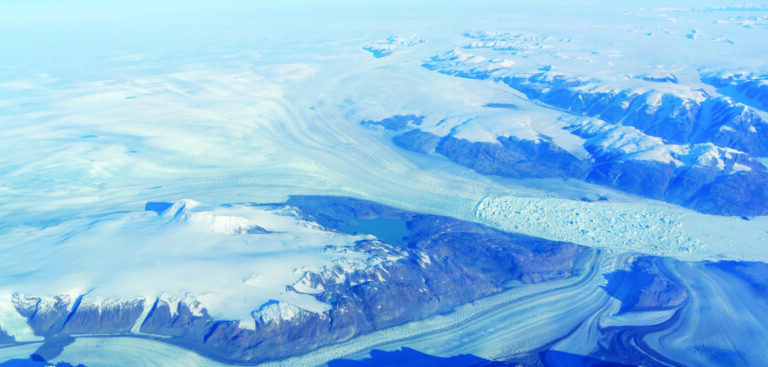
Researchers from the Potsdam Institute for Climate Impact Research (PIK) in Germany have used advanced simulations to identify two carbon emission tipping points for the Greenland Ice Sheet. Alarmingly, around 500Gt of carbon has been emitted into the atmosphere to date – half the amount needed to reach the first tipping point. Dennis Höning, a climate scientist at PIK, led the analysis of various anthropogenic carbon emission scenarios on the ice sheet.
What attracted you to the sector?
I have always been curious about understanding the world around us. That’s why I studied geophysics and worked as an Earth and planetary scientist for many years. But with the climate crises that humanity is already facing all over the world, I felt that it was increasingly important to also contribute to a better understanding of climate change and the consequences for the Earth system arising from it.
What is your area of expertise?
My expertise is in Earth system modeling, connecting different processes that control Earth’s reservoirs (such as atmosphere and cryosphere), and understanding relevant feedback processes that arise from it. The Earth system is extremely complex and if, for example, a large ice sheet melts due to long-term elevated temperatures, consequences could range from changes in ocean currents to changes in the global temperature distribution on our planet.
What is your favorite part of the job?
I have a natural curiosity to understand the mechanisms that drive the evolution of our planet. This, combined with the prospect of providing insights into socially very relevant topics, means this job is really exciting to me.
Who has been your biggest inspiration?
James Lovelock, who was an Earth scientist and environmentalist. He is famous for the so-called Gaia Theory, which describes the Earth together with its biosphere as one intertwined system. Even though parts of the hypothesis are considered controversial in the scientific community, I believe that it’s still very inspirational to better understand our planet.
What did you look at in your latest study?
We studied the stability of the Greenland Ice Sheet for potential future atmospheric conditions. The ice sheet responds to elevated temperatures in a non-linear manner: while small changes in the temperature may only have a comparatively small effect, crossing critical thresholds will inevitably cause further, irreversible melt. We then connected the results to potential future carbon emission scenarios to see how close we are to reaching these so-called tipping points.
What did you discover?
We found two critical thresholds. According to our results, the first threshold will be crossed if the cumulative carbon emissions exceed 1,000Gt. In this case, the southern part of the Greenland Ice Sheet will inevitably melt, even though this melting will take a very long time. The second threshold is further away: more than 2,500Gt of carbon would have to be emitted into the atmosphere to melt the entire Greenland Ice Sheet in the long term.
What did you do differently from other similar simulations?
For the first time we combined a complex Earth system model – connecting all relevant feedback processes – to an interactive model of the Greenland Ice Sheet. There have been previous studies focusing on the ice sheet to find equilibrium states, but the connection between anthropogenic carbon emission scenarios, the transient response of the Greenland Ice Sheet to these scenarios and, in particular, the link to its stability, is new.
Can we avoid the first tipping point?
Whether or not we can avoid reaching the first tipping point depends on the global, cumulative carbon emissions. CO2 has a very long lifetime in the atmosphere, so our global total budget is limited. The faster we start reducing carbon emissions, the better the options for future generations to remain within the budget. It is also important to note that the Greenland Ice Sheet is extremely large, and melting most of it would take hundreds or even thousands of years – but now we are setting the long-term path.
This article originally appeared in the April 2023 issue of Meteorological Technology International. To view the magazine in full, click here.