


Close Menu
Meteorological Technology International
  • News
    • A-E
      • Agriculture
      • Automated Weather Stations
      • Aviation
      • Climate Measurement
      • Data
      • Developing Countries
      • Digital Applications
      • Early Warning Systems
      • Extreme Weather
    • G-P
      • Hydrology
      • Lidar
      • Lightning Detection
      • New Appointments
      • Nowcasting
      • Numerical Weather Prediction
      • Polar Weather
    • R-S
      • Radar
      • Rainfall
      • Remote Sensing
      • Renewable Energy
      • Satellites
      • Solar
      • Space Weather
      • Supercomputers
    • T-Z
      • Training
      • Transport
      • Weather Instruments
      • Wind
      • World Meteorological Organization
      • Meteorological Technology World Expo
  • Features
  • Online Magazines
    • January 2026
    • April 2025
    • January 2025
    • September 2024
    • April 2024
    • Archive Issues
    • Subscribe Free!
  • Opinion
  • Videos
  • Supplier Spotlight
  • Expo
LinkedIn X (Twitter) Facebook
  • Sign-up for Free Weekly E-Newsletter
  • Meet the Editors
  • Contact Us
  • Media Pack
LinkedIn Facebook
Subscribe
Meteorological Technology International
  • News
      • Agriculture
      • Automated Weather Stations
      • Aviation
      • Climate Measurement
      • Data
      • Developing Countries
      • Digital Applications
      • Early Warning Systems
      • Extreme Weather
      • Hydrology
      • Lidar
      • Lightning Detection
      • New Appointments
      • Nowcasting
      • Numerical Weather Prediction
      • Polar Weather
      • Radar
      • Rainfall
      • Remote Sensing
      • Renewable Energy
      • Satellites
      • Solar
      • Space Weather
      • Supercomputers
      • Training
      • Transport
      • Weather Instruments
      • Wind
      • World Meteorological Organization
      • Meteorological Technology World Expo
  • Features
  • Online Magazines
    1. April 2026
    2. January 2026
    3. September 2025
    4. April 2025
    5. January 2025
    6. September 2024
    7. April 2024
    8. January 2024
    9. Archive Issues
    10. Subscribe Free!
    Featured
    May 5, 2026

    In this Issue – April 2026

    By Web TeamMay 5, 2026
    Recent

    In this Issue – April 2026

    May 5, 2026

    In this Issue – January 2026

    November 27, 2025

    In this Issue – September 2025

    August 11, 2025
  • Opinion
  • Videos
  • Supplier Spotlight
  • Expo
Facebook LinkedIn
Subscribe
Meteorological Technology International
Climate Measurement

Climate change visualization portrays “stark picture” of danger facing future generations

Dan SymondsBy Dan SymondsMarch 21, 20234 Mins Read
Share LinkedIn Facebook Twitter Email
Share
LinkedIn Facebook Twitter Email

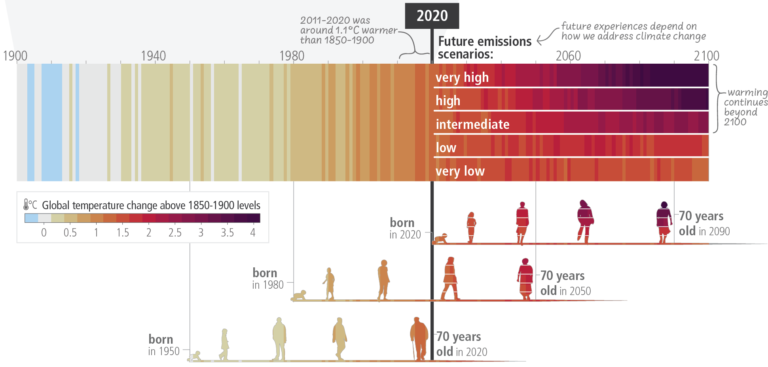
A climate change visualization created at the University of Reading has been used in the Intergovernmental Panel on Climate Change’s (IPCC) Sixth Assessment Report.

Professor Ed Hawkins, climate scientist at the University of Reading and National Centre for Atmospheric Science (NCAS), initially created the warming stripes in 2017 to show the rise in global average temperature for each year since 1850, with blue for cooler temperatures and red for hotter years. The graphic illustrates the different worlds future generations will face depending on how early climate action is taken. If drastic action is not taken sooner and warming continues beyond 2100, future generations will face extreme weather conditions due to rising temperatures.

Hawkins said, “The use of the warming stripes in the IPCC’s Assessment Report is a haunting reminder of the consequences we are facing if we fail to act on climate change now. These stripes portray a stark picture of the different and dangerous worlds that future generations could inherit, depending on our actions today.

“The deepening red stripes are an urgent warning of the adverse effects of rising temperatures. If we don’t take rapid action by lowering emissions, future generations will be left to bear the brunt of extreme weather, such as more intense heatwaves, droughts, floods and storms. This is not just about rising numbers on a chart, this is about the genuine impact on people’s lives, businesses and communities. Every bit of warming avoided makes the consequences less severe,” he said.

The IPCC’s Sixth Assessment Report calls for ‘urgent climate action’ to ‘secure a liveable future for all’. The report, produced by climate scientists from around the world, is the culmination of key findings on the causes, impacts and solutions to climate change that have been released over the past five years.

Commenting on the report, Bill Collins, Professor of Climate Processes at the University of Reading, said, “This latest report sets out the exciting possibility of a sustainable future. While some have worried about the cost of this, a key finding from this report is that there will be substantial benefits to air quality (such as ground-level ozone) from moving away from fossil fuel economies. The economic returns from these immediate health benefits are assessed to be greater than the costs incurred even before accounting for all the future climate benefits.

“But we are not currently on this path. Future CO2  emissions just from the fossil fuel infrastructures currently in place will take us beyond 1.5°C. Time is running out. How much fossil fuel we burn this decade will determine whether warming can be limited to 1.5°C or 2°C. The time is now to decide whether or not to take the sustainable path set out by the IPCC.”

Professor Andy Turner, a climate scientist with expertise in monsoon systems at University of Reading, and a lead author of IPCC AR6 WGI (Chapter 10 – Linking Global to Regional Climate Change), said, “The IPCC Sixth Assessment Report has demonstrated clearly that every additional fraction of warming will lead to intensification of the global water cycle and larger extremes. For the monsoon regions around the globe, most worrying is the increase in variability, associated with a greater likelihood of flood and drought, which are damaging to agricultural yields, water supply and human health.

“As the Synthesis Report makes clear, the scale of the challenge is unprecedented, with the burden falling disproportionately on the developing world such as those in the monsoon regions and elsewhere in the tropics.

“The IPCC Sixth Assessment offers a clear way forward in ‘climate-resilient development’, which seeks win-win solutions to reduce or avoid greenhouse gas emissions at the same time as improving quality of life.

“Just as the damaging impacts of climate change will worsen with each degree of warming, the costs of taking action will also rise, should we delay making the necessary deep and sustained cuts in greenhouse gas emissions,” said Turner.

Previous ArticleNOC to manage more than 30 research missions in 2023
Next Article Sustainable aviation fuel used for first time during FAAM training flight

Read Similar Stories

Automated Weather Stations

University of Vermont launches first station in statewide weather monitoring network

May 8, 20262 Mins Read
Extreme Weather

Wildfires can create ‘burn scar heat islands’ that alter weather patterns, study finds

May 6, 20263 Mins Read
Digital Applications

AI models lag behind traditional systems in predicting extreme weather

May 5, 20262 Mins Read
Latest News

University of Vermont launches first station in statewide weather monitoring network

May 8, 2026

G7 countries pledge additional funding for CREWS early warning initiative

May 7, 2026

Wildfires can create ‘burn scar heat islands’ that alter weather patterns, study finds

May 6, 2026

Receive breaking stories and features in your inbox each week, for free


Enter your email address:


Supplier Spotlights
  • ZOGLAB Microsystem Co., Ltd
Getting in Touch
  • Contact Us / Advertise
  • Meet the Editors
  • Media Pack
  • Free Weekly E-Newsletter
Our Social Channels
  • Facebook
  • LinkedIn
© 2026 UKi Media & Events a division of UKIP Media & Events Ltd
  • Cookie Policy
  • Privacy Policy
  • Terms and Conditions
  • Notice and Takedown Policy

Type above and press Enter to search. Press Esc to cancel.