


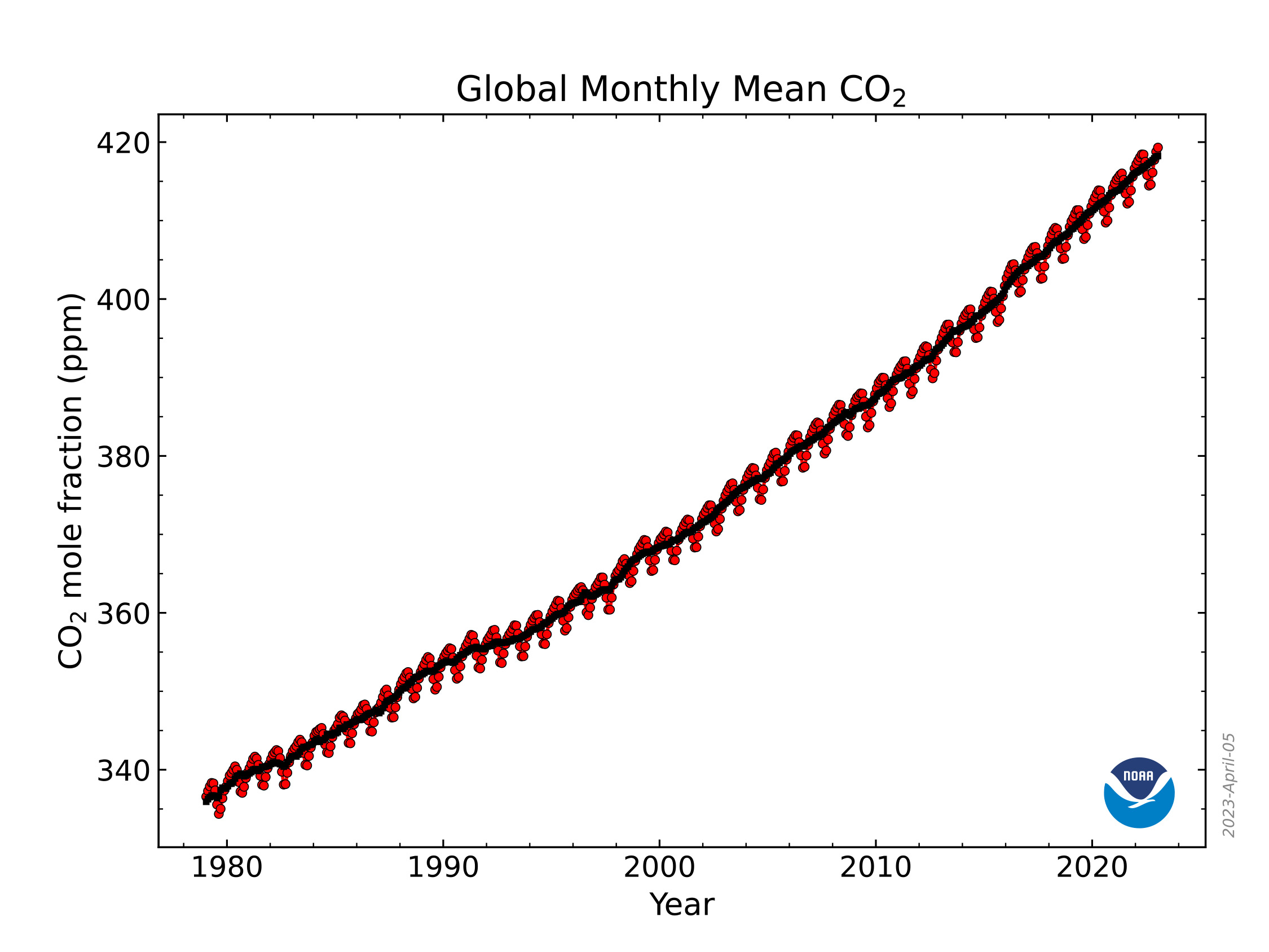
According to NOAA scientists, levels of carbon dioxide (CO2), methane and nitrous oxide continued their historically high rates of growth in the atmosphere during 2022.
The global surface average for CO2 rose by 2.13 parts per million (ppm) to 417.06 ppm, roughly the same rate observed during the last decade. Atmospheric CO2 is now 50% higher than pre-industrial levels. The researchers also reported that 2022 was the 11th consecutive year CO2 increased by more than 2ppm, the highest sustained rate of CO2 increases in the 65 years since monitoring began. Prior to 2013, three consecutive years of CO2 growth of 2ppm or more had never been recorded.
The Global Monitoring Division of NOAA/Earth System Research Laboratory has measured carbon dioxide and other greenhouse gases for several decades at a globally distributed network of air sampling sites. NOAA’s Global Monitoring Laboratory collected more than 14,000 air samples from monitoring stations around the world in 2022 and analyzed them in its state-of-the-art laboratory in Boulder, Colorado. Every spring, NOAA calculates and releases the preliminary global average levels of the three primary long-lived greenhouse gases – CO2, methane and nitrous oxide – observed during the previous year. Measurements are obtained from air samples collected from sites in NOAA’s Global Greenhouse Gas Reference Network, which includes more than 50 cooperative sampling sites around the world.
Stephen Montzka, senior scientist at NOAA’s Global Monitoring Laboratory, said, “Our latest measurements confirm that the most important greenhouse gases continue to increase rapidly in the atmosphere. It’s a clear sign that much more effort will be required if we hope to stabilize levels of these gases in the next few decades.”
 Atmospheric methane, which is far less abundant but much more potent than CO2 at trapping heat in the atmosphere, increased to an average of 1,911.9 parts per billion (ppb). The 2022 methane increase was 14.0ppb, the fourth-largest annual increase recorded since NOAA’s systematic measurements began in 1983 and follows record growth in 2020 and 2021. Methane levels in the atmosphere are now more than two and a half times their pre-industrial level.
In 2022, levels of the third-most significant anthropogenic greenhouse gas, nitrous oxide, rose by 1.24ppb to 335.7ppb, which is tied with 2014 as the third-largest jump since 2000 and a 24% increase over its pre-industrial level of 270ppb. The two years of highest growth occurred in 2020 and 2021. Increases in atmospheric nitrous oxide during recent decades are mainly from use of nitrogen fertilizer and manure from the expansion and intensification of agriculture.
Rick Spinrad, NOAA administrator, said, “The observations collected by NOAA scientists in 2022 show that greenhouse gas emissions continue to rise at an alarming pace and will persist in the atmosphere for thousands of years. The time is now to address greenhouse gas pollution and to lower human-caused emissions as we continue to build toward a Climate-Ready Nation.”
The organization emphasized that CO2 is by far the most important contributor to climate change. The main driver of increasing atmospheric CO2 is the burning of fossil fuels, with emissions increasing from 10.9 billion tons per year in the 1960s – which is when the measurements at the Mauna Loa Observatory in Hawaii began – to about 36.6 billion tons per year in 2022, according to the Global Carbon Project, which uses NOAA’s greenhouse gas measurements in its estimates.
According to the research, the amount of CO2 in the atmosphere today is comparable to where it was around 4.3 million years ago during the mid-Pliocene epoch when sea level was about 75ft higher than today, the average temperature was 7°F higher than in pre-industrial times and studies indicate large forests occupied areas of the Arctic that are now tundra. Furthermore, the team found that about a quarter of the CO2 emissions from fossil fuels to date have been absorbed by the world ocean, contributing to ocean acidification, which may threaten some fisheries and aquaculture around the world.
NOAA’s long-term measurements show that atmospheric methane increased rapidly during the 1980s, nearly stabilized in the mid-1990s and early 2000s, then resumed a rapid rise in 2007. A 2022 study by NOAA and NASA scientists suggests that as much as 85% of the increase from 2006 to 2016 was due to increased microbial emissions generated by livestock, agriculture, human and agricultural waste, wetlands and other aquatic sources. The rest of the increase was attributed to increased fossil fuel emissions.
Xin Lan, GML carbon cycle scientist and a CIRES researcher working at NOAA, said, “The exact causes of the recent increase in methane are not yet fully known. One possibility is the influence of a persistent three-year La Nina, which, on average, results in enhanced precipitation over tropical wetland regions, which may increase the activity of microbes that generate methane emissions as a result. NOAA scientists are investigating the possibility that climate change is causing wetlands to give off increasing methane emissions in a feedback loop.”
For more on the NOAA, click here.