



Close Menu
Meteorological Technology International
  • News
    • A-E
      • Agriculture
      • Automated Weather Stations
      • Aviation
      • Climate Measurement
      • Data
      • Developing Countries
      • Digital Applications
      • Early Warning Systems
      • Extreme Weather
    • G-P
      • Hydrology
      • Lidar
      • Lightning Detection
      • New Appointments
      • Nowcasting
      • Numerical Weather Prediction
      • Polar Weather
    • R-S
      • Radar
      • Rainfall
      • Remote Sensing
      • Renewable Energy
      • Satellites
      • Solar
      • Space Weather
      • Supercomputers
    • T-Z
      • Training
      • Transport
      • Weather Instruments
      • Wind
      • World Meteorological Organization
      • Meteorological Technology World Expo
  • Features
  • Online Magazines
    • January 2026
    • April 2025
    • January 2025
    • September 2024
    • April 2024
    • Archive Issues
    • Subscribe Free!
  • Opinion
  • Videos
  • Supplier Spotlight
  • Expo
LinkedIn X (Twitter) Facebook
  • Sign-up for Free Weekly E-Newsletter
  • Meet the Editors
  • Contact Us
  • Media Pack
LinkedIn Facebook
Subscribe
Meteorological Technology International
  • News
      • Agriculture
      • Automated Weather Stations
      • Aviation
      • Climate Measurement
      • Data
      • Developing Countries
      • Digital Applications
      • Early Warning Systems
      • Extreme Weather
      • Hydrology
      • Lidar
      • Lightning Detection
      • New Appointments
      • Nowcasting
      • Numerical Weather Prediction
      • Polar Weather
      • Radar
      • Rainfall
      • Remote Sensing
      • Renewable Energy
      • Satellites
      • Solar
      • Space Weather
      • Supercomputers
      • Training
      • Transport
      • Weather Instruments
      • Wind
      • World Meteorological Organization
      • Meteorological Technology World Expo
  • Features
  • Online Magazines
    1. April 2026
    2. January 2026
    3. September 2025
    4. April 2025
    5. January 2025
    6. September 2024
    7. April 2024
    8. January 2024
    9. Archive Issues
    10. Subscribe Free!
    Featured
    May 5, 2026

    In this Issue – April 2026

    By Web TeamMay 5, 2026
    Recent

    In this Issue – April 2026

    May 5, 2026

    In this Issue – January 2026

    November 27, 2025

    In this Issue – September 2025

    August 11, 2025
  • Opinion
  • Videos
  • Supplier Spotlight
  • Expo
Facebook LinkedIn
Subscribe
Meteorological Technology International
Climate Measurement

India’s Oceansat-3 transmits first images from polar orbit

Dan SymondsBy Dan SymondsDecember 9, 20222 Mins Read
Share LinkedIn Facebook Twitter Email
Credit: Pixabay
Share
LinkedIn Facebook Twitter Email

India’s third-generation satellite for monitoring oceans – Earth Observation Satellite-6 (EOS-6), also known as Oceansat-3, has begun transmitting its first images of Earth after reaching orbit.

Launched by the Indian Space Research Organisation (ISRO) in partnership with Ministry of Earth Sciences (MoES) on November 26, 2022, the ocean observing mission is a follow up to OceanSat-1 (IRS-P4) and OceanSat-2 launched in 1999 and 2009, respectively. The satellite was launched aboard the Polar Satellite Launch Vehicle (PSLV) on its 56th flight (24th flight of the PSLV-XL version) along with several other small commercial satellites (CubeSats).

Oceansat-3 was placed in polar orbit at around 740km above sea level. For the first time in the series it houses three ocean observing sensors including Ocean Color Monitor (OCM-3), Sea Surface Temperature Monitor (SSTM), and Ku-Band scatterometer (SCAT-3).

The advance 13 channel OCM with 360m spatial resolution and 1,400km swath will observe the day side of the Earth every day and will provide crucial data on distribution of ocean algae which is the base of the food chain within marine ecosystem.

The SSTM will provide ocean surface temperature which is a critical ocean parameter to provide various forecasts ranging from fish aggregation to cyclone genesis and movement. Temperature is a key parameter required to monitor health of the coral reefs, and if needed, to provide coral bleaching alerts.
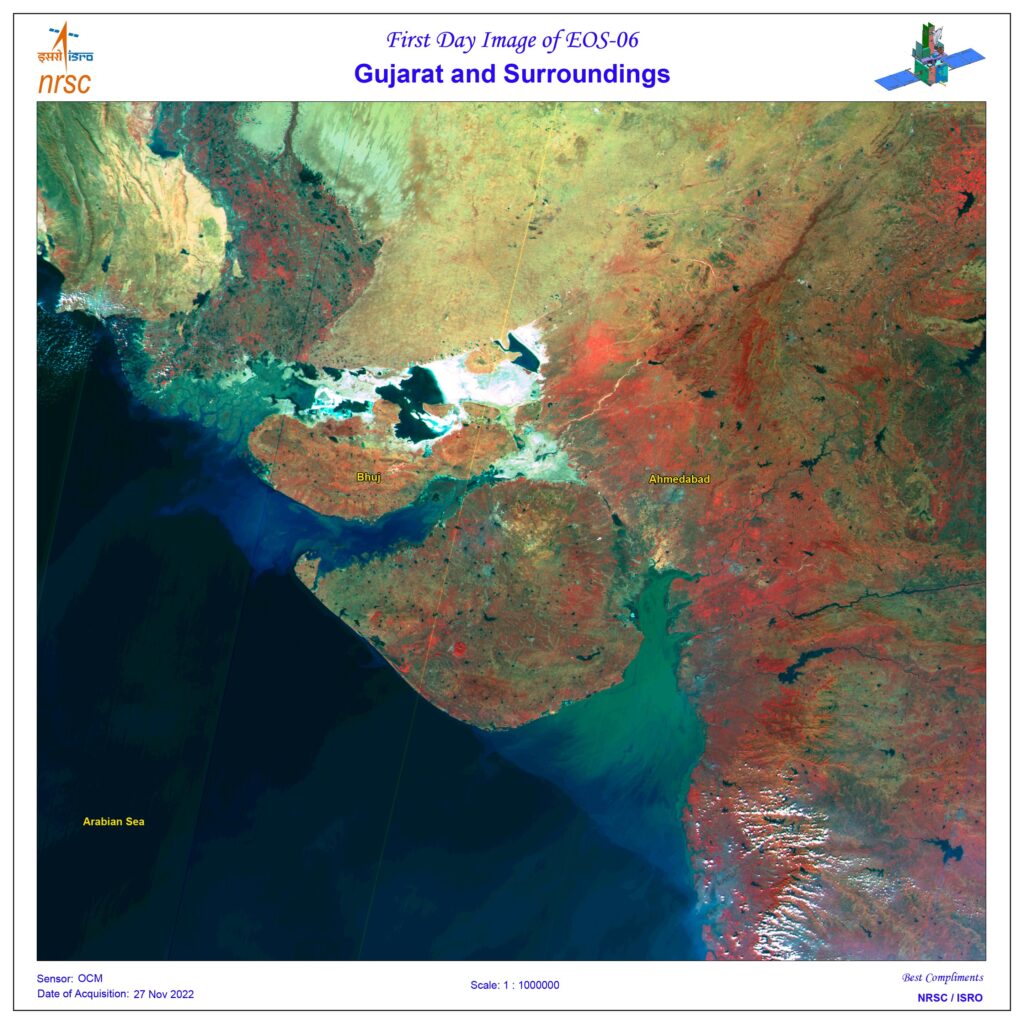
EOS-6.
Credit: NRSC ISRO

The Ku-Band Pencil beam scatterometer on board EOS-6 will provide high-resolution wind vector (speed and direction) at the ocean surface. The data of temperature and wind is also very important for assimilation into ocean and weather models to improve their forecast accuracies.

The additional ARGOS instrumentation is a communication payload jointly developed with France and it is used for low-power (energy-efficient) communications including marine robotic floats (Argo floats), fish-tags, drifters, and distress alert devices useful for conducting effective search and rescue operations.

Previous ArticleKIT researcher awarded grant to improve subseasonal forecasts at reduced computational power
Next Article VIDEO: Meteopress demonstrates its C-band solid-state weather radar

Read Similar Stories

Oceans

VIDEO: Sentinel-6 satellite detects El Niño precursor in Pacific

June 4, 20262 Mins Read
Solar

New forecasting framework targets solar-limb flare blind spot

June 4, 20262 Mins Read
Nowcasting

Colorado State University and Nvidia partner to extend severe storm prediction lead times

June 2, 20262 Mins Read
Latest News

VIDEO: Sentinel-6 satellite detects El Niño precursor in Pacific

June 4, 2026

New forecasting framework targets solar-limb flare blind spot

June 4, 2026

Colorado State University and Nvidia partner to extend severe storm prediction lead times

June 2, 2026

Receive breaking stories and features in your inbox each week, for free


Enter your email address:


Supplier Spotlights
  • Geolux d.o.o.
Getting in Touch
  • Contact Us / Advertise
  • Meet the Editors
  • Media Pack
  • Free Weekly E-Newsletter
Our Social Channels
  • Facebook
  • LinkedIn
© 2026 UKi Media & Events a division of UKIP Media & Events Ltd
  • Cookie Policy
  • Privacy Policy
  • Terms and Conditions
  • Notice and Takedown Policy

Type above and press Enter to search. Press Esc to cancel.