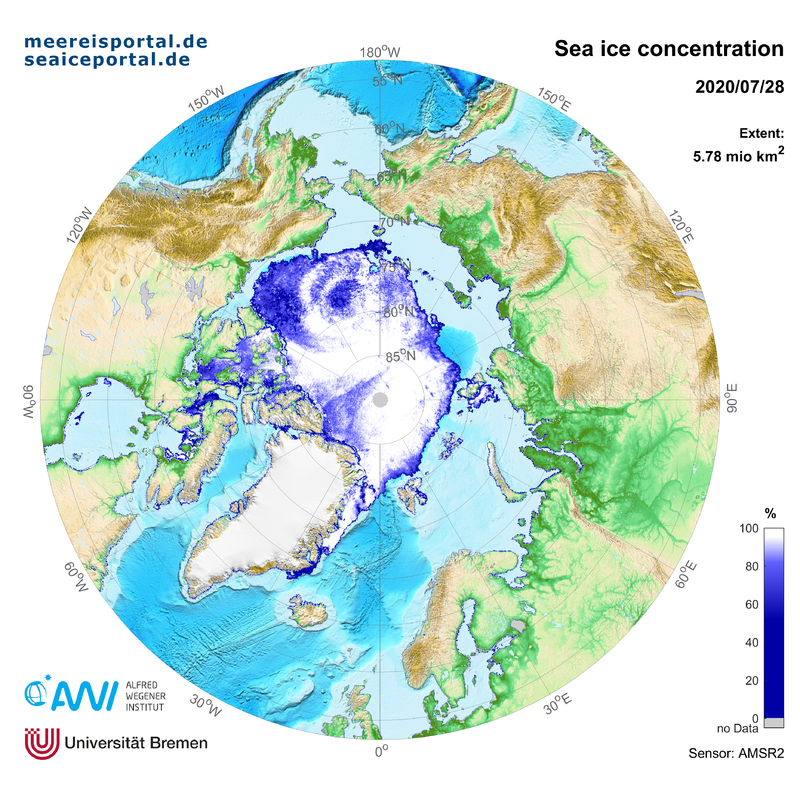
The Arctic sea-ice extent is at its lowest ebb for the month of July since satellite observations began, says the AWI (Alfred-Wegener-Institut Helmholtz-Zentrum für Polar- und Meeresforschung), which is responsible for the MOSAiC Arctic research project.
It notes that sea-ice retreat is especially pronounced off the Siberian coast, as a result of which the Northeast Passage (also referred to as the Northern Sea Route) was ice-free by mid-July. The AWI says that from the outset, 2020 promised to be anomalous in terms of both ice thickness and ice drift. Additionally, in June there was a cell of warm air that produced extremely high temperatures in Siberia and seriously impacted the sea-ice cover.
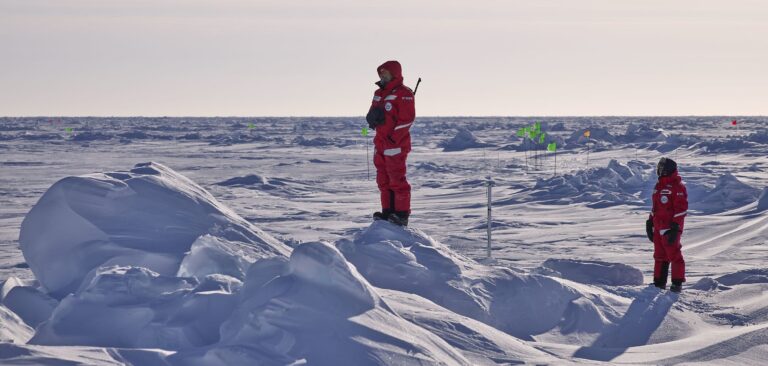
During the AWI’s MOSAiC expedition last winter, a number of unusual factors were observed and investigated. These included anomalies in ice drift and ice thickness, which AWI experts surmised would likely have an effect on the summertime melting; model comparisons have since proved them right.
AWI states that there are further factors that can contribute to the sea-ice retreat, the most rapid loss of ice cover ever recorded in the month of July. Most notable was the fact that this year, temperatures on the East Siberian coast were more than 6°C (11°F) warmer than the long-term average in May and June. As a result, the snow melted early in the year, and Siberia’s permafrost soils began thawing.
In June, it says this warming also led to intensified sea-ice retreat in the Laptev Sea, a phenomenon that spread to the East Siberian Sea in early July. The institute has observed that conditions have changed since the beginning of July: there is a high-pressure cell over the East Siberian and Chukchi Seas, accompanied by unusually warm temperatures (up to 10°C [18°F] above average) over the Central Arctic. The stable atmospheric pressure system over the Arctic helped to strengthen the warm-air cell, which led to intensified melting of the snow cover on the ice, and with it, to an earlier breakup and melting of seasonal ice.
Looking more closely at Russia’s Arctic coast, in the sector from 30° to 180° East sea-ice extent is at a historically low level for this region and time of year. “In this sector of the Arctic we’re currently seeing roughly 1,700,000km2 (656,400 square miles) of ice cover, which is 1,000,000km2 (386,000 square miles) less ice than the average for the past seven years. In other words, around 40% more of the ocean than usual is ice-free,” explained Dr Gunnar Spreen from the Institute of Environmental Physics at the University of Bremen and a member of the Sea Ice Team on the MOSAiC expedition.
For the Arctic as a whole, the current sea-ice extent (6,000,000km2 [2,320,000 square miles]) is roughly 16% below the average for the years 2013 to 2019. Researchers note that it is too soon to say whether this trend will continue until the yearly minimum in September, as it is largely dependent on weather conditions.
In terms of how this development could affect the MOSAiC expedition, AWI sea ice physicist Dr Marcel Nicolaus said, “Introducing so much warmth into the system so early in the year has accelerated the melting of the ice. This has also been worsened by the low albedo at this time of year, when the sun sits high in the sky during the Polar Day, producing an especially pronounced feedback.
“It should be very interesting when we start analyzing our extensive field data. At the moment, we’re closely monitoring how our MOSAiC floe is melting near the marginal ice zone at 79°41’N and 1°51’W. To the best of my knowledge, this is the first time that the melting has been consistently monitored up to the point at which the ice completely disappears,” added Nicolaus, who is also part of the MOSAiC expedition team.
Meanwhile, the expedition’s vessel, Polarstern, is currently in the Fram Strait between Svalbard and Greenland. Prof. Markus Rex, leader of the MOSAiC project and an atmospheric physicist at the AWI in Potsdam, said, “All the ice around us has long since broken up or been ground into fragments. But our MOSAiC floe, selected for the expedition back in October 2019, continues to offer an impressively stable basis for our work. Nevertheless, even this floe will soon end its lifecycle in the marginal ice zone. For the last phase of MOSAiC, our focus will be on the freezing phase: the last piece of the puzzle in our observations of the Arctic’s annual cycle. Accordingly, we will proceed far to the north, where the freezing will soon begin.”