


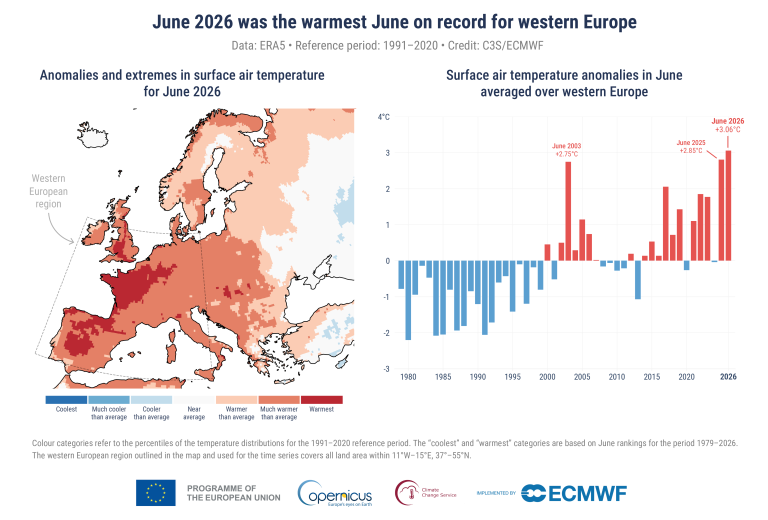
June 2026 was the hottest June on record for Western Europe and the second-warmest June globally, driven in part by the highest sea surface temperatures on record for the month, according to data released by the Copernicus Climate Change Service (C3S), implemented by the European Centre for Medium-Range Weather Forecasts (ECMWF).
The month brought extreme heat over both land and sea, with much of Western Europe hit by a record-breaking heatwave and marine heatwaves recorded across the western Mediterranean and along the Atlantic coasts.
The global average sea surface temperature (SST) for the extra-polar ocean (60°S–60°N) reached 20.86°C, the highest for June on record, exceeding the previous record set in June 2024 by 0.01°C, a rise partly linked to strengthening El Niño conditions in the equatorial Pacific.
The heatwave that struck much of Europe in the second half of June followed an intense heatwave in May, with another emerging in early July. The June heatwave broke monthly and all-time temperature records in several European countries and contributed to severe health impacts, including heat-related deaths.
Widespread dryness compounded the extreme heat, contributing to wildfire activity, particularly in the Iberian Peninsula and southern France, and raising drought risk in parts of Eastern Europe. Soils across Western and Central Europe were already dry heading into the June heatwave, following conditions that developed during May’s heatwave.
Samantha Burgess, strategic lead for climate at ECMWF, said, “June 2026 underscored how profoundly the climate is changing. Western Europe recorded its warmest June on record, and continued record warmth in the global ocean. Together, these records reflect a climate system continuing to accumulate heat. The result is increasingly intense heatwaves, a persistently warm ocean, and growing risks for people, ecosystems and infrastructure across Europe and beyond.”
Key figures
Globally, June 2026’s average surface air temperature was 16.54°C, 0.56°C above the 1991–2020 average and 1.39°C above the estimated pre-industrial (1850–1900) average, ranking as the second-warmest June on record behind June 2024.
European land temperatures averaged 19.14°C, 1.78°C above the 1991–2020 average, the second-highest on record behind June 2019. Western Europe itself averaged 20.74°C, 3.05°C above average, surpassing the previous record set in June 2025.
Arctic sea ice extent in June was around 5% below average, the sixth-lowest for the month, while Antarctic sea ice extent was about 8% below average, also ranking sixth-lowest.
Related news, Western Europe records hottest June on record, Copernicus data shows