


Close Menu
Meteorological Technology International
  • News
    • A-E
      • Agriculture
      • Automated Weather Stations
      • Aviation
      • Climate Measurement
      • Data
      • Developing Countries
      • Digital Applications
      • Early Warning Systems
      • Extreme Weather
    • G-P
      • Hydrology
      • Lidar
      • Lightning Detection
      • New Appointments
      • Nowcasting
      • Numerical Weather Prediction
      • Polar Weather
    • R-S
      • Radar
      • Rainfall
      • Remote Sensing
      • Renewable Energy
      • Satellites
      • Solar
      • Space Weather
      • Supercomputers
    • T-Z
      • Training
      • Transport
      • Weather Instruments
      • Wind
      • World Meteorological Organization
      • Meteorological Technology World Expo
  • Features
  • Online Magazines
    • January 2026
    • April 2025
    • January 2025
    • September 2024
    • April 2024
    • Archive Issues
    • Subscribe Free!
  • Opinion
  • Videos
  • Supplier Spotlight
  • Expo
LinkedIn X (Twitter) Facebook
  • Sign-up for Free Weekly E-Newsletter
  • Meet the Editors
  • Contact Us
  • Media Pack
LinkedIn Facebook
Subscribe
Meteorological Technology International
  • News
      • Agriculture
      • Automated Weather Stations
      • Aviation
      • Climate Measurement
      • Data
      • Developing Countries
      • Digital Applications
      • Early Warning Systems
      • Extreme Weather
      • Hydrology
      • Lidar
      • Lightning Detection
      • New Appointments
      • Nowcasting
      • Numerical Weather Prediction
      • Polar Weather
      • Radar
      • Rainfall
      • Remote Sensing
      • Renewable Energy
      • Satellites
      • Solar
      • Space Weather
      • Supercomputers
      • Training
      • Transport
      • Weather Instruments
      • Wind
      • World Meteorological Organization
      • Meteorological Technology World Expo
  • Features
  • Online Magazines
    1. April 2026
    2. January 2026
    3. September 2025
    4. April 2025
    5. January 2025
    6. September 2024
    7. April 2024
    8. January 2024
    9. Archive Issues
    10. Subscribe Free!
    Featured
    May 5, 2026

    In this Issue – April 2026

    By Web TeamMay 5, 2026
    Recent

    In this Issue – April 2026

    May 5, 2026

    In this Issue – January 2026

    November 27, 2025

    In this Issue – September 2025

    August 11, 2025
  • Opinion
  • Videos
  • Supplier Spotlight
  • Expo
Facebook LinkedIn
Subscribe
Meteorological Technology International
Climate Measurement

New study finds warmer night air making Western wildfires more active at night

Helen NormanBy Helen NormanAugust 12, 20213 Mins Read
Share LinkedIn Facebook Twitter Email
Wildfires
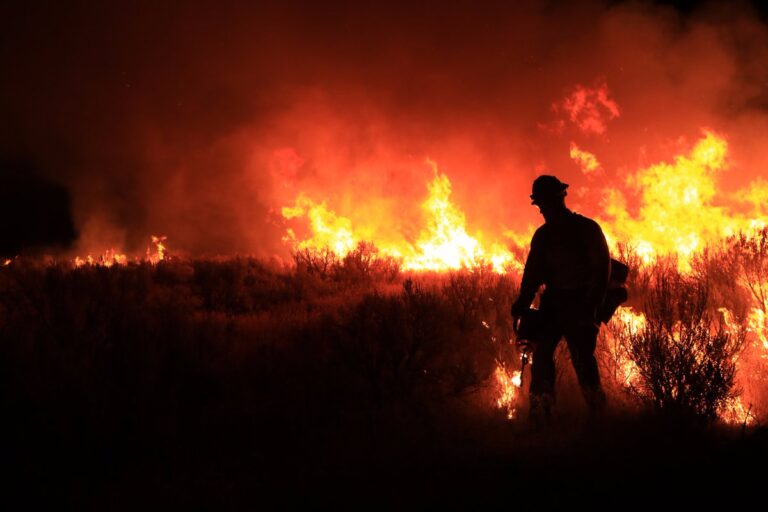
A firefighter in Idaho works after dark in 2008. Idaho is one of the places that the new study finds that the drying power of night-time air has increased dramatically over the past 40 years. Image: Idaho Bureau of Land Management/Flickr
Share
LinkedIn Facebook Twitter Email

Firefighters have reported that Western wildfires in the US are starting earlier in the morning and dying down later at night, hampering their ability to recover and regroup before the next day’s flareup.

A study by University of Washington and US Forest Service scientists has revealed why this is happening. The drying power of night-time air over much of the Western US has increased dramatically in the past 40 years.

“Night-time is an important time in fire management. When fires die down at night it gives firefighters a chance to rest, move equipment and strategize. The problem firefighters are reporting is an unexpected increase in night-time fire activity,” said lead author Andy Chiodi, a UW research scientist at the Cooperative Institute for Climate, Ocean and Ecosystem Studies, a joint center with NOAA. “Our findings support that this has been going on over the past 40 years over much, but not all, of the Western US.”

Warmer night air had been suspected as the culprit altering the daily pattern of wildfire activity, with burns continuing later into the night. The new study, however, shows it’s not just that the night air is warmer, but also a dramatic shift from 1980 to 2019 in its drying power – how much moisture the night-time air can carry away from the fuels – over much of the Western US. This shift is not captured in climate models, and the authors say it could be related to natural long-term cycles rather than to climate change.

“We paid special attention to the change in recent years compared to the conditions seen in the 1980s and 1990s, which is when many of the current firefighters started their careers, and presumably formed their ideas about what normal fire behavior should look like,” Chiodi explained. “We tried to quantify the changes that we were hearing about from firefighters.”

The study looks at the vapor pressure deficit, or the difference between the moisture in the air and the saturation moisture level at that air temperature. This difference is a measure of the air’s drying power.

“In the southern Sierra Nevada, the average summer night-time vapor pressure deficit for the recent decade was 50% higher than the average in the 1980s and 1990s,” Chiodi said. “I was surprised – it’s unusual to see geophysical data change that dramatically.”

Some of this shift in vapor pressure deficit is happening because warmer night-time air, caused by climate change, produce higher saturation values. But part of the drying power is happening because the night-time air in some regions has less moisture, and that effect is not predicted by climate change models, at least this much or in this pattern. The authors find a possible connection to the Pacific Decadal Oscillation, a long-term cycle that can influence inland weather.

The analysis used hourly weather outputs from the European Centre for Medium-Range Weather Forecasts. The recently released hourly reconstructions of historical weather allowed investigation of daily cycles. The next step is to further explore the causes of these changes in night-time vapor pressure deficit.

To read the full study, click here: Multi-Decadal Change in Western US Nighttime Vapor Pressure Deficit.

Previous ArticleStanford researchers discuss a new machine learning model for predicting precipitation
Next Article South Africa’s space weather ambitions receive government approval

Read Similar Stories

Oceans

VIDEO: Sentinel-6 satellite detects El Niño precursor in Pacific

June 4, 20262 Mins Read
Nowcasting

Colorado State University and Nvidia partner to extend severe storm prediction lead times

June 2, 20262 Mins Read
Climate Measurement

WMO warns El Niño is developing with 80% certainty, urges preparation

June 2, 20263 Mins Read
Latest News

VIDEO: Sentinel-6 satellite detects El Niño precursor in Pacific

June 4, 2026

New forecasting framework targets solar-limb flare blind spot

June 4, 2026

Colorado State University and Nvidia partner to extend severe storm prediction lead times

June 2, 2026

Receive breaking stories and features in your inbox each week, for free


Enter your email address:


Supplier Spotlights
  • REMTECH
Getting in Touch
  • Contact Us / Advertise
  • Meet the Editors
  • Media Pack
  • Free Weekly E-Newsletter
Our Social Channels
  • Facebook
  • LinkedIn
© 2026 UKi Media & Events a division of UKIP Media & Events Ltd
  • Cookie Policy
  • Privacy Policy
  • Terms and Conditions
  • Notice and Takedown Policy

Type above and press Enter to search. Press Esc to cancel.