

Close Menu
Meteorological Technology International
  • News
    • A-E
      • Agriculture
      • Automated Weather Stations
      • Aviation
      • Climate Measurement
      • Data
      • Developing Countries
      • Digital Applications
      • Early Warning Systems
      • Extreme Weather
    • G-P
      • Hydrology
      • Lidar
      • Lightning Detection
      • New Appointments
      • Nowcasting
      • Numerical Weather Prediction
      • Polar Weather
    • R-S
      • Radar
      • Rainfall
      • Remote Sensing
      • Renewable Energy
      • Satellites
      • Solar
      • Space Weather
      • Supercomputers
    • T-Z
      • Training
      • Transport
      • Weather Instruments
      • Wind
      • World Meteorological Organization
      • Meteorological Technology World Expo
  • Features
  • Online Magazines
    • January 2026
    • April 2025
    • January 2025
    • September 2024
    • April 2024
    • Archive Issues
    • Subscribe Free!
  • Opinion
  • Videos
  • Supplier Spotlight
  • Expo
LinkedIn X (Twitter) Facebook
  • Sign-up for Free Weekly E-Newsletter
  • Meet the Editors
  • Contact Us
  • Media Pack
LinkedIn Facebook
Subscribe
Meteorological Technology International
  • News
      • Agriculture
      • Automated Weather Stations
      • Aviation
      • Climate Measurement
      • Data
      • Developing Countries
      • Digital Applications
      • Early Warning Systems
      • Extreme Weather
      • Hydrology
      • Lidar
      • Lightning Detection
      • New Appointments
      • Nowcasting
      • Numerical Weather Prediction
      • Polar Weather
      • Radar
      • Rainfall
      • Remote Sensing
      • Renewable Energy
      • Satellites
      • Solar
      • Space Weather
      • Supercomputers
      • Training
      • Transport
      • Weather Instruments
      • Wind
      • World Meteorological Organization
      • Meteorological Technology World Expo
  • Features
  • Online Magazines
    1. January 2026
    2. September 2025
    3. April 2025
    4. January 2025
    5. September 2024
    6. April 2024
    7. January 2024
    8. September 2023
    9. April 2023
    10. Archive Issues
    11. Subscribe Free!
    Featured
    November 27, 2025

    In this Issue – January 2026

    By Hazel KingNovember 27, 2025
    Recent

    In this Issue – January 2026

    November 27, 2025

    In this Issue – September 2025

    August 11, 2025

    In this Issue – April 2025

    April 15, 2025
  • Opinion
  • Videos
  • Supplier Spotlight
  • Expo
Facebook LinkedIn
Subscribe
Meteorological Technology International
Extreme Weather

Record Siberia temperatures could be attributed to human actions

Lawrence ButcherBy Lawrence ButcherJuly 17, 20203 Mins Read
Share LinkedIn Facebook Twitter Email
Share
LinkedIn Facebook Twitter Email

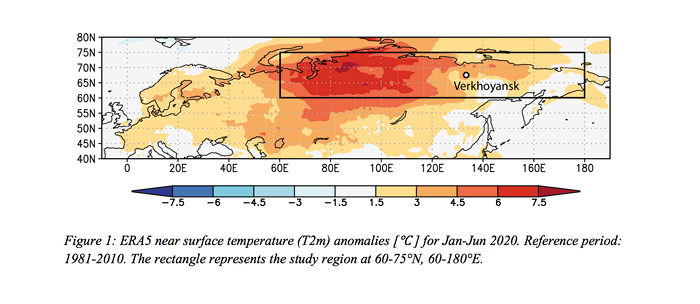
According to the WMO, the recent prolonged Siberia heat from January to June 2020 would have been almost impossible without the influence of human-caused climate change, according to a rapid attribution analysis by a team of climate scientists.

The researchers from international universities and meteorological services from the Russian Federation, France, Germany, the Netherlands, Switzerland and the UK concluded that temperatures were likely more than 2°C hotter than they would have been if humans had not been releasing greenhouse gas emissions.

The WMO noted that temperatures in Siberia have been more than 5°C above average from January to June, and in June up to 10°C above average. This has contributed to the first half of the year being the second warmest on record for the region. A temperature of 38°C was recorded in the Russian town of Verkhoyansk on June 20. The WMO is set to verify whether this is a new record temperature north of the Arctic Circle and establish a corresponding new category in its Global Weather and Climate Extremes Archive.

To try and ascertain the effect of human-influenced climate change on these high temperatures, the scientists contributing to the World Weather Attribution (WWA) initiative ran computer simulations to compare the climate as it is today, with about 1°C of global warming, with the climate as it might have been without human influence, using the same methods as in past rapid and peer-reviewed studies.

“In many previous studies we have seen hot spells and heatwaves become hotter and more frequent around the world, consistent with our scientific understanding. In places such as Siberia, a hotter climate can have devastating effects, not just on the local wildlife and people who live there, but also on the world’s climate system as a whole, for example through thawing permafrost, reduced snow cover and melting ice,” said the World Weather Attribution scientists.

The WMO said the analysis showed that prolonged heat like Siberia experienced from January to June this year would likely only happen less than once in every 80,000 years without human-induced climate change – the claim being that this makes it almost impossible in a climate that had not been warmed by greenhouse gas emissions. Their analysis suggests that climate change increased the chances of the prolonged heat by a factor of at least 600. This is among the strongest results of any attribution study conducted to date and is being touted as unequivocal evidence of the influence of human-induced climate change on the planet.

The scientists noted that even in the current climate the prolonged heat was still unlikely – such extreme conditions can be expected to occur less than once every 130 years – but it maintains that without rapid cuts in greenhouse gas emissions they risk becoming frequent by the end of the century.

Previous ArticleTraining of flash flood forecasters accelerates in South Asia
Next Article Taiwan receives new ocean research vessel

Read Similar Stories

Agriculture

Extreme heat posing significant risks to ecosystems and agriculture, FAO-WMO report warns

April 22, 20263 Mins Read
Extreme Weather

AI model improves real-time prediction of wildfire spread

April 16, 20263 Mins Read
Climate Measurement

Study identifies atmospheric trigger behind flash droughts in Puerto Rico

April 15, 20263 Mins Read
Latest News

Extreme heat posing significant risks to ecosystems and agriculture, FAO-WMO report warns

April 22, 2026

Atmospheric G2 secures Japan weather forecasting license

April 21, 2026

China completes Antarctic meteorological research mission with Xuelong icebreaker

April 21, 2026

Receive breaking stories and features in your inbox each week, for free


Enter your email address:


Supplier Spotlights
  • EUMETSAT
Getting in Touch
  • Contact Us / Advertise
  • Meet the Editors
  • Media Pack
  • Free Weekly E-Newsletter
Our Social Channels
  • Facebook
  • LinkedIn
© 2026 UKi Media & Events a division of UKIP Media & Events Ltd
  • Cookie Policy
  • Privacy Policy
  • Terms and Conditions
  • Notice and Takedown Policy

Type above and press Enter to search. Press Esc to cancel.