


Close Menu
Meteorological Technology International
  • News
    • A-E
      • Agriculture
      • Automated Weather Stations
      • Aviation
      • Climate Measurement
      • Data
      • Developing Countries
      • Digital Applications
      • Early Warning Systems
      • Extreme Weather
    • G-P
      • Hydrology
      • Lidar
      • Lightning Detection
      • New Appointments
      • Nowcasting
      • Numerical Weather Prediction
      • Polar Weather
    • R-S
      • Radar
      • Rainfall
      • Remote Sensing
      • Renewable Energy
      • Satellites
      • Solar
      • Space Weather
      • Supercomputers
    • T-Z
      • Training
      • Transport
      • Weather Instruments
      • Wind
      • World Meteorological Organization
      • Meteorological Technology World Expo
  • Features
  • Online Magazines
    • January 2026
    • April 2025
    • January 2025
    • September 2024
    • April 2024
    • Archive Issues
    • Subscribe Free!
  • Opinion
  • Videos
  • Supplier Spotlight
  • Expo
LinkedIn X (Twitter) Facebook
  • Sign-up for Free Weekly E-Newsletter
  • Meet the Editors
  • Contact Us
  • Media Pack
LinkedIn Facebook
Subscribe
Meteorological Technology International
  • News
      • Agriculture
      • Automated Weather Stations
      • Aviation
      • Climate Measurement
      • Data
      • Developing Countries
      • Digital Applications
      • Early Warning Systems
      • Extreme Weather
      • Hydrology
      • Lidar
      • Lightning Detection
      • New Appointments
      • Nowcasting
      • Numerical Weather Prediction
      • Polar Weather
      • Radar
      • Rainfall
      • Remote Sensing
      • Renewable Energy
      • Satellites
      • Solar
      • Space Weather
      • Supercomputers
      • Training
      • Transport
      • Weather Instruments
      • Wind
      • World Meteorological Organization
      • Meteorological Technology World Expo
  • Features
  • Online Magazines
    1. April 2026
    2. January 2026
    3. September 2025
    4. April 2025
    5. January 2025
    6. September 2024
    7. April 2024
    8. January 2024
    9. Archive Issues
    10. Subscribe Free!
    Featured
    May 5, 2026

    In this Issue – April 2026

    By Web TeamMay 5, 2026
    Recent

    In this Issue – April 2026

    May 5, 2026

    In this Issue – January 2026

    November 27, 2025

    In this Issue – September 2025

    August 11, 2025
  • Opinion
  • Videos
  • Supplier Spotlight
  • Expo
Facebook LinkedIn
Subscribe
Meteorological Technology International
Satellites

Researcher discovers meteorological phenomenon coined ‘atmospheric lakes’

Dan SymondsBy Dan SymondsJanuary 5, 20223 Mins Read
Share LinkedIn Facebook Twitter Email
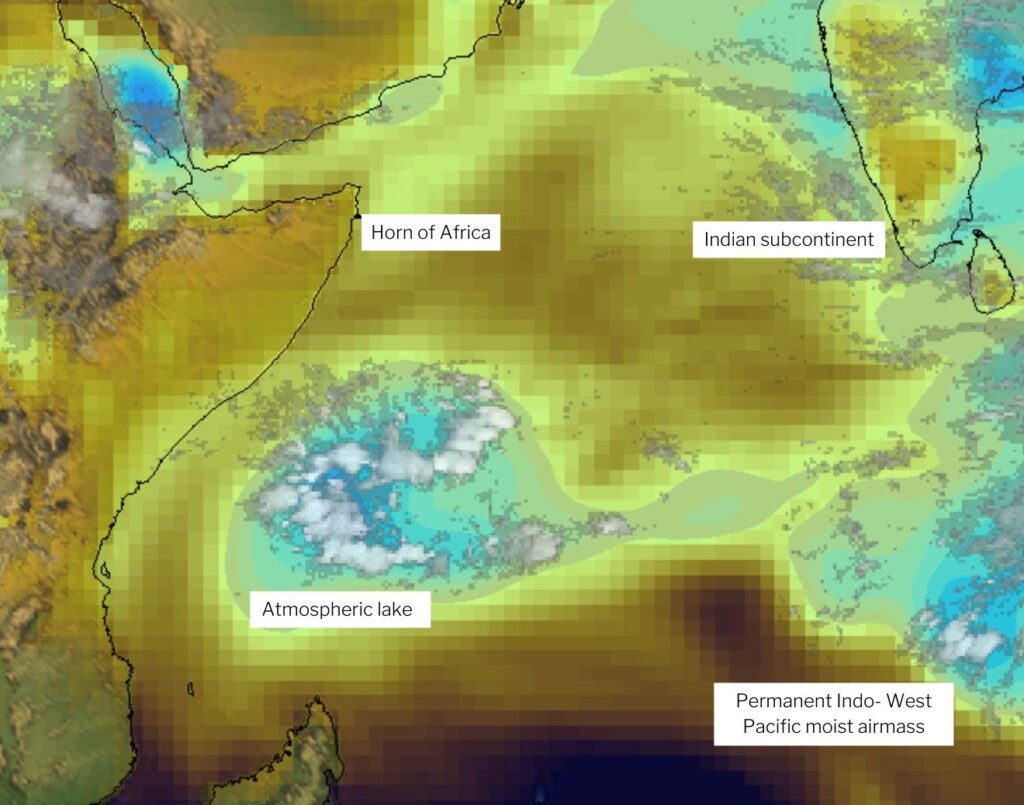
Atmospheric lakes start as filaments of water vapor in the Indo-Pacific that become their own measurable, isolated objects - Credit: Brian Mapes/NOAA ERA-Interim reanalysis data set
Share
LinkedIn Facebook Twitter Email

Research from the University of Miami has identified a new meteorological phenomenon called an ‘atmospheric lake’, a compact pool of moisture originating over the western Indian Ocean which brings water to dry lowlands along East Africa’s coastline.

Like the better-known atmospheric rivers, atmospheric lakes start as filaments of water vapor in the Indo-Pacific but are defined by the presence of water vapor concentrated enough to produce rain, rather than being formed and defined by a vortex, like most storms. Unlike the fast-flowing atmospheric rivers, the smaller atmospheric lakes detach from their source as they move at a sedate pace toward the coast.

Atmospheric lakes begin as water vapor streams that flow from the western side of the South Asian monsoon and pinch off to become their own measurable, isolated objects. They then float along ocean and coastal regions at the equatorial line in areas where the average wind speed is around zero.

In an initial survey to catalog such storms, Brian Mapes, an atmospheric scientist at the University of Miami, used five years of satellite data to spot 17 atmospheric lakes lasting longer than six days and within 10 degrees of the equator, in all seasons. Lakes farther off the equator also occur and sometimes become tropical cyclones.

The atmospheric lakes last for days at a time and occur several times a year. If all the water vapor from these lakes were liquified, it would form a puddle only a few centimeters deep and around 1,000km (620 miles) wide. This amount of water can create significant precipitation for the dry lowlands of eastern African countries where millions of people live, according to Mapes.

“It’s a place that’s dry on average, so when these [atmospheric lakes] happen, they’re surely very consequential,” Mapes said. “I look forward to learning more local knowledge about them, in this area with a venerable and fascinating nautical history where observant sailors coined the word monsoon for wind patterns, and surely noticed these occasional rainstorms, too.”

Weather patterns in this region of the world have received little attention from meteorologists, limited mostly to studies of rain and water vapor on a monthly rather than day-to-day scale, according to Mapes. He is working to understand why atmospheric lakes pinch off from the river-like pattern from which they form, and how and why they move westward. This might be due to some feature of the larger wind pattern, or perhaps that the atmospheric lakes are self-propelled by winds generated during rain production.

These are questions that would need to be answered before Mapes and other researchers can begin to study how climate change could affect atmospheric lake systems. He plans to study these events more closely using satellite data and will look into the possibility that these atmospheric lakes occur elsewhere in the world.

“The winds that carry these things to ashore are so tantalizingly, delicately near zero [wind speed], that everything could affect them,” Mapes said. “That’s when you need to know, do they self-propel, or are they driven by some very much larger-scale wind patterns that may change with climate change.”

Previous Article2021 Antarctic ozone hole one of the longest-lasting on record, says CAMS
Next Article Deforestation of West African coastal areas linked to increase in flash floods and thunderstorms

Read Similar Stories

Oceans

VIDEO: Sentinel-6 satellite detects El Niño precursor in Pacific

June 4, 20262 Mins Read
Solar

New forecasting framework targets solar-limb flare blind spot

June 4, 20262 Mins Read
Nowcasting

Colorado State University and Nvidia partner to extend severe storm prediction lead times

June 2, 20262 Mins Read
Latest News

VIDEO: Sentinel-6 satellite detects El Niño precursor in Pacific

June 4, 2026

New forecasting framework targets solar-limb flare blind spot

June 4, 2026

Colorado State University and Nvidia partner to extend severe storm prediction lead times

June 2, 2026

Receive breaking stories and features in your inbox each week, for free


Enter your email address:


Supplier Spotlights
  • Reuniwatt
Getting in Touch
  • Contact Us / Advertise
  • Meet the Editors
  • Media Pack
  • Free Weekly E-Newsletter
Our Social Channels
  • Facebook
  • LinkedIn
© 2026 UKi Media & Events a division of UKIP Media & Events Ltd
  • Cookie Policy
  • Privacy Policy
  • Terms and Conditions
  • Notice and Takedown Policy

Type above and press Enter to search. Press Esc to cancel.