


Close Menu
Meteorological Technology International
  • News
    • A-E
      • Agriculture
      • Automated Weather Stations
      • Aviation
      • Climate Measurement
      • Data
      • Developing Countries
      • Digital Applications
      • Early Warning Systems
      • Extreme Weather
    • G-P
      • Hydrology
      • Lidar
      • Lightning Detection
      • New Appointments
      • Nowcasting
      • Numerical Weather Prediction
      • Polar Weather
    • R-S
      • Radar
      • Rainfall
      • Remote Sensing
      • Renewable Energy
      • Satellites
      • Solar
      • Space Weather
      • Supercomputers
    • T-Z
      • Training
      • Transport
      • Weather Instruments
      • Wind
      • World Meteorological Organization
      • Meteorological Technology World Expo
  • Features
  • Online Magazines
    • January 2026
    • April 2025
    • January 2025
    • September 2024
    • April 2024
    • Archive Issues
    • Subscribe Free!
  • Opinion
  • Videos
  • Supplier Spotlight
  • Expo
LinkedIn X (Twitter) Facebook
  • Sign-up for Free Weekly E-Newsletter
  • Meet the Editors
  • Contact Us
  • Media Pack
LinkedIn Facebook
Subscribe
Meteorological Technology International
  • News
      • Agriculture
      • Automated Weather Stations
      • Aviation
      • Climate Measurement
      • Data
      • Developing Countries
      • Digital Applications
      • Early Warning Systems
      • Extreme Weather
      • Hydrology
      • Lidar
      • Lightning Detection
      • New Appointments
      • Nowcasting
      • Numerical Weather Prediction
      • Polar Weather
      • Radar
      • Rainfall
      • Remote Sensing
      • Renewable Energy
      • Satellites
      • Solar
      • Space Weather
      • Supercomputers
      • Training
      • Transport
      • Weather Instruments
      • Wind
      • World Meteorological Organization
      • Meteorological Technology World Expo
  • Features
  • Online Magazines
    1. April 2026
    2. January 2026
    3. September 2025
    4. April 2025
    5. January 2025
    6. September 2024
    7. April 2024
    8. January 2024
    9. Archive Issues
    10. Subscribe Free!
    Featured
    May 5, 2026

    In this Issue – April 2026

    By Web TeamMay 5, 2026
    Recent

    In this Issue – April 2026

    May 5, 2026

    In this Issue – January 2026

    November 27, 2025

    In this Issue – September 2025

    August 11, 2025
  • Opinion
  • Videos
  • Supplier Spotlight
  • Expo
Facebook LinkedIn
Subscribe
Meteorological Technology International
Space Weather

NOAA forecasts a strong geomagnetic storm after several eruptions on the sun

Elizabeth BakerBy Elizabeth BakerAugust 19, 20222 Mins Read
Share LinkedIn Facebook Twitter Email
Share
LinkedIn Facebook Twitter Email

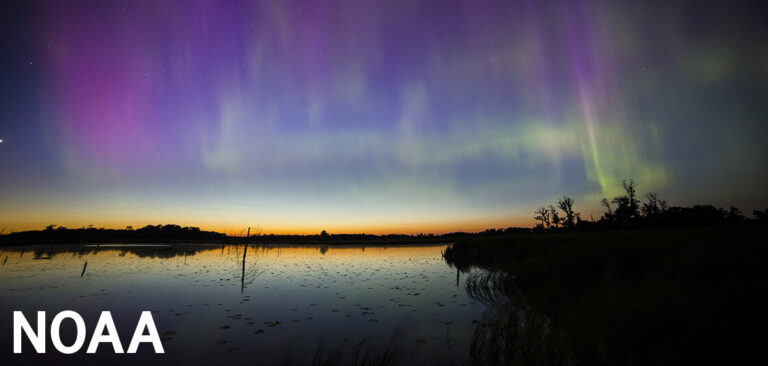
The National Oceanic and Atmospheric Administration (NOAA) has forecasted a strong geomagnetic storm after recording several eruptions on the sun.

Geomagnetic storms can affect infrastructure in near-Earth orbit and on the surface, potentially disrupting communications, the electric power grid, navigation, radio and satellite operations. It can also drive the aurora further south from its usual position over the polar region. Auroras for this storm may be visible, if the weather conditions are favorable, as far south as Pennsylvania to Iowa to Oregon.

NOAA’s Space Weather Prediction Center (SWPC) – a division of the National Weather Service – has been monitoring the sun and solar winds following a series of coronal mass ejections (CME) that began at 08:30am EDT on August 14. The space weather forecasters predict a G3 geomagnetic storm on NOAA’s scales, late on August 18, and moderate (G2) geomagnetic storming on August 19. The organization has issued a Geomagnetic Storm Watch through August 19, 2022.

Forecasters are monitoring a small but compact and magnetically complex sunspot grouping designated active Region 3078, currently located just west of the sun’s central meridian in the southern hemisphere. Region 3078 produced frequent flares, including an M5 x-ray flare (R2-Moderate radio blackout) at 03:58am EDT on August 16. M-class flares are still possible from this sunspot region; however, recent imagery indicated possible signs of weakening and potential decay. SWPC forecasters continue to monitor NOAA’s DSCOVR satellite and its real-time solar winds for signs of the arrival and strength of the CMEs and will issue any appropriate geomagnetic storm warnings once data is received.

Previous ArticleNASA studies find previously unknown loss of Antarctic ice
Next Article National Center for Atmospheric Research provides wildfire research guidance

Read Similar Stories

Satellites

SMILE mission launches to study Earth’s magnetic shield and space weather

May 20, 20263 Mins Read
Space Weather

Northumbria University secures £4m to study Earth’s radiation belts

April 16, 20262 Mins Read
Solar

Mauna Loa Solar Observatory reopens to support Artemis II mission

April 8, 20262 Mins Read
Latest News

R.M. Young Company reengineers SNOdar snow-depth sensor

May 21, 2026

SMILE mission launches to study Earth’s magnetic shield and space weather

May 20, 2026

Cloud measurement campaign targets improved climate model accuracy

May 20, 2026

Receive breaking stories and features in your inbox each week, for free


Enter your email address:


Supplier Spotlights
  • Geolux d.o.o.
Getting in Touch
  • Contact Us / Advertise
  • Meet the Editors
  • Media Pack
  • Free Weekly E-Newsletter
Our Social Channels
  • Facebook
  • LinkedIn
© 2026 UKi Media & Events a division of UKIP Media & Events Ltd
  • Cookie Policy
  • Privacy Policy
  • Terms and Conditions
  • Notice and Takedown Policy

Type above and press Enter to search. Press Esc to cancel.