


A research team led by associate professor Yosuke Matsumoto from the Institute for Advanced Academic Research at Chiba University in Japan has begun testing the use of soft x-ray imaging to measure magnetic reconnection rates in Earth’s magnetosphere, which, it says, could pave the way to more accurate space weather predictions.
The study, co-authored by Ryota Momose from Chiba University and Prof. Yoshizumi Miyoshi from Nagoya University, was made available online on June 23, 2025, and was published in Volume 52, Issue 12 of the journal Geophysical Research Letters on June 28, 2025.
Supercomputer simulations
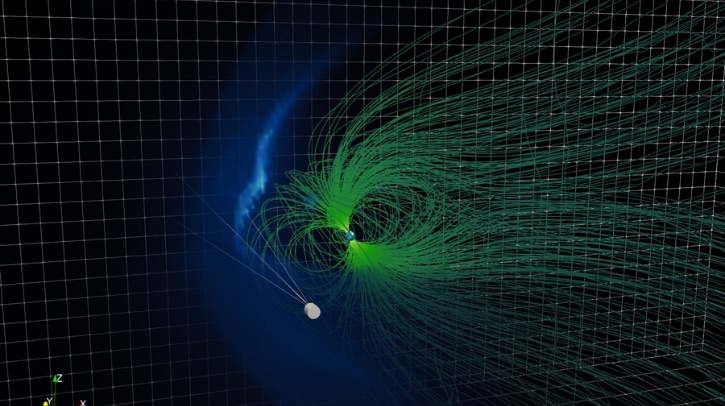
In the study, the researchers proposed leveraging the soft x-rays that are naturally emitted when solar wind particles interact with the boundaries of the magnetosphere to remotely measure reconnection rates across much larger regions than previously possible.
The team conducted advanced computer simulations on the Fugaku supercomputer, combining high-resolution global magnetohydrodynamic simulations of Earth’s magnetosphere with a model of soft x-ray emission. From the simulations, they analyzed how reconnection-related x-rays can be viewed from a satellite positioned at a lunar distance during intense solar wind conditions. This vantage point roughly matches that of an upcoming x-ray imaging satellite like Geo-X, which is scheduled for launch in the near future.
Future forecasts
After analyzing the simulation results, the researchers found that the brightest x-ray emissions form distinct cusp-shaped patterns that directly reflect the magnetic field structure around reconnection zones. By measuring the opening angle of these bright regions, they calculated the global reconnection rate to have a value of 0.13, which closely matches theoretical predictions and previous laboratory measurements. Therefore, the results demonstrate that the geometry of bright x-ray features correlates with the reconnection rate, offering a new method to estimate this parameter.
“Imaging x-rays from the sun-facing magnetospheric boundary can now potentially quantify solar wind energy inflow into the magnetosphere, making x-rays a novel space weather diagnostic tool,” said Dr Matsumoto.
“Magnetic reconnection is not only responsible for breaching Earth’s magnetic shield but is also the underlying process behind explosive events in plasma devices, the sun and black holes. Understanding this process is essential for advancing technologies like plasma confinement in fusion reactors and investigating the origin of high-energy cosmic rays.”
In related news, the University of Surrey recently launched the Surrey Space Institute, which will research three areas: managing water and climate on Earth; strengthening space systems, such as satellite communications and cybersecurity; and developing the tools and legal frameworks needed to explore and operate beyond Earth. Read the full story here