


Close Menu
Meteorological Technology International
  • News
    • A-E
      • Agriculture
      • Automated Weather Stations
      • Aviation
      • Climate Measurement
      • Data
      • Developing Countries
      • Digital Applications
      • Early Warning Systems
      • Extreme Weather
    • G-P
      • Hydrology
      • Lidar
      • Lightning Detection
      • New Appointments
      • Nowcasting
      • Numerical Weather Prediction
      • Polar Weather
    • R-S
      • Radar
      • Rainfall
      • Remote Sensing
      • Renewable Energy
      • Satellites
      • Solar
      • Space Weather
      • Supercomputers
    • T-Z
      • Training
      • Transport
      • Weather Instruments
      • Wind
      • World Meteorological Organization
      • Meteorological Technology World Expo
  • Features
  • Online Magazines
    • January 2026
    • April 2025
    • January 2025
    • September 2024
    • April 2024
    • Archive Issues
    • Subscribe Free!
  • Opinion
  • Videos
  • Supplier Spotlight
  • Expo
LinkedIn X (Twitter) Facebook
  • Sign-up for Free Weekly E-Newsletter
  • Meet the Editors
  • Contact Us
  • Media Pack
LinkedIn Facebook
Subscribe
Meteorological Technology International
  • News
      • Agriculture
      • Automated Weather Stations
      • Aviation
      • Climate Measurement
      • Data
      • Developing Countries
      • Digital Applications
      • Early Warning Systems
      • Extreme Weather
      • Hydrology
      • Lidar
      • Lightning Detection
      • New Appointments
      • Nowcasting
      • Numerical Weather Prediction
      • Polar Weather
      • Radar
      • Rainfall
      • Remote Sensing
      • Renewable Energy
      • Satellites
      • Solar
      • Space Weather
      • Supercomputers
      • Training
      • Transport
      • Weather Instruments
      • Wind
      • World Meteorological Organization
      • Meteorological Technology World Expo
  • Features
  • Online Magazines
    1. April 2026
    2. January 2026
    3. September 2025
    4. April 2025
    5. January 2025
    6. September 2024
    7. April 2024
    8. January 2024
    9. Archive Issues
    10. Subscribe Free!
    Featured
    May 5, 2026

    In this Issue – April 2026

    By Web TeamMay 5, 2026
    Recent

    In this Issue – April 2026

    May 5, 2026

    In this Issue – January 2026

    November 27, 2025

    In this Issue – September 2025

    August 11, 2025
  • Opinion
  • Videos
  • Supplier Spotlight
  • Expo
Facebook LinkedIn
Subscribe
Meteorological Technology International
Satellites

SMILE mission launches to study Earth’s magnetic shield and space weather

Alex PackBy Alex PackMay 20, 20263 Mins Read
Share LinkedIn Facebook Twitter Email
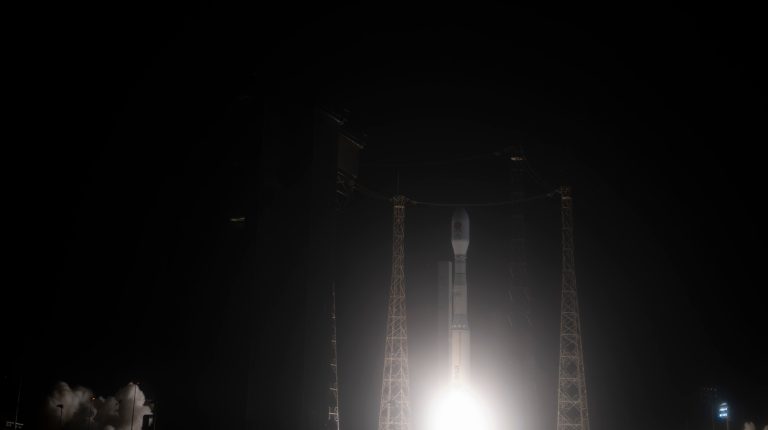
Vega-C liftoff from Europe’s Spaceport in French Guiana at 00:52 local time (04:52 BST/05:52 CEST) on May 19 2026.
Vega-C liftoff from Europe’s Spaceport in French Guiana at 00:52 local time (04:52 BST/05:52 CEST) on 19 May 2026. Vega-C carried the Smile mission to space on flight VV29. Credit: ESA
Share
LinkedIn Facebook Twitter Email

The SMILE spacecraft has launched on a Vega-C rocket from Europe’s Spaceport in French Guiana, marking the start of a joint mission to study space weather and Earth’s magnetic environment.

Liftoff took place at 04:52 BST on May 19, 2026. The first signal from the spacecraft was received by the European Space Agency’s New Norcia ground station in Australia at 06:49 CEST, followed by successful deployment of its solar panels one minute later.

SMILE (Solar wind Magnetosphere Ionosphere Link Explorer) is a collaboration between the European Space Agency (ESA) and the Chinese Academy of Sciences (CAS). The mission aims to improve understanding of how Earth responds to solar wind, solar storms and geomagnetic activity.

The spacecraft will use an x-ray camera to capture the first x-ray observations of Earth’s magnetosphere, alongside an ultraviolet imager capable of observing auroras continuously for up to 45 hours. By combining these datasets, scientists aim to track how solar activity interacts with Earth’s magnetic shield in near real time.

“We are about to witness something we’ve never seen before – Earth’s invisible armor in action,” said ESA director general Josef Aschbacher. “With SMILE, we are pushing the boundaries of science in an effort to answer big questions that have remained a mystery since we discovered, over 70 years ago, that Earth sits safely within a giant magnetic bubble.

“ESA and China have a long-standing record of cooperation spanning 25 years, from early data-sharing arrangements in the 1990s to the co-developed SMILE mission. This mission stands as a testament to ESA’s commitment to international collaboration, advancing scientific knowledge and promoting the peaceful use of space.”

The mission will build on previous ESA programs, including Cluster and XMM-Newton, applying established technologies in new ways to study Earth’s magnetic environment.

SMILE will operate in an extremely elliptical orbit, reaching up to 121,000km above the North Pole before descending to around 5,000km above the South Pole to transmit data. The data collection will begin in earnest in July, after the team has unfolded booms, opened camera covers and confirmed that everything works as expected.

“The evidence that Smile collects will help us better understand planet Earth and our Solar System as a whole,” said ESA Smile project scientist Philippe Escoubet. “And the science it uncovers will improve our models of Earth’s magnetic environment, which could ultimately help keep our astronauts and space technologies safe for decades to come.”

The mission includes contributions from across Europe, with Airbus Defence and Space in Spain responsible for the payload module and the University of Leicester leading development of the x-ray camera. In total, more than 40 companies and institutes have been involved in the project.

ESA says the data gathered by SMILE could support improved space weather forecasting and help protect satellites, astronauts and other space-based technologies.

Related news, Northumbria University secures £4m to study Earth’s radiation belts

Previous ArticleCloud measurement campaign targets improved climate model accuracy

Read Similar Stories

Climate Measurement

Cloud measurement campaign targets improved climate model accuracy

May 20, 20263 Mins Read
Videos

VIDEO: Meteosat-12 imagery over Europe and Africa made available via YouTube streams

May 19, 20262 Mins Read
Extreme Weather

Wildfires can create ‘burn scar heat islands’ that alter weather patterns, study finds

May 6, 20263 Mins Read
Latest News

SMILE mission launches to study Earth’s magnetic shield and space weather

May 20, 2026

Cloud measurement campaign targets improved climate model accuracy

May 20, 2026

VIDEO: Meteosat-12 imagery over Europe and Africa made available via YouTube streams

May 19, 2026

Receive breaking stories and features in your inbox each week, for free


Enter your email address:


Supplier Spotlights
  • ZX Lidars
Getting in Touch
  • Contact Us / Advertise
  • Meet the Editors
  • Media Pack
  • Free Weekly E-Newsletter
Our Social Channels
  • Facebook
  • LinkedIn
© 2026 UKi Media & Events a division of UKIP Media & Events Ltd
  • Cookie Policy
  • Privacy Policy
  • Terms and Conditions
  • Notice and Takedown Policy

Type above and press Enter to search. Press Esc to cancel.