


Close Menu
Meteorological Technology International
  • News
    • A-E
      • Agriculture
      • Automated Weather Stations
      • Aviation
      • Climate Measurement
      • Data
      • Developing Countries
      • Digital Applications
      • Early Warning Systems
      • Extreme Weather
    • G-P
      • Hydrology
      • Lidar
      • Lightning Detection
      • New Appointments
      • Nowcasting
      • Numerical Weather Prediction
      • Polar Weather
    • R-S
      • Radar
      • Rainfall
      • Remote Sensing
      • Renewable Energy
      • Satellites
      • Solar
      • Space Weather
      • Supercomputers
    • T-Z
      • Training
      • Transport
      • Weather Instruments
      • Wind
      • World Meteorological Organization
      • Meteorological Technology World Expo
  • Features
  • Online Magazines
    • January 2026
    • April 2025
    • January 2025
    • September 2024
    • April 2024
    • Archive Issues
    • Subscribe Free!
  • Opinion
  • Videos
  • Supplier Spotlight
  • Expo
LinkedIn X (Twitter) Facebook
  • Sign-up for Free Weekly E-Newsletter
  • Meet the Editors
  • Contact Us
  • Media Pack
LinkedIn Facebook
Subscribe
Meteorological Technology International
  • News
      • Agriculture
      • Automated Weather Stations
      • Aviation
      • Climate Measurement
      • Data
      • Developing Countries
      • Digital Applications
      • Early Warning Systems
      • Extreme Weather
      • Hydrology
      • Lidar
      • Lightning Detection
      • New Appointments
      • Nowcasting
      • Numerical Weather Prediction
      • Polar Weather
      • Radar
      • Rainfall
      • Remote Sensing
      • Renewable Energy
      • Satellites
      • Solar
      • Space Weather
      • Supercomputers
      • Training
      • Transport
      • Weather Instruments
      • Wind
      • World Meteorological Organization
      • Meteorological Technology World Expo
  • Features
  • Online Magazines
    1. January 2026
    2. September 2025
    3. April 2025
    4. January 2025
    5. September 2024
    6. April 2024
    7. January 2024
    8. September 2023
    9. April 2023
    10. Archive Issues
    11. Subscribe Free!
    Featured
    November 27, 2025

    In this Issue – January 2026

    By Hazel KingNovember 27, 2025
    Recent

    In this Issue – January 2026

    November 27, 2025

    In this Issue – September 2025

    August 11, 2025

    In this Issue – April 2025

    April 15, 2025
  • Opinion
  • Videos
  • Supplier Spotlight
  • Expo
Facebook LinkedIn
Subscribe
Meteorological Technology International
Radar

Vaisala develops method for improving weather radar observations

Lawrence ButcherBy Lawrence ButcherJanuary 22, 20213 Mins Read
Share LinkedIn Facebook Twitter Email
Share
LinkedIn Facebook Twitter Email

Technologies such as wireless local area networks (WLANs) make connectivity more convenient and productive, but they can also interfere with weather observations.

WLANs operate at the same frequencies as some weather radars and can severely degrade measurements made by those radars. Weather radars work by sending and receiving pulses of energy at radio (microwave) frequencies. Radar receivers must be sensitive enough to detect light precipitation hundreds of kilometers away from the radar site. When another device near the weather radar emits even small amounts of energy at similar frequencies as the radar, the radar may receive interference called radio frequency interference (RFI). When displayed, RFI can appear as dots, spokes, or streaks in the image of the weather radar data.

Neither regulations governing the sharing of the radio frequency spectrum nor special hardware installed on the radars have completely solved the problem of mitigating RFI in weather radar data. Several software-based solutions have been attempted, but so far these methods haven’t proven to be sufficient in cleaning up weather radar data affected by this type of interference.

Meteorological equipment specialist Vaisala says that its scientists have recently developed and applied for a US patent on a software-based method for more effectively mitigating RFI in weather radar data. The method is based on techniques used in the field of computer vision. The method works by firstly detecting RFI in weather radar data, then removing the detected interference, and finally recreating a reasonable remaining signal to fill the areas that were previously corrupted. The method has been successfully demonstrated on single- and dual-polarization moment data collected by radars operating at S-, C-, and X- frequency bands showing that it is both flexible and robust.

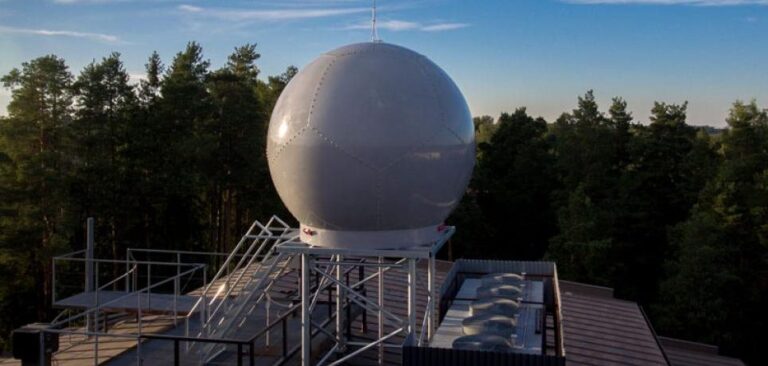
The illustration above shows an example case of weather radar data collected by Vaisala’s Integrated Radome Mounted Apparatus (IRMA) prototype C-band weather radar deployed in Helsinki, Finland. The image in the left panel shows the original, RFI-contaminated data for a particularly challenging scenario. In this scenario, RFI is present where both precipitation is and is not present. In the right panel, the successful result is shown, with the RFI mitigation technique removing the corrupted signals in both areas of the image.
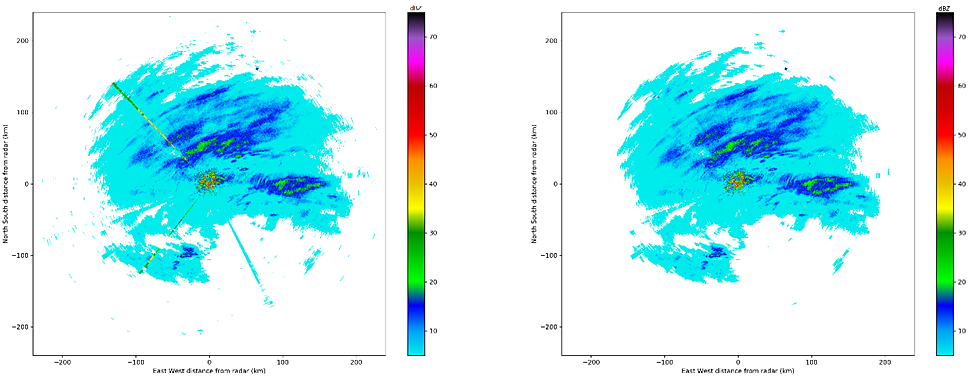
A particularly challenging scenario for mitigating RFI from weather radar reflectivity data. The image on the left shows the original data containing RFI exhibited as high-intensity streaks where precipitation is and is not observed. The image on the right shows the successful result removing these streaks and restoring the precipitation data in their places by applying the new method developed by Vaisala scientists to mitigate RFI from weather radar data. 


Previous ArticleNOAA predicts 30% maximum Great Lakes ice cover for 2021 winter
Next Article Researchers find solar winds hit north pole more than south

Read Similar Stories

Radar

EWR Radar Systems wins US Air Force contract for portable Doppler radar support

April 20, 20262 Mins Read
Climate Measurement

China inaugurates 27th national climate observatory in Hebei

April 9, 20262 Mins Read
Solar

Mauna Loa Solar Observatory reopens to support Artemis II mission

April 8, 20262 Mins Read
Latest News

Extreme heat posing significant risks to ecosystems and agriculture, FAO-WMO report warns

April 22, 2026

Atmospheric G2 secures Japan weather forecasting license

April 21, 2026

China completes Antarctic meteorological research mission with Xuelong icebreaker

April 21, 2026

Receive breaking stories and features in your inbox each week, for free


Enter your email address:


Supplier Spotlights
  • MicroStep-MIS
Getting in Touch
  • Contact Us / Advertise
  • Meet the Editors
  • Media Pack
  • Free Weekly E-Newsletter
Our Social Channels
  • Facebook
  • LinkedIn
© 2026 UKi Media & Events a division of UKIP Media & Events Ltd
  • Cookie Policy
  • Privacy Policy
  • Terms and Conditions
  • Notice and Takedown Policy

Type above and press Enter to search. Press Esc to cancel.