


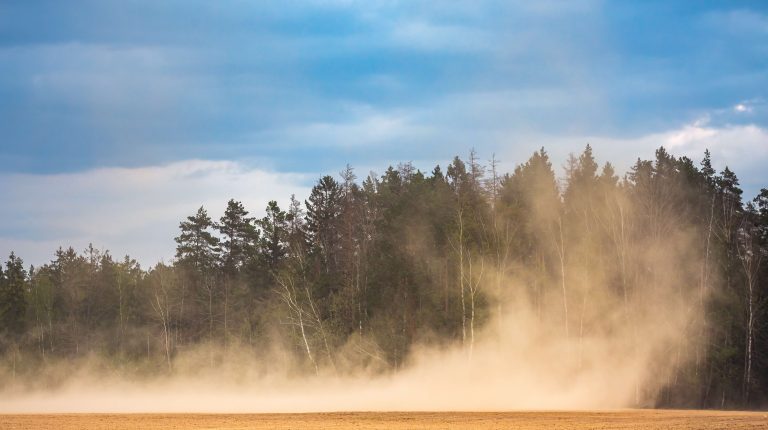
Parts of the world, including China and the USA-Mexico border region, experienced record-breaking sand and dust storms in 2025, though overall global average dust concentrations remained similar to 2024, according to the World Meteorological Organization’s WMO Airborne Dust Bulletin.
The bulletin, now in its 10th annual edition, examines dust hotspots and reviews advances in research, forecasting and warnings, including the potential of artificial intelligence and satellite technology to improve monitoring.
Around 2,000 million tons of dust enters the atmosphere each year and can travel thousands of kilometers across continents and oceans, with the most significant sources concentrated in arid and semi-arid regions such as the Sahara, the Gobi and the Arabian Desert.
WMO secretary-general Celeste Saulo said, “Sand and dust storms affect air quality and human health. They reduce agricultural productivity, disrupt transport and aviation, strain water and energy systems, and damage ecosystems. No country is immune to their impacts.” She added that international cooperation, including shared observations and regional forecasting capacity, is essential given that dust storms and droughts do not respect borders.
The highest annual mean dust concentrations worldwide remained centered in the Bodélé Depression in Chad. North Africa and the Middle East saw a series of major dust intrusions that harmed air quality and reduced visibility.
In April 2025, dust swept from Mongolia into China, producing the country’s worst sand and dust storm in a decade in terms of intensity, reach and duration. Hourly concentrations of PM10 particles exceeded 1,000μg/m³ in northern China, with some areas reaching 3,000-4,000μg/m³, far above World Health Organization limits.
Along the Mexico-USA border, dust storms were exceptionally frequent, intense and prolonged. El Paso, Texas, recorded 50 days of dust weather in 2025, more than double its annual average, and the greatest number of dust storms since the 1935 “Dust Bowl” era. On March 18, more than six hours of continuous storm conditions produced a daily average PM10 concentration of 2,064µg/m³ and an hourly peak of 8,142µg/m³, the highest recorded in Texas since hourly monitoring began around 27 years ago. Schools, highways and airports were temporarily closed, public events were canceled, and multiple fatal highway crashes occurred.
The report notes that accurate dust forecasting remains challenging due to complex atmospheric interactions and the high computational cost of traditional physics-based models. AI models, once trained, require substantially fewer computational resources and can help identify and map global dust hotspots, though the WMO said no single AI approach currently performs best across all situations.
WMO’s Sand and Dust Storm Warning Advisory and Assessment System, established in 2007, coordinates forecasting through four regional centers: Jeddah, Barcelona, Beijing and Bridgetown.
Related news, Ocean warming, marine heatwaves and sea-level rise pose increasing risk in Southwest Pacific, WMO reports