

Close Menu
Meteorological Technology International
  • News
    • A-E
      • Agriculture
      • Automated Weather Stations
      • Aviation
      • Climate Measurement
      • Data
      • Developing Countries
      • Digital Applications
      • Early Warning Systems
      • Extreme Weather
    • G-P
      • Hydrology
      • Lidar
      • Lightning Detection
      • New Appointments
      • Nowcasting
      • Numerical Weather Prediction
      • Polar Weather
    • R-S
      • Radar
      • Rainfall
      • Remote Sensing
      • Renewable Energy
      • Satellites
      • Solar
      • Space Weather
      • Supercomputers
    • T-Z
      • Training
      • Transport
      • Weather Instruments
      • Wind
      • World Meteorological Organization
      • Meteorological Technology World Expo
  • Features
  • Online Magazines
    • January 2026
    • April 2025
    • January 2025
    • September 2024
    • April 2024
    • Archive Issues
    • Subscribe Free!
  • Opinion
  • Videos
  • Supplier Spotlight
  • Expo
LinkedIn X (Twitter) Facebook
  • Sign-up for Free Weekly E-Newsletter
  • Meet the Editors
  • Contact Us
  • Media Pack
LinkedIn Facebook
Subscribe
Meteorological Technology International
  • News
      • Agriculture
      • Automated Weather Stations
      • Aviation
      • Climate Measurement
      • Data
      • Developing Countries
      • Digital Applications
      • Early Warning Systems
      • Extreme Weather
      • Hydrology
      • Lidar
      • Lightning Detection
      • New Appointments
      • Nowcasting
      • Numerical Weather Prediction
      • Polar Weather
      • Radar
      • Rainfall
      • Remote Sensing
      • Renewable Energy
      • Satellites
      • Solar
      • Space Weather
      • Supercomputers
      • Training
      • Transport
      • Weather Instruments
      • Wind
      • World Meteorological Organization
      • Meteorological Technology World Expo
  • Features
  • Online Magazines
    1. January 2026
    2. September 2025
    3. April 2025
    4. January 2025
    5. September 2024
    6. April 2024
    7. January 2024
    8. September 2023
    9. April 2023
    10. Archive Issues
    11. Subscribe Free!
    Featured
    November 27, 2025

    In this Issue – January 2026

    By Hazel KingNovember 27, 2025
    Recent

    In this Issue – January 2026

    November 27, 2025

    In this Issue – September 2025

    August 11, 2025

    In this Issue – April 2025

    April 15, 2025
  • Opinion
  • Videos
  • Supplier Spotlight
  • Expo
Facebook LinkedIn
Subscribe
Meteorological Technology International
Features

Q&A: Exploring impact-based forecasts with FMI’s director of weather, sea and climate service

Juhana Hyrkkänen, director of weather, sea and climate service at the Finnish Meteorological Institute By Juhana Hyrkkänen, director of weather, sea and climate service at the Finnish Meteorological Institute December 14, 20223 Mins Read
Share LinkedIn Facebook Twitter Email
Share
LinkedIn Facebook Twitter Email

Juhana Hyrkkänen, director of weather, sea and climate service at the Finnish Meteorological Institute (FMI), provides some insight into the department’s work on impact-based forecasting and how it is helping people and businesses to prepare for extreme weather incidents

Impact-based forecasting is a key topic in the industry at present, can you tell me a bit about your work in this area?
My department provides operational weather, sea and climate services for the whole Finnish society on a 24/7 basis. Our customer base includes the general public, authorities, as well as the commercial sector.

Impact-based forecasting is a new paradigm of weather forecasting. Traditional weather forecasts purely predict weather conditions such as temperature, precipitation and wind, whereas impact-based forecasts predict impacts of weather. This is not only related to weather but depends on many other parameters such as the time of a year, time of day, state of nature, region, human behavior and so on.

Why do we need impact-based forecasts?
Impact-based forecasts and warnings help end-users to make the right decisions at the right time. A traditional weather forecast or weather warning doesn’t help end-users if corresponding decisions and protective actions are not in place.

What impact-based forecasting services do you provide?
In the case of a storm for instance, we predict the amount of rescue tasks or households without electricity, which helps emergency services and electricity network operators to allocate resources in an effective manner. This enables society to recover faster from the storm. Other applications include a snow plowing timing system, to calculate the time when the snow on the road must be plowed, and an energy weather forecast, to calculate estimation of electricity production and consumption.

What is a typical scenario where an impact-based forecast is created and distributed?
An upcoming storm is the most typical weather event where impact-based forecasting applies. The amount of forest damage, electricity outages and car accidents are typical outputs. Results are based on historical data and machine learning (ML), so they are as good as the historical data available. Results are getting better as the teaching period for the ML increases. We just got positive feedback from one open air park that our estimation of visitor numbers was working very well last summer.
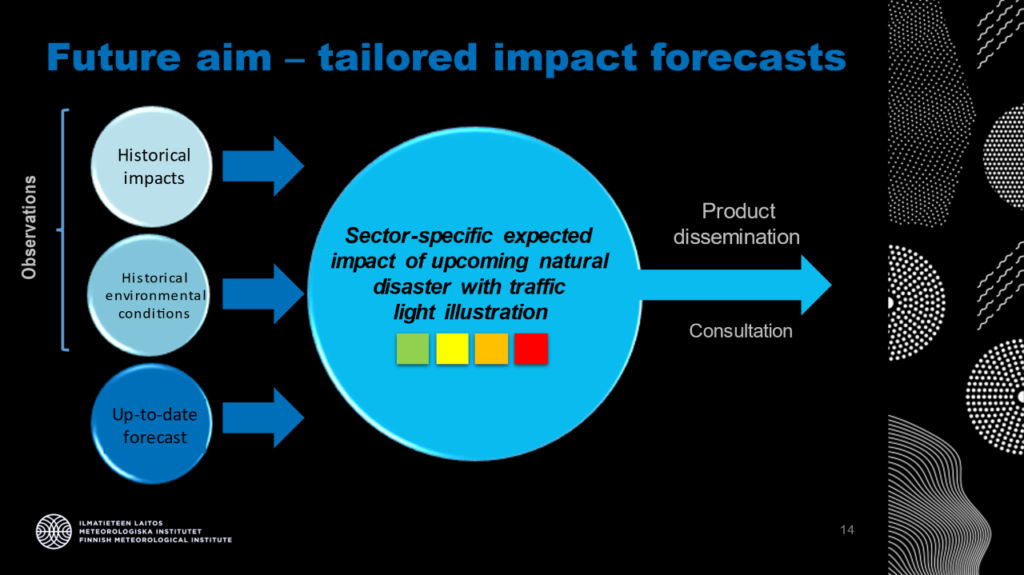
Credit – Ari-Juhani Punkka, project manager, SILVA

Are you working with any met agencies from different countries to help them improve their impact-based forecasting capabilities?
Not extensively so far. However, in the past decades, more than 100 countries have been assisted in international co-operation in the field of meteorology worldwide by FMI. If impact data is available in a target country, it is possible to apply the system anywhere.

What technologies are needed to create impact-based forecasts?
You need historical impact data, weather data and machine learning tools.

What technological advancements have taken place in recent years to facilitate the advent of impact-based forecasting?
The process is very data intensive and better availability of data helps a lot. The current trend of machine learning applications also promotes this work.

What do you have planned for 2023?
As for better availability of meteorological data, we are starting a new EU-funded project called RODEO with our European stakeholders. This aims to enable open discovery and access to European meteorological ‘high-value data sets’. This is going to be a one-stop-shop for meteorological weather observations in the European context.
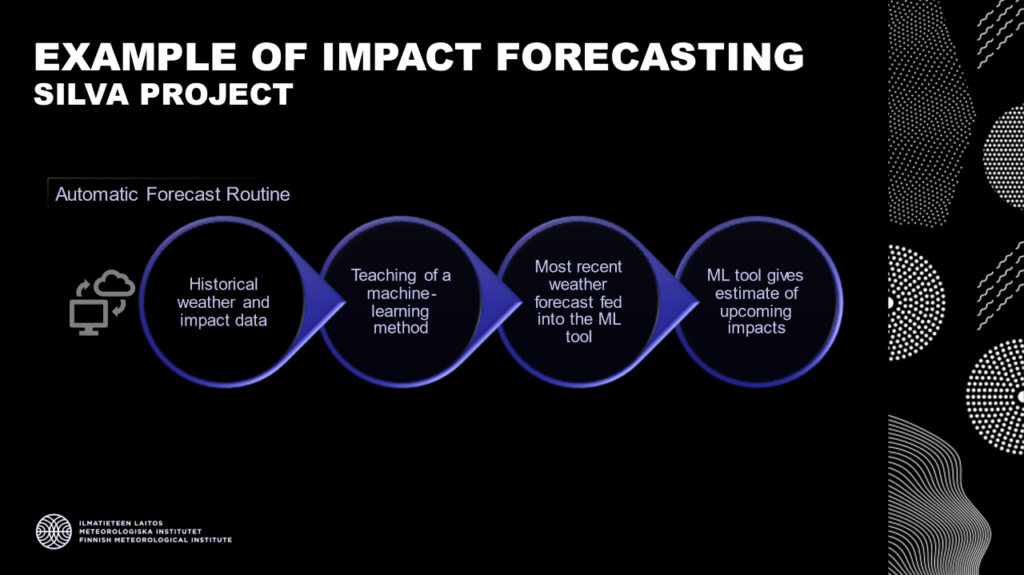
Credit – Ari-Juhani Punkka, project manager, SILVA


Previous ArticleUCAR launches virtual tour of Mesa Lab and supercomputing facility
Next Article European met community hails successful launch of MTG-I1

Read Similar Stories

Features

FEATURE: How the Arctic oscillation fueled widespread winter storms

April 9, 20265 Mins Read
Features

EXCLUSIVE INTERVIEW: Chris Hyde, energy lead at Meteomatics

March 19, 20264 Mins Read
Features

EXCLUSIVE INTERVIEW: Mausumi Dikpati, NSF NCAR senior scientist

March 5, 20265 Mins Read
Latest News

WMO signals increasing likelihood of El Niño developing in 2026

April 24, 2026

Alabama partners with Climavision to expand weather radar coverage statewide

April 24, 2026

Extreme heat posing significant risks to ecosystems and agriculture, FAO-WMO report warns

April 22, 2026

Receive breaking stories and features in your inbox each week, for free


Enter your email address:


Supplier Spotlights
  • MicroStep-MIS
Getting in Touch
  • Contact Us / Advertise
  • Meet the Editors
  • Media Pack
  • Free Weekly E-Newsletter
Our Social Channels
  • Facebook
  • LinkedIn
© 2026 UKi Media & Events a division of UKIP Media & Events Ltd
  • Cookie Policy
  • Privacy Policy
  • Terms and Conditions
  • Notice and Takedown Policy

Type above and press Enter to search. Press Esc to cancel.