


Close Menu
Meteorological Technology International
  • News
    • A-E
      • Agriculture
      • Automated Weather Stations
      • Aviation
      • Climate Measurement
      • Data
      • Developing Countries
      • Digital Applications
      • Early Warning Systems
      • Extreme Weather
    • G-P
      • Hydrology
      • Lidar
      • Lightning Detection
      • New Appointments
      • Nowcasting
      • Numerical Weather Prediction
      • Polar Weather
    • R-S
      • Radar
      • Rainfall
      • Remote Sensing
      • Renewable Energy
      • Satellites
      • Solar
      • Space Weather
      • Supercomputers
    • T-Z
      • Training
      • Transport
      • Weather Instruments
      • Wind
      • World Meteorological Organization
      • Meteorological Technology World Expo
  • Features
  • Online Magazines
    • January 2026
    • April 2025
    • January 2025
    • September 2024
    • April 2024
    • Archive Issues
    • Subscribe Free!
  • Opinion
  • Videos
  • Supplier Spotlight
  • Expo
LinkedIn X (Twitter) Facebook
  • Sign-up for Free Weekly E-Newsletter
  • Meet the Editors
  • Contact Us
  • Media Pack
LinkedIn Facebook
Subscribe
Meteorological Technology International
  • News
      • Agriculture
      • Automated Weather Stations
      • Aviation
      • Climate Measurement
      • Data
      • Developing Countries
      • Digital Applications
      • Early Warning Systems
      • Extreme Weather
      • Hydrology
      • Lidar
      • Lightning Detection
      • New Appointments
      • Nowcasting
      • Numerical Weather Prediction
      • Polar Weather
      • Radar
      • Rainfall
      • Remote Sensing
      • Renewable Energy
      • Satellites
      • Solar
      • Space Weather
      • Supercomputers
      • Training
      • Transport
      • Weather Instruments
      • Wind
      • World Meteorological Organization
      • Meteorological Technology World Expo
  • Features
  • Online Magazines
    1. April 2026
    2. January 2026
    3. September 2025
    4. April 2025
    5. January 2025
    6. September 2024
    7. April 2024
    8. January 2024
    9. Archive Issues
    10. Subscribe Free!
    Featured
    May 5, 2026

    In this Issue – April 2026

    By Web TeamMay 5, 2026
    Recent

    In this Issue – April 2026

    May 5, 2026

    In this Issue – January 2026

    November 27, 2025

    In this Issue – September 2025

    August 11, 2025
  • Opinion
  • Videos
  • Supplier Spotlight
  • Expo
Facebook LinkedIn
Subscribe
Meteorological Technology International
Climate Measurement

Antarctic sea-ice plays key role in Earth’s radiative energy budget, report finds

Elizabeth BakerBy Elizabeth BakerOctober 29, 20213 Mins Read
Share LinkedIn Facebook Twitter Email
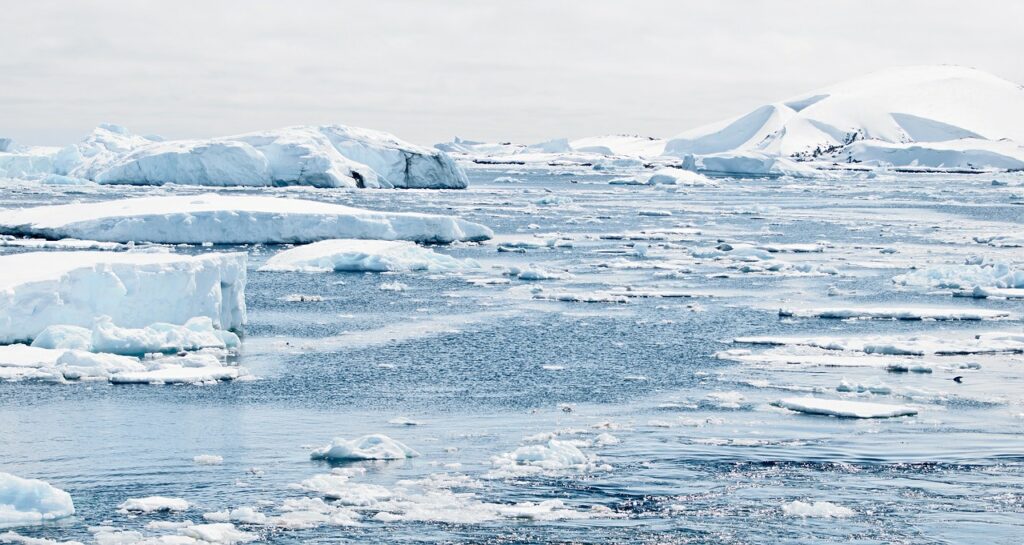
Credit – Angie Agostino from Pixabay
Share
LinkedIn Facebook Twitter Email

Researchers from the Finnish Meteorological Institute and the Norwegian Institute of Bioeconomy Research have calculated that an expansion in Antarctic sea-ice cover between 2000 and 2015 produced a cooling effect that largely balanced out the warming effect caused by the melting of the Arctic region over the same period.

In their new study published in Nature Geoscience, which analyzed satellite data from 1982 to 2018, the researchers found that in 2016 there was a notable reduction in Antarctic sea-ice cover, which reversed the cooling effect that had increased over the previous 15 years. Between 1992 and 2018, the average changes in the reflectivity of polar regions amounted to a global warming effect of +0.08W/m2 . This corresponds to about 10% of the warming effect caused by annual man-made carbon dioxide emissions since 1992. Therefore, these researchers warn that this share may increase if the Antarctic sea-ice cover does not recover from its recent shrinkage.

The reflectivity of Earth’s surface – known as albedo – decreases when Earth’s snow and ice cover melts; consequently, less sunlight is reflected into space when the albedo of Earth’s surface decreases. This leads to more solar radiation energy remaining on Earth, and a warmer climate system. Similarly, as the snow and ice cover grows, reflectivity increases, which has a cooling effect. This mechanism is called snow and ice albedo feedback. The scale of the snow and ice albedo feedback is determined by, for example, the amount of sunlight and cloudiness.

Aku Riihelä, research professor at the Finnish Meteorological Institute and one of the study’s authors, said, “Our results highlight the important, but previously little-known, role of the Antarctica’s sea-ice cover as a regulator of the radiative energy budget in polar regions. The dramatic change in the sea-ice cover in 2016 also shows that major changes in the sea-ice cover can take place rapidly. For this reason, more attention should be paid to the monitoring of Antarctica and its sea-ice in the future, as well as the development of related models.”

Ryan Bright, one of the study’s co-authors and a research professor at the Norwegian Institute of Bioeconomy Research, said, “The question of whether the huge loss in Antarctic sea-ice can be recovered is important, given the profound implications for Earth’s radiative energy balance. The Antarctic has long served as a sort of refrigerator in the Earth system. Breaking it beyond repair would really chip away at our remaining emission budgets, making it ever more difficult to meet our ambitious mitigation targets.”

However, recent studies have shown partial recovery in the Antarctic sea-ice. “While this may be seen as good news, we cannot afford to dismiss the 2016-2018 reversal as anomalous until we really understand the mechanisms that caused it,” Bright said.

The study was carried out in 2020–2021 by the Finnish Meteorological Institute and the Norwegian Institute of Bioeconomy Research (NIBIO). The work of researchers from the Finnish Meteorological Institute was partly financed by the Academy of Finland. The main suppliers of satellite measurements used in the study were the European Organisation for the Exploitation of Meteorological Satellites (EUMETSAT) and NASA.

Previous ArticleFox News partners with WeatherStem to launch on-demand weather service
Next Article Climate action “way off track” as WMO reports record GHG levels

Read Similar Stories

Extreme Weather

Impacts of extreme weather and rising temperatures intensify across Latin America and Caribbean

May 15, 20263 Mins Read
Automated Weather Stations

University of Vermont launches first station in statewide weather monitoring network

May 8, 20262 Mins Read
Extreme Weather

Wildfires can create ‘burn scar heat islands’ that alter weather patterns, study finds

May 6, 20263 Mins Read
Latest News

Impacts of extreme weather and rising temperatures intensify across Latin America and Caribbean

May 15, 2026

Ventusky adds fire monitoring to its weather maps

May 14, 2026

“For over a century, precipitation gauges have measured too low” – Vaisala addresses the measurement gap

May 13, 2026

Receive breaking stories and features in your inbox each week, for free


Enter your email address:


Supplier Spotlights
  • Baron
Getting in Touch
  • Contact Us / Advertise
  • Meet the Editors
  • Media Pack
  • Free Weekly E-Newsletter
Our Social Channels
  • Facebook
  • LinkedIn
© 2026 UKi Media & Events a division of UKIP Media & Events Ltd
  • Cookie Policy
  • Privacy Policy
  • Terms and Conditions
  • Notice and Takedown Policy

Type above and press Enter to search. Press Esc to cancel.