


Close Menu
Meteorological Technology International
  • News
    • A-E
      • Agriculture
      • Automated Weather Stations
      • Aviation
      • Climate Measurement
      • Data
      • Developing Countries
      • Digital Applications
      • Early Warning Systems
      • Extreme Weather
    • G-P
      • Hydrology
      • Lidar
      • Lightning Detection
      • New Appointments
      • Nowcasting
      • Numerical Weather Prediction
      • Polar Weather
    • R-S
      • Radar
      • Rainfall
      • Remote Sensing
      • Renewable Energy
      • Satellites
      • Solar
      • Space Weather
      • Supercomputers
    • T-Z
      • Training
      • Transport
      • Weather Instruments
      • Wind
      • World Meteorological Organization
      • Meteorological Technology World Expo
  • Features
  • Online Magazines
    • January 2026
    • April 2025
    • January 2025
    • September 2024
    • April 2024
    • Archive Issues
    • Subscribe Free!
  • Opinion
  • Videos
  • Supplier Spotlight
  • Expo
LinkedIn X (Twitter) Facebook
  • Sign-up for Free Weekly E-Newsletter
  • Meet the Editors
  • Contact Us
  • Media Pack
LinkedIn Facebook
Subscribe
Meteorological Technology International
  • News
      • Agriculture
      • Automated Weather Stations
      • Aviation
      • Climate Measurement
      • Data
      • Developing Countries
      • Digital Applications
      • Early Warning Systems
      • Extreme Weather
      • Hydrology
      • Lidar
      • Lightning Detection
      • New Appointments
      • Nowcasting
      • Numerical Weather Prediction
      • Polar Weather
      • Radar
      • Rainfall
      • Remote Sensing
      • Renewable Energy
      • Satellites
      • Solar
      • Space Weather
      • Supercomputers
      • Training
      • Transport
      • Weather Instruments
      • Wind
      • World Meteorological Organization
      • Meteorological Technology World Expo
  • Features
  • Online Magazines
    1. January 2026
    2. September 2025
    3. April 2025
    4. January 2025
    5. September 2024
    6. April 2024
    7. January 2024
    8. September 2023
    9. April 2023
    10. Archive Issues
    11. Subscribe Free!
    Featured
    November 27, 2025

    In this Issue – January 2026

    By Hazel KingNovember 27, 2025
    Recent

    In this Issue – January 2026

    November 27, 2025

    In this Issue – September 2025

    August 11, 2025

    In this Issue – April 2025

    April 15, 2025
  • Opinion
  • Videos
  • Supplier Spotlight
  • Expo
Facebook LinkedIn
Subscribe
Meteorological Technology International
Climate Measurement

Research book addresses understanding of El Niño Southern Oscillation

Lawrence ButcherBy Lawrence ButcherNovember 10, 20203 Mins Read
Share LinkedIn Facebook Twitter Email
Share
LinkedIn Facebook Twitter Email

The future of the El Niño Southern Oscillation, or ENSO, is the subject of a new book published by the American Geophysical Union. With 21 chapters written by 98 authors from 58 research institutions in 16 countries, the volume covers the latest theories, models and observations, and explores the challenges of forecasting El Niño and La Niña. The book, El Niño Southern Oscillation in a Changing Climate was published online at the start of November.

ENSO is a cycle of warm El Niño and cool La Niña episodes that happen every few years in the tropical Pacific Ocean. It is the most dramatic year-to-year variation of the Earth’s climate system, affecting agriculture, public health, freshwater availability, power generation, and economic activity in the USA and around the globe.

“This is the first comprehensive examination of how ENSO, its dynamics and its impacts may change under the influence of rising greenhouse gas concentrations in the atmosphere,” said Michael McPhaden, senior scientist with NOAA’s Pacific Marine Environmental Laboratory in Seattle, Washington, and co-editor of the new volume.

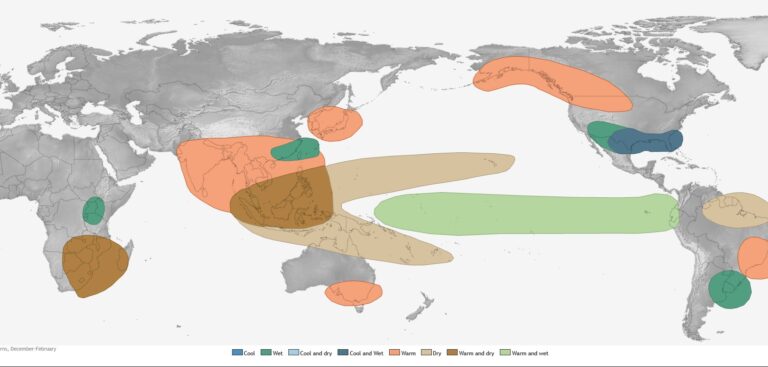
During El Niño, chances for drought increase across India, Indonesia and Australia and a large part of the Amazon, while the southern USA tends to see more precipitation. During La Niña, the pattern is effectively reversed, with wetter conditions for Indonesia, Australia and parts of the Amazon, and dry conditions in the southern tier of the USA. In September, NOAA’s Climate Prediction Center announced that a La Niña had developed in the Pacific and was likely to last through the Northern Hemisphere winter.

The book tracks the historical development of ideas about ENSO, explores underlying physical processes and reveals the latest science on how ENSO responds to external factors such as climate phenomena outside the tropical Pacific, volcanic eruptions, and anthropogenic greenhouse gas forcing.

Antonietta Capotondi, a CIRES scientist working at NOAA’s Physical Sciences Laboratory, said in recent decades, scientists have come to appreciate how significantly ENSO impacts can vary from event to event: “No two El Niños or La Niñas are perfectly alike. We’ve seen how diverse ENSO events can be. This diversity adds another degree of complexity for understanding how climate change will influence future ENSO events.”

So how are ENSO impacts likely to evolve in the coming decades? According to McPhaden, “Extreme El Niño and La Niña events may increase in frequency from about one every 20 years to one every 10 years by the end of the 21st century under aggressive greenhouse gas emission scenarios. The strongest events may also become even stronger than they are today.”

In a warming climate, rainfall extremes are projected to shift eastward along the equator in the Pacific Ocean during El Niño events and westward during extreme La Niña events. Less clear is the potential evolution of rainfall patterns in the mid-latitudes, but extremes may be more pronounced if strong El Niños and La Niñas increase in frequency and amplitude, he said.

Some ENSO impacts are already being amplified, such as the extensive coral bleaching and increases in tropical Pacific storm activity observed during the 2015-16 El Niño. ENSO is expected to impact tropical cyclone genesis in the future as it does today in the Atlantic, Pacific and Indian Oceans, but precisely how is still an open question.

Previous ArticleCopernicus data reveals October sets temperature records
Next Article NOAA’s October weather report sees mix of average and extremes

Read Similar Stories

Climate Measurement

WMO signals increasing likelihood of El Niño developing in 2026

April 24, 20263 Mins Read
Radar

Alabama partners with Climavision to expand weather radar coverage statewide

April 24, 20262 Mins Read
Agriculture

Extreme heat posing significant risks to ecosystems and agriculture, FAO-WMO report warns

April 22, 20263 Mins Read
Latest News

WMO signals increasing likelihood of El Niño developing in 2026

April 24, 2026

Alabama partners with Climavision to expand weather radar coverage statewide

April 24, 2026

Extreme heat posing significant risks to ecosystems and agriculture, FAO-WMO report warns

April 22, 2026

Receive breaking stories and features in your inbox each week, for free


Enter your email address:


Supplier Spotlights
  • Raymetrics
Getting in Touch
  • Contact Us / Advertise
  • Meet the Editors
  • Media Pack
  • Free Weekly E-Newsletter
Our Social Channels
  • Facebook
  • LinkedIn
© 2026 UKi Media & Events a division of UKIP Media & Events Ltd
  • Cookie Policy
  • Privacy Policy
  • Terms and Conditions
  • Notice and Takedown Policy

Type above and press Enter to search. Press Esc to cancel.