


Close Menu
Meteorological Technology International
  • News
    • A-E
      • Agriculture
      • Automated Weather Stations
      • Aviation
      • Climate Measurement
      • Data
      • Developing Countries
      • Digital Applications
      • Early Warning Systems
      • Extreme Weather
    • G-P
      • Hydrology
      • Lidar
      • Lightning Detection
      • New Appointments
      • Nowcasting
      • Numerical Weather Prediction
      • Polar Weather
    • R-S
      • Radar
      • Rainfall
      • Remote Sensing
      • Renewable Energy
      • Satellites
      • Solar
      • Space Weather
      • Supercomputers
    • T-Z
      • Training
      • Transport
      • Weather Instruments
      • Wind
      • World Meteorological Organization
      • Meteorological Technology World Expo
  • Features
  • Online Magazines
    • January 2026
    • April 2025
    • January 2025
    • September 2024
    • April 2024
    • Archive Issues
    • Subscribe Free!
  • Opinion
  • Videos
  • Supplier Spotlight
  • Expo
LinkedIn X (Twitter) Facebook
  • Sign-up for Free Weekly E-Newsletter
  • Meet the Editors
  • Contact Us
  • Media Pack
LinkedIn Facebook
Subscribe
Meteorological Technology International
  • News
      • Agriculture
      • Automated Weather Stations
      • Aviation
      • Climate Measurement
      • Data
      • Developing Countries
      • Digital Applications
      • Early Warning Systems
      • Extreme Weather
      • Hydrology
      • Lidar
      • Lightning Detection
      • New Appointments
      • Nowcasting
      • Numerical Weather Prediction
      • Polar Weather
      • Radar
      • Rainfall
      • Remote Sensing
      • Renewable Energy
      • Satellites
      • Solar
      • Space Weather
      • Supercomputers
      • Training
      • Transport
      • Weather Instruments
      • Wind
      • World Meteorological Organization
      • Meteorological Technology World Expo
  • Features
  • Online Magazines
    1. April 2026
    2. January 2026
    3. September 2025
    4. April 2025
    5. January 2025
    6. September 2024
    7. April 2024
    8. January 2024
    9. Archive Issues
    10. Subscribe Free!
    Featured
    May 5, 2026

    In this Issue – April 2026

    By Web TeamMay 5, 2026
    Recent

    In this Issue – April 2026

    May 5, 2026

    In this Issue – January 2026

    November 27, 2025

    In this Issue – September 2025

    August 11, 2025
  • Opinion
  • Videos
  • Supplier Spotlight
  • Expo
Facebook LinkedIn
Subscribe
Meteorological Technology International
Climate Measurement

Slight decrease recorded in Antarctic ozone hole compared with 2021

Dan SymondsBy Dan SymondsOctober 27, 20223 Mins Read
Share LinkedIn Facebook Twitter Email
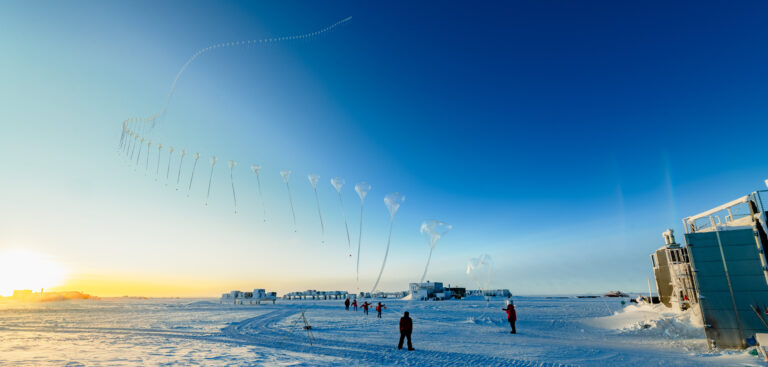
A NOAA ozonesonde ascends over the South Pole in this time-lapse photo taken October 21, 2020. Photo credit: Yuya Makino-IceCube
Share
LinkedIn Facebook Twitter Email

The hole in the ozone layer above the Antarctic is continuing to decrease, according to NOAA and NASA scientists.

The hole in the ozone, the portion of the stratosphere that protects the planet from the sun’s ultraviolet rays, has an average area of 23.2 million square kilometers. That measurement is slightly smaller than the 23.3 million square kilometers reached last year, and well below the average seen in 2006 when the hole size peaked.

Paul Newman, chief scientist for Earth sciences at NASA’s Goddard Space Flight Center, said, “Over time, steady progress is being made and the hole is getting smaller. We see some wavering as weather changes and other factors make the numbers wiggle slightly from day to day and week to week. But overall, we see it decreasing through the last two decades. Eliminating ozone-depleting substances through the Montreal Protocol is shrinking the hole.”

The ozone hole appears when the protective ozone layer in the stratosphere above the South Pole begins to thin every September. Chlorine and bromine derived from human-produced compounds are released from reactions in high-altitude polar clouds. The chemical reactions then begin to deplete the ozone layer as the sun rises at the end of the winter in the southern hemisphere, with the strongest depletion occurring above Antarctica.

NOAA and NASA researchers detect and measure the growth and breakup of the ozone hole with satellite instruments aboard Aura, Suomi-NPP and NOAA-20 satellites. This year, satellite observations determined that the ozone hole area reached a single-day maximum of 26.4 million square kilometers on October 5, but is now shrinking.
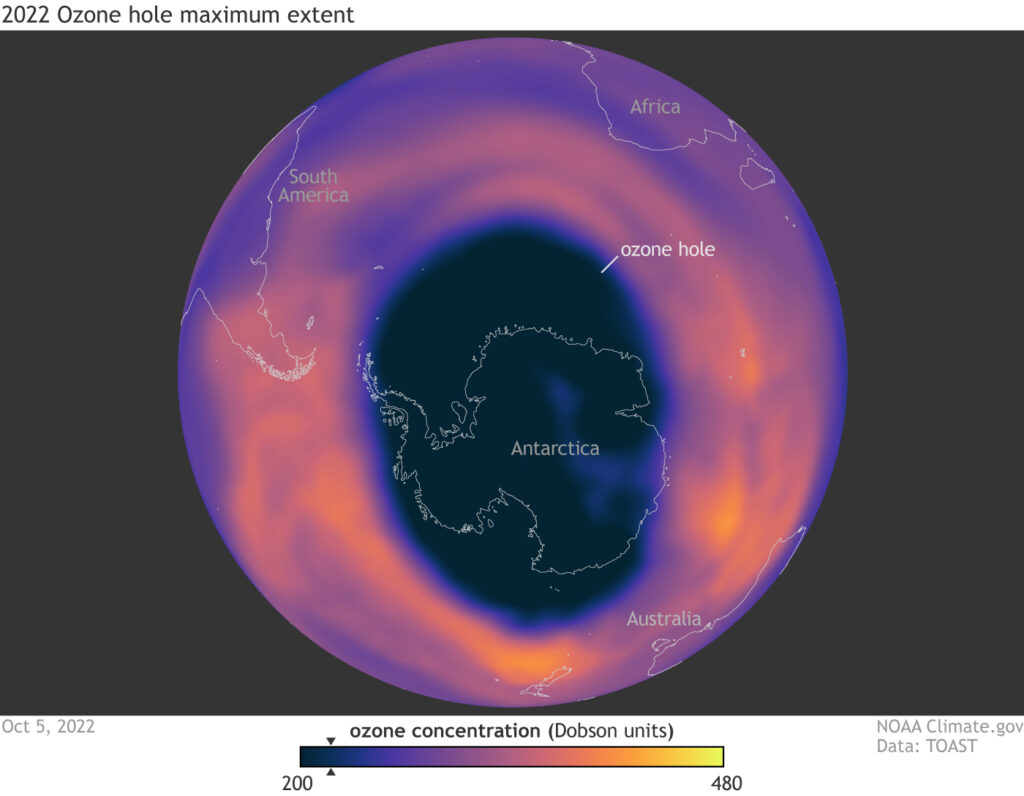
The ozone hole reached its annual maximum area of 26.4 million square kilometers on October 5, 2022. Picture credit: NOAA

NOAA scientists at the South Pole Station also record the ozone layer’s thickness by releasing weather balloons carrying ozonesondes that measure the varying ozone concentrations, measured in Dobson units, as the balloon rises into the stratosphere.

The lowest column amount detected by ozonesondes at the South Pole this year was 101 Dobson units on October 3, according to Bryan Johnson from NOAA’s Global Monitoring Laboratory. This is very similar to last year’s measurements. At altitudes between 14 and 21km, the ozone was almost completely depleted when the ozone hole was at its maximum.

Measurements made via satellite and ozonesondes show that the Antarctic ozone hole has been smaller in recent years than it was in the late 1990s and early 2000s. This is due to the Montreal Protocol, a treaty adopted 35 years ago to ban the release of harmful ozone-depleting chemicals called chlorofluorocarbons (CFCs). It remains the only international treaty ratified by every country on Earth. Amendments have helped it evolve to meet new scientific, technical and economic developments and challenges.

Scientists were also concerned about the potential stratospheric effects of the Hunga Tonga-Hunga Ha’apai volcano eruption on January 15, 2022, but so far, no direct effects on the ozone layer have been noted in the data.

Previous ArticleClimate change to increase danger of heat stress during Arba’een pilgrimage
Next Article FMI to end use of HIRLAM weather forecast model in October

Read Similar Stories

Climate Measurement

Cloud measurement campaign targets improved climate model accuracy

May 20, 20263 Mins Read
Videos

VIDEO: Meteosat-12 imagery over Europe and Africa made available via YouTube streams

May 19, 20262 Mins Read
Extreme Weather

Impacts of extreme weather and rising temperatures intensify across Latin America and Caribbean

May 15, 20263 Mins Read
Latest News

R.M. Young Company reengineers SNOdar snow-depth sensor

May 21, 2026

SMILE mission launches to study Earth’s magnetic shield and space weather

May 20, 2026

Cloud measurement campaign targets improved climate model accuracy

May 20, 2026

Receive breaking stories and features in your inbox each week, for free


Enter your email address:


Supplier Spotlights
  • Senseca
Getting in Touch
  • Contact Us / Advertise
  • Meet the Editors
  • Media Pack
  • Free Weekly E-Newsletter
Our Social Channels
  • Facebook
  • LinkedIn
© 2026 UKi Media & Events a division of UKIP Media & Events Ltd
  • Cookie Policy
  • Privacy Policy
  • Terms and Conditions
  • Notice and Takedown Policy

Type above and press Enter to search. Press Esc to cancel.