



Close Menu
Meteorological Technology International
  • News
    • A-E
      • Agriculture
      • Automated Weather Stations
      • Aviation
      • Climate Measurement
      • Data
      • Developing Countries
      • Digital Applications
      • Early Warning Systems
      • Extreme Weather
    • G-P
      • Hydrology
      • Lidar
      • Lightning Detection
      • New Appointments
      • Nowcasting
      • Numerical Weather Prediction
      • Polar Weather
    • R-S
      • Radar
      • Rainfall
      • Remote Sensing
      • Renewable Energy
      • Satellites
      • Solar
      • Space Weather
      • Supercomputers
    • T-Z
      • Training
      • Transport
      • Weather Instruments
      • Wind
      • World Meteorological Organization
      • Meteorological Technology World Expo
  • Features
  • Online Magazines
    • January 2026
    • April 2025
    • January 2025
    • September 2024
    • April 2024
    • Archive Issues
    • Subscribe Free!
  • Opinion
  • Videos
  • Supplier Spotlight
  • Expo
LinkedIn X (Twitter) Facebook
  • Sign-up for Free Weekly E-Newsletter
  • Meet the Editors
  • Contact Us
  • Media Pack
LinkedIn Facebook
Subscribe
Meteorological Technology International
  • News
      • Agriculture
      • Automated Weather Stations
      • Aviation
      • Climate Measurement
      • Data
      • Developing Countries
      • Digital Applications
      • Early Warning Systems
      • Extreme Weather
      • Hydrology
      • Lidar
      • Lightning Detection
      • New Appointments
      • Nowcasting
      • Numerical Weather Prediction
      • Polar Weather
      • Radar
      • Rainfall
      • Remote Sensing
      • Renewable Energy
      • Satellites
      • Solar
      • Space Weather
      • Supercomputers
      • Training
      • Transport
      • Weather Instruments
      • Wind
      • World Meteorological Organization
      • Meteorological Technology World Expo
  • Features
  • Online Magazines
    1. January 2026
    2. September 2025
    3. April 2025
    4. January 2025
    5. September 2024
    6. April 2024
    7. January 2024
    8. September 2023
    9. April 2023
    10. Archive Issues
    11. Subscribe Free!
    Featured
    November 27, 2025

    In this Issue – January 2026

    By Hazel KingNovember 27, 2025
    Recent

    In this Issue – January 2026

    November 27, 2025

    In this Issue – September 2025

    August 11, 2025

    In this Issue – April 2025

    April 15, 2025
  • Opinion
  • Videos
  • Supplier Spotlight
  • Expo
Facebook LinkedIn
Subscribe
Meteorological Technology International
Climate Measurement

NOAA study reveals side effects of solar geoengineering actions to counter global warming

Helen NormanBy Helen NormanMay 12, 20212 Mins Read
Share LinkedIn Facebook Twitter Email
Global warming
Share
LinkedIn Facebook Twitter Email

A new modeling study led by two NOAA researchers has highlighted the vast challenges and potentially damaging consequences of solar geoengineering actions large enough to ward off extreme warming by the end of the 21st century.

The study explored a set of climate model simulations generated by researchers at the National Center for Atmospheric Research (NCAR) called the Geoengineering Large Ensemble.
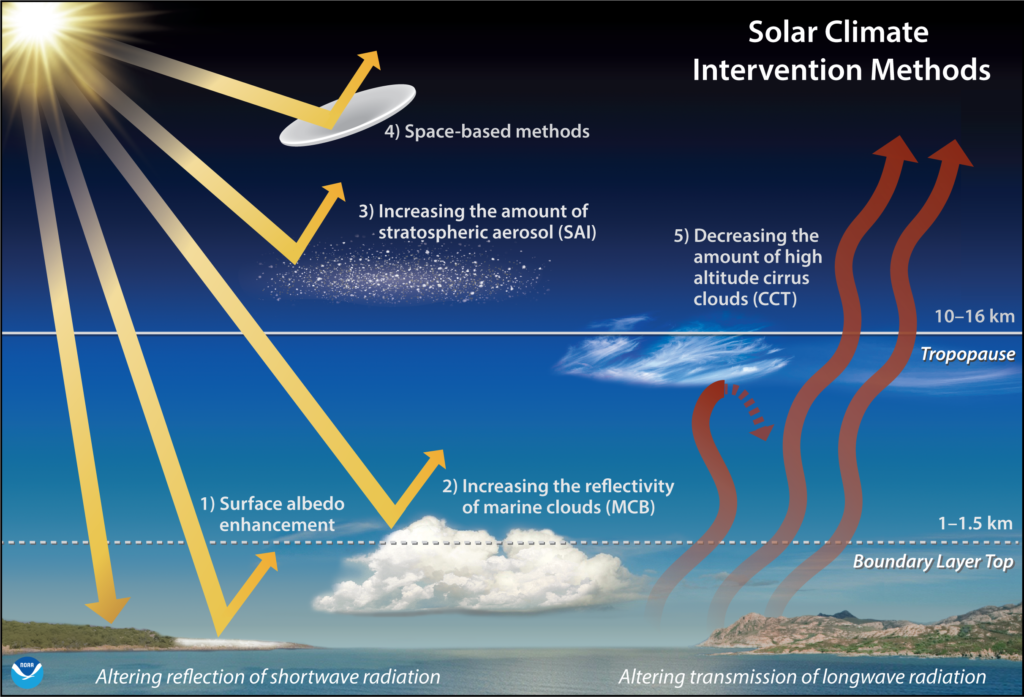
This figure illustrates proposed methods for climate intervention that would affect climate by modifying either incoming or outgoing solar radiation. Image: Chelsea Thompson, NOAA/CIRES

A group of 20 simulations projected the climate-forcing influence of hypothetical sulfate aerosol injections in the stratosphere sufficient to reflect enough sunlight to counter global warming from rising carbon dioxide levels throughout the end of the 21st century.

According to the study, which was published in Atmospheric Chemistry and Physics, the model required enormous inputs of sulfur dioxide to counter the expected warming. As much as 50 million metric tons would need to be continuously injected into the stratosphere every year by the end of the century to obtain zero global-mean temperature change even as carbon dioxide continues to increase.

Lead author Antara Banerjee, a CIRES research scientist working at NOAA’s Chemical Sciences Laboratory, said, “While these sulfate aerosols would largely mitigate the impacts of greenhouse gas-induced climate change, there are unintended side effects in these simulations that we need to understand.”

For example, while the simulations mitigated around two-thirds of expected winter warming trends due to climate change in Eurasia, a robust surface warming of up to 1.5°C, (3°F), every 30 years, still occurred.

According to the study, another side effect identified in the simulations is reduced precipitation in the Mediterranean during winter, when the arid region normally receives most of its annual moisture. This begins mid-century, when the simulated geoengineering effort scales up. However, the loss of winter precipitation is balanced by an increase in summer moisture. The opposite would occur in Scandinavia where they would experience wetter winters and drier summers.
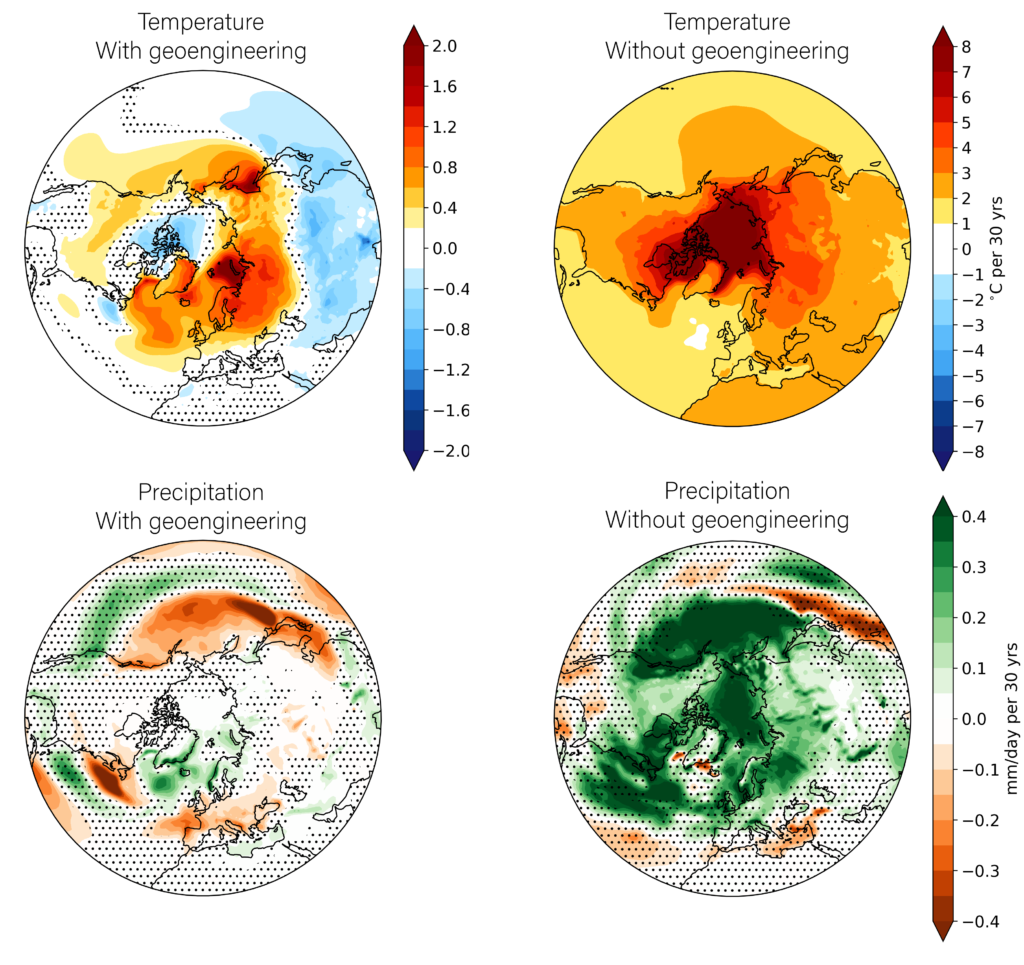
These illustrations depict the simulated change in wintertime trends for temperature and precipitation between 2020 and 2095 under a geoengineering scenario (first column) and without geoengineering (second column). Units are degrees Celsius per 30 years and millimeters of precipitation day per 30 years. Image: Antara Banerjee, NOAA/CIRES.

To read the full study, click here. 

Previous ArticleCREWS early warning initiative releases 2020 report revealing progress made during Covid-19
Next Article Trace gases from oceans are source of particles accelerating Antarctic climate change

Read Similar Stories

Extreme Weather

Researchers investigate links between air pollution, extreme weather and climate

May 1, 20262 Mins Read
Radar

Météo-France begins construction of France’s tallest weather radar tower in Sembadel

April 29, 20262 Mins Read
Climate Measurement

European climate report highlights record heat, glacier loss and rising extremes

April 27, 20263 Mins Read
Latest News

Researchers investigate links between air pollution, extreme weather and climate

May 1, 2026

China expands MAZU early warning system for developing countries

April 30, 2026

Météo-France begins construction of France’s tallest weather radar tower in Sembadel

April 29, 2026

Receive breaking stories and features in your inbox each week, for free


Enter your email address:


Supplier Spotlights
  • Synoptic Data PBC
Getting in Touch
  • Contact Us / Advertise
  • Meet the Editors
  • Media Pack
  • Free Weekly E-Newsletter
Our Social Channels
  • Facebook
  • LinkedIn
© 2026 UKi Media & Events a division of UKIP Media & Events Ltd
  • Cookie Policy
  • Privacy Policy
  • Terms and Conditions
  • Notice and Takedown Policy

Type above and press Enter to search. Press Esc to cancel.