


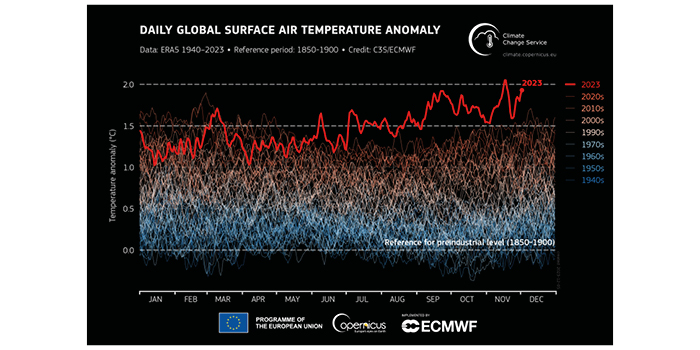
The Copernicus Climate Change Service (C3S) has found that November 2023 was the warmest November on record globally, with an average surface air temperature of 14.22°C, 0.85°C above the 1991-2020 average for November and 0.32°C above the temperature of the previous warmest November, in 2020.
The Copernicus Climate Change Service (C3S), implemented by the European Centre for Medium-Range Weather Forecasts on behalf of the European Commission with funding from the EU, routinely publishes monthly climate bulletins reporting on the changes observed in global surface air and sea temperatures, sea ice cover and hydrological variables. All the reported findings are based on computer-generated analyses and according to the ERA5 data set, using billions of measurements from satellites, ships, aircraft and weather stations around the world.
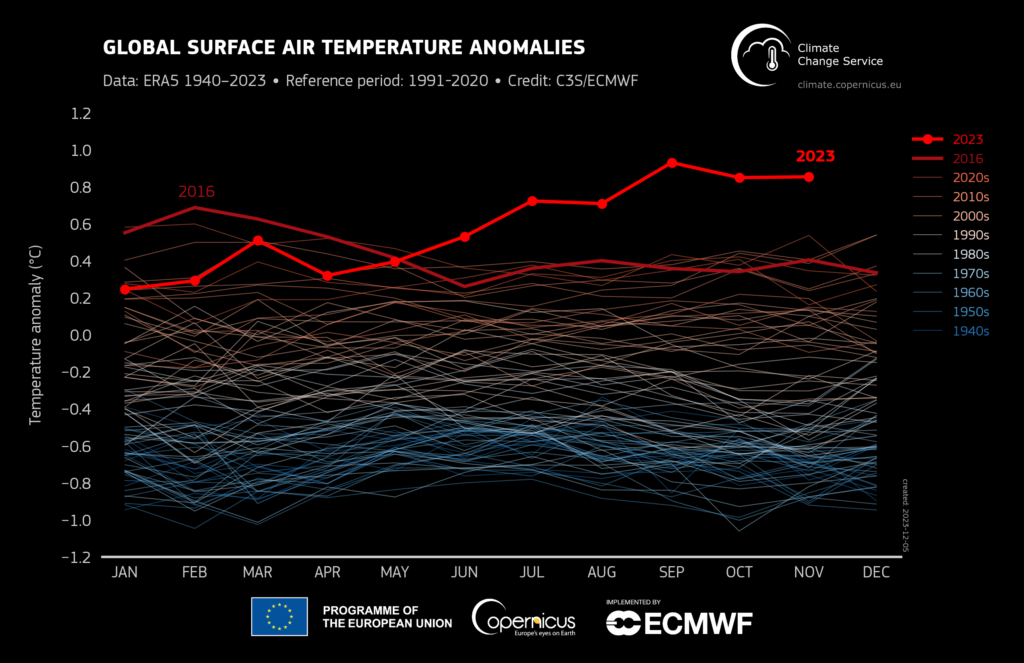
The global temperature anomaly for November 2023 was on a par with October 2023, and only lower than the September 2023 anomaly of 0.93°C. November 2023 was about 1.75°C warmer than an estimate of the November average for 1850-1900, the designated pre-industrial reference period. For the calendar year to date, January to November, the global mean temperature for 2023 is the highest on record, 1.46°C above the 1850-1900 pre-industrial average, and 0.13°C higher than the 11-month average for 2016, currently the warmest calendar year on record.
The report also found that the average sea surface temperature for November 2023 over 60°S–60°N was the highest on record for November at 0.25 °C warmer than the second warmest November, in 2015. The El Niño event continued in the equatorial Pacific, with anomalies remaining lower than those reached at this time of year in the 2015 event.
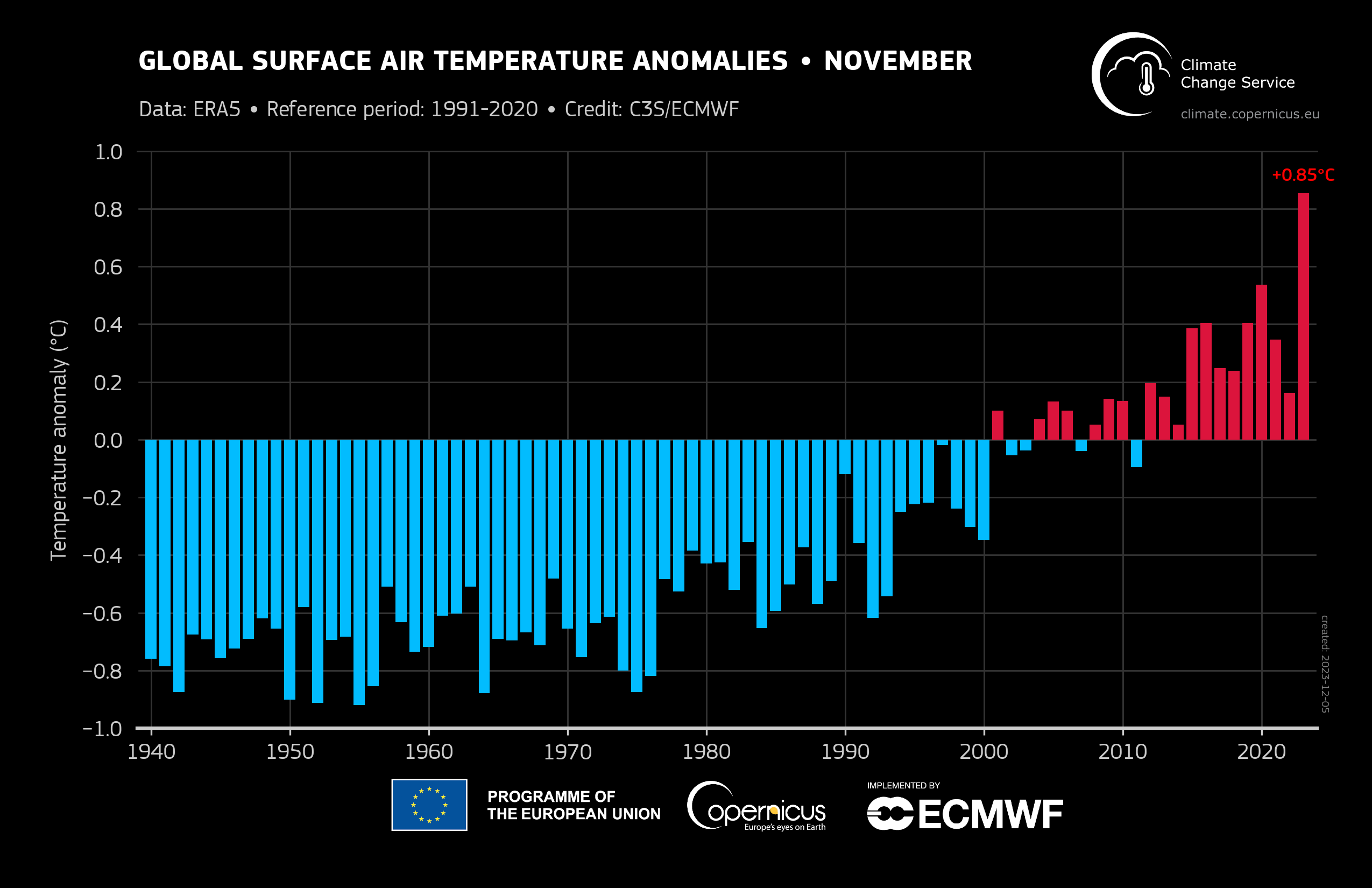 According to the organization, the boreal autumn September–November 2023 was the warmest on record globally by a large margin, with an average temperature of 15.30°C, which is 0.88°C above average. The European average temperature for September–November 2023 was 10.96°C, which is 1.43°C above average. This made the boreal autumn 2023 the second warmest on record, just 0.03°C cooler than autumn 2020.
Samantha Burgess, deputy director of the Copernicus Climate Change Service (C3S), said, “2023 has now had six record-breaking months and two record-breaking seasons. The extraordinary global November temperatures, including two days warmer than 2°C above preindustrial, mean that 2023 is the warmest year in recorded history.”
Carlo Buontempo, director of C3S, added, “As long as greenhouse gas concentrations keep rising we can’t expect different outcomes from those seen this year. The temperature will keep rising and so will the impacts of heatwaves and droughts. Reaching net zero as soon as possible is an effective way to manage our climate risks.”
The researchers also found that the Arctic sea ice extent reached its eighth lowest value for November, at 4% below average, well above the lowest November value recorded in 2016 (13% below average). Antarctic sea ice extent was the second lowest for November, at 9% below average, after reaching record-low values for the time of year by large margins for six consecutive months.
 In November 2023, it was wetter than average across most of Europe – storm Ciarán impacted many regions, including Italy, bringing heavy precipitation and floods. Drier-than-average conditions were established in several regions of the USA, and central and eastern Asia, as well as over most of the extratropical southern hemisphere, being particularly pronounced in South America.
Boreal autumn 2023 saw precipitation above average over a large latitudinal band across Europe, as well as over the UK and Ireland, most of Scandinavia and Türkiye. During the season, several storms triggered widespread rainfall and floods locally. In the period September to November 2023, it was drier than average over much of North America, over central and easternmost Asia as well as over most of Australia, South America and southern Africa. Extratropical wetter-than-average regions included northwest of the Caspian Sea and parts of Russia, easternmost China, southern Brazil, Chile as well as the Horn of Africa.
For more key climate measurement updates from the meteorological technology industry, click here.
This article was originally posted on the ECMWF website, and can be viewed here.
Headline and opening paragraph adapted to suit the Meteorological Technology International website. Content shared under Creative Commons — Attribution 4.0 International — CC BY 4.0