


Meteorological Technology International
  • News
    • A-E
      • Agriculture
      • Automated Weather Stations
      • Aviation
      • Climate Measurement
      • Data
      • Developing Countries
      • Digital Applications
      • Early Warning Systems
      • Extreme Weather
    • G-P
      • Hydrology
      • Lidar
      • Lightning Detection
      • New Appointments
      • Nowcasting
      • Numerical Weather Prediction
      • Polar Weather
    • R-S
      • Radar
      • Rainfall
      • Remote Sensing
      • Renewable Energy
      • Satellites
      • Solar
      • Space Weather
      • Supercomputers
    • T-Z
      • Training
      • Transport
      • Weather Instruments
      • Wind
      • World Meteorological Organization
      • Meteorological Technology World Expo
  • Features
  • Online Magazines
    • January 2026
    • April 2025
    • January 2025
    • September 2024
    • April 2024
    • Archive Issues
    • Subscribe Free!
  • Opinion
  • Videos
  • Supplier Spotlight
  • Expo
LinkedIn Twitter Facebook
  • Sign-up for Free Weekly E-Newsletter
  • Meet the Editors
  • Contact Us
  • Media Pack
LinkedIn Facebook
Subscribe
Meteorological Technology International
  • News
      • Agriculture
      • Automated Weather Stations
      • Aviation
      • Climate Measurement
      • Data
      • Developing Countries
      • Digital Applications
      • Early Warning Systems
      • Extreme Weather
      • Hydrology
      • Lidar
      • Lightning Detection
      • New Appointments
      • Nowcasting
      • Numerical Weather Prediction
      • Polar Weather
      • Radar
      • Rainfall
      • Remote Sensing
      • Renewable Energy
      • Satellites
      • Solar
      • Space Weather
      • Supercomputers
      • Training
      • Transport
      • Weather Instruments
      • Wind
      • World Meteorological Organization
      • Meteorological Technology World Expo
  • Features
  • Online Magazines
    1. January 2026
    2. September 2025
    3. April 2025
    4. January 2025
    5. September 2024
    6. April 2024
    7. January 2024
    8. September 2023
    9. April 2023
    10. Archive Issues
    11. Subscribe Free!
    Featured
    November 27, 2025

    In this Issue – January 2026

    By Hazel KingNovember 27, 2025
    Recent

    In this Issue – January 2026

    November 27, 2025

    In this Issue – September 2025

    August 11, 2025

    In this Issue – April 2025

    April 15, 2025
  • Opinion
  • Videos
  • Supplier Spotlight
  • Expo
Facebook LinkedIn
Subscribe
Meteorological Technology International
Supercomputers

NOAA Research develops AI-powered weather forecast model

Elizabeth BakerBy Elizabeth BakerJuly 29, 20254 Mins Read
Share LinkedIn Facebook Twitter Email
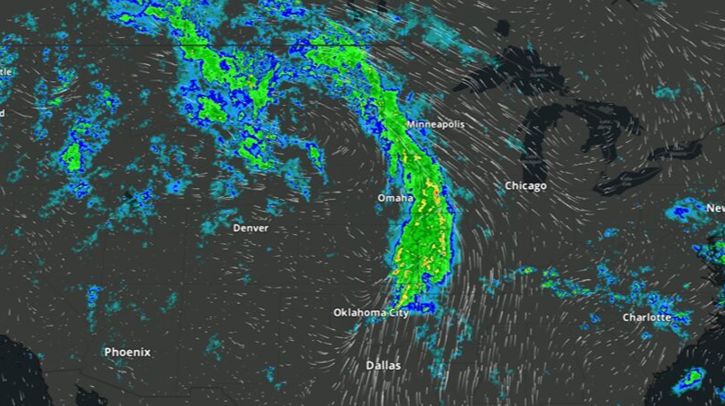
A map showing weather systems in the Rockies, Great Plains and East Coast representing the model output of HRRR-CAST
HRRR-Cast output showing simulated reflectivity and wind particles over the contiguous-U.S. domain for a line of strong thunderstorms that occurred May 6, 2024. This image was created using GSL’s DESI tool. Credit: NOAA/GSL
Share
LinkedIn Facebook Twitter Email

NOAA’s Global Systems Laboratory (GSL) is to release an experimental, AI-powered short-term weather forecast model trained on three years of High Resolution Rapid Refresh (HRRR) short-term weather forecast model data, for testing by NOAA’s National Weather Service (NWS) in August.

Developing the AI-powered model

The model, named HRRR-Cast, is NOAA’s first regional experimental AI forecast system and a key component of NOAA’s broader Project EAGLE, a long-term project to provide NOAA and the US weather enterprise with the ability to rapidly test, develop and identify the most promising AI models for global to regional ensemble forecasting.

“HRRR-Cast has been shared with colleagues in NOAA’s Environmental Modeling Center for evaluation and potential integration into a demonstration forecast system,” said project manager Isidora Jankov, GSL’s scientific computing branch chief. “This represents a significant leap forward in the application of AI to environmental modeling.”

HRRR-Cast emerged from a collaborative effort within NOAA’s Office of Oceanic and Atmospheric Research led by GSL, which created the HRRR model, a widely used short-term operational weather model. GSL scientists recognized that the enormous volume of high-quality data generated by the HRRR would be an ideal training dataset for an AI-powered high-resolution model, and that they could harness AI capabilities to improve the HRRR system.

The HRRR is a real-time, numerical weather prediction model that forecasts weather conditions across the continental USA using a 3km surface grid with 50 vertical elevations. The 3km resolution enables the HRRR to simulate clouds and convective features that are too small to be resolved by the global models running on a traditional 13km grid. The HRRR generates a new 18-hour forecast every hour, and a new 48-hour forecast every six hours. The HRRR directly assimilates weather radar data four times per hour, which significantly enhances its ability to forecast precipitation and hazardous weather events like severe thunderstorms and tornadoes.

The product of grassroots research in NOAA’s Office of Oceanic and Atmospheric Research (OAR), HRRR-Cast was boosted by support from GSL and the NOAA Office of the Chief Information Officer’s Scientific Engineering and Novel Architecture program. Important contributions have come from scientists in NOAA’s Physical Sciences Laboratory and National Severe Storms Laboratory, the cooperative institutes CIRES and CIRA, and OAR’s Weather Program Office. HRRR-Cast’s integration with Project EAGLE will be done in coordination with the Earth Prediction Innovation Center (EPIC).

Outgrowing supercomputers
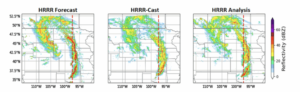
Three panels comparing the skill of the HRRR Forecast and the HRRR-CAST to observations.
This panel displays from left to right, the operational HRRR Composite Reflectivity forecast for a line of thunderstorms sweeping across the central USA, initialized at 2300 UTC on May 6, 2024, followed by experimental HRRR-Cast forecast and the HRRR analysis of radar observations from the event. Credit: NOAA Global Systems Laboratory

As a traditional, physics-driven numerical weather model, the HRRR relies on complex mathematical equations and supercomputers to simulate atmospheric processes and predict future weather conditions. Data-driven models like HRRR-Cast, in contrast, “learn” by analyzing vast amounts of similar, historical weather data to identify patterns which they then use to make predictions. HRRR-Cast is lightweight enough to run on a single laptop, unlike the operational HRRR, which requires a supercomputer.

“By leveraging new, high-resolution observations that help us better understand fine-scale physical processes, physical models can be improved, thereby improving the data on which AI-driven models are trained,” Jankov said. She added that her fellow researchers believe that the future of forecasting lies with a hybrid approach using both physical and data-driven models to take advantage of the gains in computational efficiency that AI techniques provide.

HRRR-Cast was initially conceived of as an emulator, developed with a goal of matching the skill of HRRR. Early evaluations are promising, GSL scientists said. Regarding one challenging variable, reflectivity forecasts, HRRR-Cast performs at least as well as the operational HRRR up to seven hours, with comparable performance up to 48 hours. Initial results show that HRRR-Cast also performs comparably to the operational HRRR in forecasting humidity, temperature and wind, and excels in producing realistic depictions of storm structure.

However, according to the researchers, HRRR-Cast is 100 to 1,000 times more computationally efficient than the operational HRRR, which enables HRRR-Cast to be run without a supercomputer.

The promising early performance of HRRR-Cast serves as a powerful proof of concept, said Curtis Alexander, a weather modeler and acting GSL director. HRRR-Cast will likely be expanded to forecast additional meteorological variables, he said, with an ensemble version of HRRR-Cast expected to be available for testing in August 2025.”

In related news, NOAA’s US$3m experimental Next Generation Fire System (NGFS) recently began undergoing a second evaluation in the Fire Weather Testbed, which is managed by the Global Systems Laboratory in Boulder, Colorado. The follow-up visit is intended to evaluate how to best send NGFS fire detections directly to land management partners across the western USA. Read the full story here

Previous ArticleUniversity of Texas engineer awarded US$740,000 to improve storm predictions with machine learning
Next Article Machine learning method improves extreme weather projections

Read Similar Stories

Extreme Weather

CMCC develops machine-learning model that delivers improved heatwave forecasting accuracy

November 6, 20253 Mins Read
Automated Weather Stations

Vaisala unveils Elements Lite software for real-time, customizable weather insights

October 14, 20252 Mins Read
Supercomputers

Europe’s first exascale computer for weather prediction enters service

September 11, 20253 Mins Read
Latest News

UK to strengthen climate observations and satellite functions with £17m space innovation investment

December 4, 2025

Uncrewed systems prove new method for observing deep ocean currents in real time

December 4, 2025

WMO predicts borderline La Niña conditions

December 4, 2025

Receive breaking stories and features in your inbox each week, for free


Enter your email address:


Supplier Spotlights
  • ROTRONIC AG
Getting in Touch
  • Contact Us / Advertise
  • Meet the Editors
  • Download Media Pack
  • Free Weekly E-Newsletter
Our Social Channels
  • Facebook
  • LinkedIn
© 2025 UKi Media & Events a division of UKIP Media & Events Ltd
  • Cookie Policy
  • Privacy Policy
  • Terms and Conditions
  • Notice and Takedown Policy

Type above and press Enter to search. Press Esc to cancel.

We use cookies on our website to give you the most relevant experience by remembering your preferences and repeat visits. By clicking “Accept”, you consent to the use of ALL the cookies.
Cookie settingsACCEPT
Manage consent

Privacy Overview

This website uses cookies to improve your experience while you navigate through the website. Out of these, the cookies that are categorized as necessary are stored on your browser as they are essential for the working of basic functionalities of the website. We also use third-party cookies that help us analyze and understand how you use this website. These cookies will be stored in your browser only with your consent. You also have the option to opt-out of these cookies. But opting out of some of these cookies may affect your browsing experience.
Necessary
Always Enabled

Necessary cookies are absolutely essential for the website to function properly. These cookies ensure basic functionalities and security features of the website, anonymously.

CookieDurationDescription
cookielawinfo-checbox-analytics11 monthsThis cookie is set by GDPR Cookie Consent plugin. The cookie is used to store the user consent for the cookies in the category "Analytics".
cookielawinfo-checbox-functional11 monthsThe cookie is set by GDPR cookie consent to record the user consent for the cookies in the category "Functional".
cookielawinfo-checbox-others11 monthsThis cookie is set by GDPR Cookie Consent plugin. The cookie is used to store the user consent for the cookies in the category "Other.
cookielawinfo-checkbox-necessary11 monthsThis cookie is set by GDPR Cookie Consent plugin. The cookies is used to store the user consent for the cookies in the category "Necessary".
cookielawinfo-checkbox-performance11 monthsThis cookie is set by GDPR Cookie Consent plugin. The cookie is used to store the user consent for the cookies in the category "Performance".
viewed_cookie_policy11 monthsThe cookie is set by the GDPR Cookie Consent plugin and is used to store whether or not user has consented to the use of cookies. It does not store any personal data.

Functional

Functional cookies help to perform certain functionalities like sharing the content of the website on social media platforms, collect feedbacks, and other third-party features.

Performance

Performance cookies are used to understand and analyze the key performance indexes of the website which helps in delivering a better user experience for the visitors.

Analytics

Analytical cookies are used to understand how visitors interact with the website. These cookies help provide information on metrics the number of visitors, bounce rate, traffic source, etc.

Advertisement

Advertisement cookies are used to provide visitors with relevant ads and marketing campaigns. These cookies track visitors across websites and collect information to provide customized ads.

Others

Other uncategorized cookies are those that are being analyzed and have not been classified into a category as yet.

SAVE & ACCEPT
Powered by