


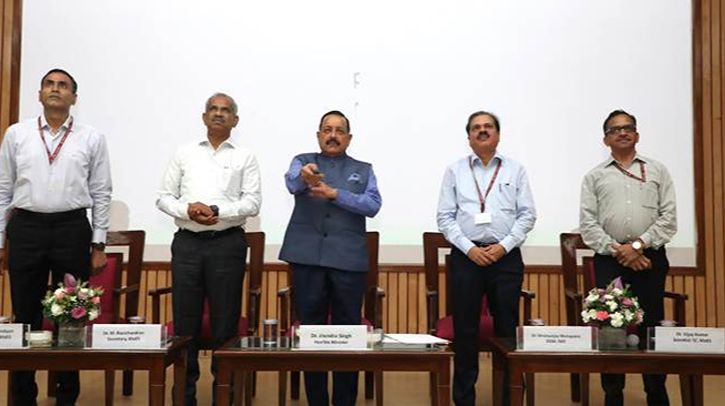
The Indian Ministry of Earth Sciences (MoES) has developed 14 meteorological tools and digital services to build a climate-resilient and scientifically empowered India. Revealed by Union Minister Dr Jitendra Singh, these tools included rainfall monitoring and crop-weather calendars; advanced weather forecasting systems like the Bharat Forecast System – Extended Range Prediction (BharatFS-ERP) tool; high-resolution rainfall datasets; updated wave atlases and seabed charts; air quality forecasting systems; marine biodiversity reports, and seismic microzonation studies of four Indian cities.
Decadal progress report
Marking the 19th foundation day of the ministry at an event held in the national capital, the Indian Meteorological Department’s (IMD) Dr Jitendra Singh noted that the number of Doppler weather radars in the country had increased from 15 to 41 in the last 10 years and that seismic and weather stations, upper-air observation systems, lightning detection networks and rain gauges have all more than doubled.
Dr Jitendra Singh said, “We are now at a stage where even a casual user can access live weather alerts, cyclone warnings, air quality updates, and ocean forecasts on their mobile phones. This is the result of a government that works in mission mode and a ministry that has turned itself into a citizen-service institution. From two to three minutes after an earthquake, we now issue alerts that are instantly accessed by lakhs of people online. Such is the demand that our servers crashed during a recent Delhi tremor due to the rush of users.”
He also praised the IMD’s progress in cyclone forecasting and said that extreme weather alerts now have a lead time of up to 10 days. He recalled how Odisha’s loss of 10,000 lives in the 1999 super cyclone spurred many improvements, with recent storms being managed with minimal casualties thanks to timely alerts. 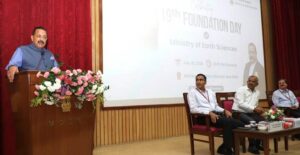
Dr Singh also highlighted how the ministry’s work is supporting sectors like agriculture and fisheries. He said over seven lakh farmers are registered on the ministry’s Meghdoot app, using its advice notifications to plan sowing, irrigation and harvest schedules. Similarly, fishermen across the coast rely on daily SMS updates to determine safe and fuel-efficient fishing zones.
The minister stressed the need to enhance communication and public outreach. “Many people still don’t know about the tools we’ve developed. We must communicate in the language people understand best,” he said, suggesting closer coordination with other ministries and government communication platforms.
Singh also drew attention to India’s efforts in ocean-based sustainability, especially in the Lakshadweep islands, where six ocean thermal energy conversion (OTEC) desalination plants now provide 150,000 liters of potable water daily. “For centuries, these islanders had no fresh water despite being surrounded by the sea. Now they are not only water-sufficient but water-rich,” he said.
A new documentary titled Life Saving Impact, produced by the IMD, was also released at the event.
India’s Deep Ocean Mission
At the 19th Foundation Day, Dr Singh also launched the Deep Ocean Mission initiative, which he called a potential game-changer, stating that India’s unexplored underwater wealth could be a major driver of future economic growth: “Just as we aim to send one Indian into space through Gaganyaan next year, we may soon see Indians diving 6km below sea level with Samudrayaan. One up, one down – that’s the vision.”
The minister also noted that the ministry’s budget had risen from ₹1,281 crore (US$148.1m) in 2014 to ₹3,658 crore (US$422.7m) in 2024, enabling projects and advanced research. He credited this shift to the sustained support of the current government and urged the scientific community to carry this momentum forward.
The Foundation Day saw the participation of MoES secretary Dr M Ravichandran; joint secretary Shri D Senthil Pandiyan; IMD director general Dr Mrutyunjay Mahapatra; program head Dr Vijay Kumar; and guest of honor Prof. Dev Niyogi, UNESCO chair at the University of Texas, who joined virtually.
In related news, India Prime Minister Narendra Modi recently launched the IMD’s Mission Mausam and Vision 2047 document. Mission Mausam aims to develop cutting-edge weather surveillance technologies and systems and implement high-resolution atmospheric observations, next-generation radars and satellites and high-performance computers. Read the full story here