

Close Menu
Meteorological Technology International
  • News
    • A-E
      • Agriculture
      • Automated Weather Stations
      • Aviation
      • Climate Measurement
      • Data
      • Developing Countries
      • Digital Applications
      • Early Warning Systems
      • Extreme Weather
    • G-P
      • Hydrology
      • Lidar
      • Lightning Detection
      • New Appointments
      • Nowcasting
      • Numerical Weather Prediction
      • Polar Weather
    • R-S
      • Radar
      • Rainfall
      • Remote Sensing
      • Renewable Energy
      • Satellites
      • Solar
      • Space Weather
      • Supercomputers
    • T-Z
      • Training
      • Transport
      • Weather Instruments
      • Wind
      • World Meteorological Organization
      • Meteorological Technology World Expo
  • Features
  • Online Magazines
    • January 2026
    • April 2025
    • January 2025
    • September 2024
    • April 2024
    • Archive Issues
    • Subscribe Free!
  • Opinion
  • Videos
  • Supplier Spotlight
  • Expo
LinkedIn X (Twitter) Facebook
  • Sign-up for Free Weekly E-Newsletter
  • Meet the Editors
  • Contact Us
  • Media Pack
LinkedIn Facebook
Subscribe
Meteorological Technology International
  • News
      • Agriculture
      • Automated Weather Stations
      • Aviation
      • Climate Measurement
      • Data
      • Developing Countries
      • Digital Applications
      • Early Warning Systems
      • Extreme Weather
      • Hydrology
      • Lidar
      • Lightning Detection
      • New Appointments
      • Nowcasting
      • Numerical Weather Prediction
      • Polar Weather
      • Radar
      • Rainfall
      • Remote Sensing
      • Renewable Energy
      • Satellites
      • Solar
      • Space Weather
      • Supercomputers
      • Training
      • Transport
      • Weather Instruments
      • Wind
      • World Meteorological Organization
      • Meteorological Technology World Expo
  • Features
  • Online Magazines
    1. January 2026
    2. September 2025
    3. April 2025
    4. January 2025
    5. September 2024
    6. April 2024
    7. January 2024
    8. September 2023
    9. April 2023
    10. Archive Issues
    11. Subscribe Free!
    Featured
    November 27, 2025

    In this Issue – January 2026

    By Hazel KingNovember 27, 2025
    Recent

    In this Issue – January 2026

    November 27, 2025

    In this Issue – September 2025

    August 11, 2025

    In this Issue – April 2025

    April 15, 2025
  • Opinion
  • Videos
  • Supplier Spotlight
  • Expo
Facebook LinkedIn
Subscribe
Meteorological Technology International
Climate Measurement

Polarstern returns to Arctic MOSAiC floe with new fieldwork team

Lawrence ButcherBy Lawrence ButcherJune 19, 20203 Mins Read
Share LinkedIn Facebook Twitter Email
Share
LinkedIn Facebook Twitter Email

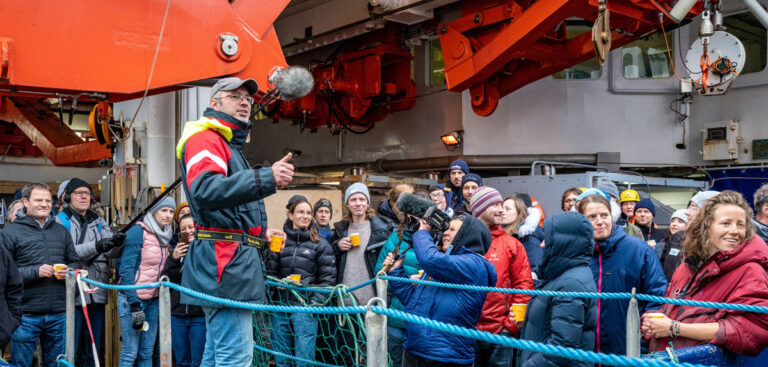
After a month’s absence, on June 17 the German research icebreaker Polarstern rendezvoused with the Arctic MOSAiC floe at 82.2° North and 8.4° East, after having previously left it on May 19, 2020, to exchange personnel and bunker supplies near Svalbard.

The location of Polarstern’s return destination was never in doubt: autonomous monitoring stations transmit positioning data from the drifting floe at regular intervals. During the absence of personnel, the station continued to automatically gather data, such as energy balances (energy transfers between the atmosphere, ice and ocean) and more, ensuring that fundamental parameters could still be monitored while the researchers were away.

Prof. Markus Rex, leader of the MOSAiC expedition, an atmospheric physicist at the Alfred Wegener Institute Helmholtz Centre for Polar and Marine Research (AWI), and a professor at the University of Potsdam in Germany, gave his first impressions of the floe upon returning: “The thickest area of the floe, which we dubbed the fortress, has for the most part weathered the deformations in the spring quite well, and continues to offer a good basis for our research camp.

“We’ll be able to continue working here well into the summer,” he continued. “But, with the extensive summertime melting that has already begun, we’ll need to keep our instruments and installations highly mobile, and be ready to adapt to changing circumstances. Later in the summer, it may be necessary to relocate the camp – it all depends on how the ice conditions develop.”

Navigating and maneuvering the Polarstern to the floe was not the work of a moment, explained Capt. Thomas Wunderlich, responsible for the operation: “What’s most important, just as it was back in the days of the early explorers, is to not just charge in, but to find the ideal position for entering the ice. For the first few days, we made good and rapid progress, thanks to the prevailing winds and good visibility.”

But from 82° North, he said the situation grew “tenser”, the ice dynamic increased and the ice grew thicker. “As a result, on the weekend of June 13/14, the pack ice slowed us to a standstill, forcing us to shut down the engines to conserve fuel,” he continued. “But coming to a dead stop like this also has the advantage of showing you that nothing about this venture is predictable or can be taken for granted – sometimes you just have to accept your circumstances.”

Highlighting the importance of the project, Rex explained, “In the summer that’s just now beginning, we’ll investigate the processes at work in the Arctic climate during the melting season in unprecedented detail.” This work will include looking at ocean eddies, which are produced below the ice by ocean currents, how the thickness and properties of sea ice influence climate processes, the role of snow cover on sea ice, the nature of the interplay between the sea ice as well as atmospheric and cloud studies.

On this final subject, summertime melting has now begun, producing pools on the surface of the sea ice that alter its energy budget. When the ice ultimately breaks, the resultant leads and channels release water vapor and aerosols, which lead to cloud formation in the atmosphere. What the characteristics of these clouds are, and whether they cool or warm the lower atmospheric layers, are some of the other questions that the research team will explore before the Polarstern departs for her homeport in Bremerhaven, where the icebreaker is expected to arrive on October 12.

Previous ArticleUS Air Force extends its rugged weather radar capabilities
Next Article Surface temperatures continue to trend upward

Read Similar Stories

Extreme Weather

Researchers investigate links between air pollution, extreme weather and climate

May 1, 20262 Mins Read
Radar

Météo-France begins construction of France’s tallest weather radar tower in Sembadel

April 29, 20262 Mins Read
Digital Applications

ForecastWatch expands with launch of new independent platform for weather forecast verification

April 28, 20262 Mins Read
Latest News

Researchers investigate links between air pollution, extreme weather and climate

May 1, 2026

China expands MAZU early warning system for developing countries

April 30, 2026

Météo-France begins construction of France’s tallest weather radar tower in Sembadel

April 29, 2026

Receive breaking stories and features in your inbox each week, for free


Enter your email address:


Supplier Spotlights
  • Nel Hydrogen
Getting in Touch
  • Contact Us / Advertise
  • Meet the Editors
  • Media Pack
  • Free Weekly E-Newsletter
Our Social Channels
  • Facebook
  • LinkedIn
© 2026 UKi Media & Events a division of UKIP Media & Events Ltd
  • Cookie Policy
  • Privacy Policy
  • Terms and Conditions
  • Notice and Takedown Policy

Type above and press Enter to search. Press Esc to cancel.