

Close Menu
Meteorological Technology International
  • News
    • A-E
      • Agriculture
      • Automated Weather Stations
      • Aviation
      • Climate Measurement
      • Data
      • Developing Countries
      • Digital Applications
      • Early Warning Systems
      • Extreme Weather
    • G-P
      • Hydrology
      • Lidar
      • Lightning Detection
      • New Appointments
      • Nowcasting
      • Numerical Weather Prediction
      • Polar Weather
    • R-S
      • Radar
      • Rainfall
      • Remote Sensing
      • Renewable Energy
      • Satellites
      • Solar
      • Space Weather
      • Supercomputers
    • T-Z
      • Training
      • Transport
      • Weather Instruments
      • Wind
      • World Meteorological Organization
      • Meteorological Technology World Expo
  • Features
  • Online Magazines
    • January 2026
    • April 2025
    • January 2025
    • September 2024
    • April 2024
    • Archive Issues
    • Subscribe Free!
  • Opinion
  • Videos
  • Supplier Spotlight
  • Expo
LinkedIn X (Twitter) Facebook
  • Sign-up for Free Weekly E-Newsletter
  • Meet the Editors
  • Contact Us
  • Media Pack
LinkedIn Facebook
Subscribe
Meteorological Technology International
  • News
      • Agriculture
      • Automated Weather Stations
      • Aviation
      • Climate Measurement
      • Data
      • Developing Countries
      • Digital Applications
      • Early Warning Systems
      • Extreme Weather
      • Hydrology
      • Lidar
      • Lightning Detection
      • New Appointments
      • Nowcasting
      • Numerical Weather Prediction
      • Polar Weather
      • Radar
      • Rainfall
      • Remote Sensing
      • Renewable Energy
      • Satellites
      • Solar
      • Space Weather
      • Supercomputers
      • Training
      • Transport
      • Weather Instruments
      • Wind
      • World Meteorological Organization
      • Meteorological Technology World Expo
  • Features
  • Online Magazines
    1. January 2026
    2. September 2025
    3. April 2025
    4. January 2025
    5. September 2024
    6. April 2024
    7. January 2024
    8. September 2023
    9. April 2023
    10. Archive Issues
    11. Subscribe Free!
    Featured
    November 27, 2025

    In this Issue – January 2026

    By Hazel KingNovember 27, 2025
    Recent

    In this Issue – January 2026

    November 27, 2025

    In this Issue – September 2025

    August 11, 2025

    In this Issue – April 2025

    April 15, 2025
  • Opinion
  • Videos
  • Supplier Spotlight
  • Expo
Facebook LinkedIn
Subscribe
Meteorological Technology International
Climate Measurement

Space-based measuring system aids measurement of new lightning records

Lawrence ButcherBy Lawrence ButcherJune 26, 20203 Mins Read
Share LinkedIn Facebook Twitter Email
Share
LinkedIn Facebook Twitter Email

A World Meteorological Organization (WMO) committee of experts has established two new world records for the longest reported distance and the longest reported duration for a single lightning flash in, respectively, Brazil and Argentina.

The new records for ‘megaflashes’, which have been verified with new satellite lightning imagery technology, more than double the previous values measured in the USA and France. The findings were published by the American Geophysical Union’s Geophysical Research Letters.

WMO’s Committee on Weather and Climate Extremes, which maintains official records of global, hemispheric and regional extremes found that:

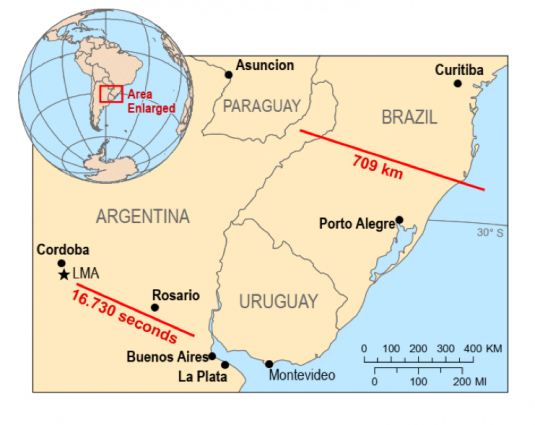
  • The world’s greatest extent for a single lightning flash is a single flash that covered a horizontal distance of 709km (±8km) [440.6 miles (±5 miles)] across parts of southern Brazil on October 31, 2018. This is equivalent to the distance between Boston and Washington DC in the USA or between London and the border of Switzerland near Basel.
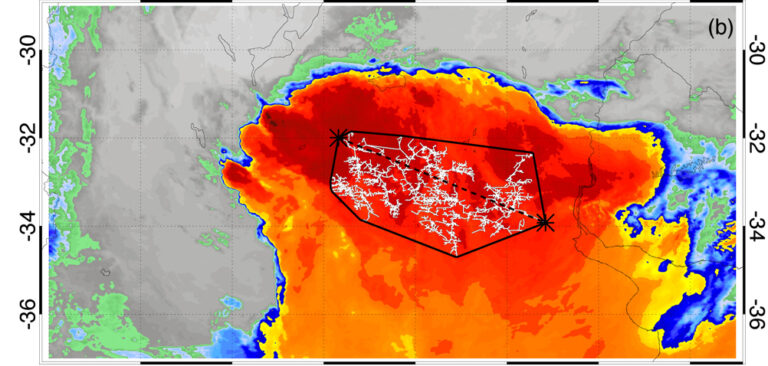
  • The greatest duration for a single lightning flash is 16.73 seconds from a flash that developed continuously over northern Argentina on March 4, 2019.

The previous record for the longest detected distance for a single lightning flash was for 321km (199.5 miles) on June 20, 2007, across the US state of Oklahoma. Both the previous and new record used the same maximum great circle distance methodology to measure flash extent. Meanwhile, the previous record for duration was for a single lightning flash that lasted continuously for 7.74 seconds on August 30, 2012, over Provence-Alpes-Côte d’Azur, France.

The earlier assessments that established the older flash duration and extent records used data collected by ground-based lightning mapping array (LMA) networks. Many lightning scientists acknowledged that there are upper limits for the scale of lightning that could be observed by any existing LMA. Identifying megaflashes beyond these extremes would require a lightning mapping technology with a larger observation domain.

The WMO said that recent advances in space-based lightning mapping offer the ability to measure flash extent and duration continuously over broad geospatial domains. These new instruments include the Geostationary Lightning Mappers (GLMs) on the R-series Geostationary Operational Environmental Satellites (GOES-16 and 17) that recorded the new lightning records, and their orbiting counterparts from Europe (the Meteosat Third Generation [MTG] Lightning Imager) and China (FY-4 Lightning Mapping Imager).

With these new space-based resources, the WMO noted that near-global coverage of total lightning (both intracloud flashes and cloud-to-ground flashes) is facilitated. This includes the Americas hotspots for Mesoscale Convective System (MCS) thunderstorms whose dynamics permit extraordinary megaflashes to occur – namely, the Great Plains in North America, and the La Plata basin in South America.
Previous ArticleWMO investigating record Arctic temperature reading
Next Article New meteorological e-learning from WMO

Read Similar Stories

Extreme Weather

Researchers investigate links between air pollution, extreme weather and climate

May 1, 20262 Mins Read
Early Warning Systems

China expands MAZU early warning system for developing countries

April 30, 20262 Mins Read
Radar

Météo-France begins construction of France’s tallest weather radar tower in Sembadel

April 29, 20262 Mins Read
Latest News

Researchers investigate links between air pollution, extreme weather and climate

May 1, 2026

China expands MAZU early warning system for developing countries

April 30, 2026

Météo-France begins construction of France’s tallest weather radar tower in Sembadel

April 29, 2026

Receive breaking stories and features in your inbox each week, for free


Enter your email address:


Supplier Spotlights
  • Reuniwatt
Getting in Touch
  • Contact Us / Advertise
  • Meet the Editors
  • Media Pack
  • Free Weekly E-Newsletter
Our Social Channels
  • Facebook
  • LinkedIn
© 2026 UKi Media & Events a division of UKIP Media & Events Ltd
  • Cookie Policy
  • Privacy Policy
  • Terms and Conditions
  • Notice and Takedown Policy

Type above and press Enter to search. Press Esc to cancel.