

Close Menu
Meteorological Technology International
  • News
    • A-E
      • Agriculture
      • Automated Weather Stations
      • Aviation
      • Climate Measurement
      • Data
      • Developing Countries
      • Digital Applications
      • Early Warning Systems
      • Extreme Weather
    • G-P
      • Hydrology
      • Lidar
      • Lightning Detection
      • New Appointments
      • Nowcasting
      • Numerical Weather Prediction
      • Polar Weather
    • R-S
      • Radar
      • Rainfall
      • Remote Sensing
      • Renewable Energy
      • Satellites
      • Solar
      • Space Weather
      • Supercomputers
    • T-Z
      • Training
      • Transport
      • Weather Instruments
      • Wind
      • World Meteorological Organization
      • Meteorological Technology World Expo
  • Features
  • Online Magazines
    • January 2026
    • April 2025
    • January 2025
    • September 2024
    • April 2024
    • Archive Issues
    • Subscribe Free!
  • Opinion
  • Videos
  • Supplier Spotlight
  • Expo
LinkedIn X (Twitter) Facebook
  • Sign-up for Free Weekly E-Newsletter
  • Meet the Editors
  • Contact Us
  • Media Pack
LinkedIn Facebook
Subscribe
Meteorological Technology International
  • News
      • Agriculture
      • Automated Weather Stations
      • Aviation
      • Climate Measurement
      • Data
      • Developing Countries
      • Digital Applications
      • Early Warning Systems
      • Extreme Weather
      • Hydrology
      • Lidar
      • Lightning Detection
      • New Appointments
      • Nowcasting
      • Numerical Weather Prediction
      • Polar Weather
      • Radar
      • Rainfall
      • Remote Sensing
      • Renewable Energy
      • Satellites
      • Solar
      • Space Weather
      • Supercomputers
      • Training
      • Transport
      • Weather Instruments
      • Wind
      • World Meteorological Organization
      • Meteorological Technology World Expo
  • Features
  • Online Magazines
    1. January 2026
    2. September 2025
    3. April 2025
    4. January 2025
    5. September 2024
    6. April 2024
    7. January 2024
    8. September 2023
    9. April 2023
    10. Archive Issues
    11. Subscribe Free!
    Featured
    November 27, 2025

    In this Issue – January 2026

    By Hazel KingNovember 27, 2025
    Recent

    In this Issue – January 2026

    November 27, 2025

    In this Issue – September 2025

    August 11, 2025

    In this Issue – April 2025

    April 15, 2025
  • Opinion
  • Videos
  • Supplier Spotlight
  • Expo
Facebook LinkedIn
Subscribe
Meteorological Technology International
Climate Measurement

WMO investigating record Arctic temperature reading

Lawrence ButcherBy Lawrence ButcherJune 24, 20202 Mins Read
Share LinkedIn Facebook Twitter Email
Share
LinkedIn Facebook Twitter Email

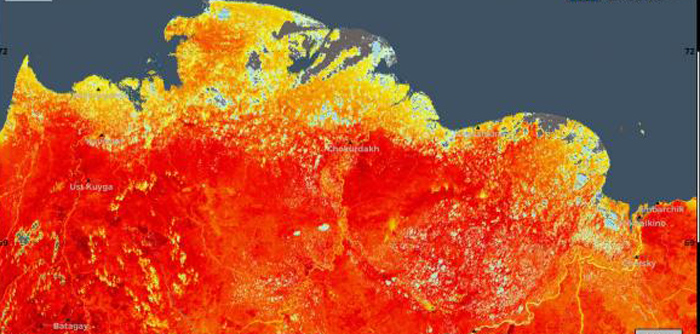
The World Meteorological Organization reported that it is seeking to verify a new record temperature north of the Arctic Circle of 38°C. This was recorded on June 20 in the Russian town of Verkhoyansk, against the setting of a prolonged Siberian heatwave and increase in wildfire activity.

The WMO noted that Verkhoyansk, located in the northern part of Republic of Sakha (Yakutia), is in a region of Eastern Siberia which has an extreme very harsh dry continental climate (very cold winter and hot summer).

The Verkhoyansk meteorological station had a previous air temperature record of 37.3°C observed on July 25, 1988, according to scientists German Alekseenkov and Vasily Smolyanitsky at the Arctic and Antarctic Research Institute of the Russian Federal Service for Hydrometeorological and Environmental Monitoring (Roshydromet). The station has provided daily measurements since 1885.

The WMO noted that final information on whether this record maximum is for the whole area of the Arctic northward of the Polar Circle needs to be assessed when more complete weather data is available. Once it receives confirmation of the temperature from Roshydromet, it will then refer the finding for verification by a team of investigators for its Weather and Climate Extremes Archive.

Until now, the WMO has not verified potential records for “highest temperature recorded north of Arctic Circle”. However, this extreme observation has garnered enough interest that it is currently studying the creation of such a new category for the official archive, according to prof. Randall Cerveny, WMO’s special rapporteur on weather and climate extremes and president’s professor of geographical sciences, Arizona State University.

“A WMO fast-response evaluation team has given tentative acceptance of this observation as a legitimate observation, which is consistent with current upper air observations at the time in Siberia,” explained Cerveny.

“This will now be subject to a normal process for a detailed formal review by a panel of WMO atmospheric scientists. It has been an unusually hot spring in Siberia, and the coinciding lack of underlying snow in the region combined with overall global temperature increases undoubtedly helped play a critical role in causing this extreme temperature observation.”

As part of the verification process, WMO is contacting the Russian meteorological agency to collect direct information on the observation such as the actual data, the type of equipment used, the quality-checks and calibration of the instrument, the observation monitoring techniques and the correspondence to surrounding stations, etc.

Previous ArticleSurface temperatures continue to trend upward
Next Article Space-based measuring system aids measurement of new lightning records

Read Similar Stories

Extreme Weather

Researchers investigate links between air pollution, extreme weather and climate

May 1, 20262 Mins Read
Early Warning Systems

China expands MAZU early warning system for developing countries

April 30, 20262 Mins Read
Radar

Météo-France begins construction of France’s tallest weather radar tower in Sembadel

April 29, 20262 Mins Read
Latest News

Researchers investigate links between air pollution, extreme weather and climate

May 1, 2026

China expands MAZU early warning system for developing countries

April 30, 2026

Météo-France begins construction of France’s tallest weather radar tower in Sembadel

April 29, 2026

Receive breaking stories and features in your inbox each week, for free


Enter your email address:


Supplier Spotlights
  • EUMETSAT
Getting in Touch
  • Contact Us / Advertise
  • Meet the Editors
  • Media Pack
  • Free Weekly E-Newsletter
Our Social Channels
  • Facebook
  • LinkedIn
© 2026 UKi Media & Events a division of UKIP Media & Events Ltd
  • Cookie Policy
  • Privacy Policy
  • Terms and Conditions
  • Notice and Takedown Policy

Type above and press Enter to search. Press Esc to cancel.