


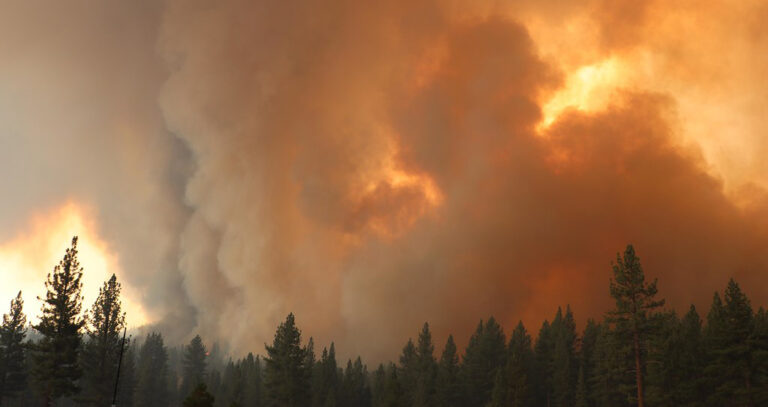
According to an experimental prediction method developed by scientists at the National Center for Atmospheric Research (NCAR), the USA’s western wildfire season in the summer of 2022 is likely to be more severe than average but not as devastating as 2021’s near-record.
The method analyzes precipitation, temperatures, drought and other climate conditions in the winter and spring to predict the extent of wildfires across the western USA during the following summer. The research team developed the method by applying machine learning techniques to observations of every wildfire season since 1984 when current satellite measurements of fires first became available.
Ronnie Abolafia-Rosenzweig, NCAR scientist and lead author of the study, and his co-authors describe the prediction method in a new study in Environmental Research Letters. The work was supported by the NOAA MAPP program as well as the US National Science Foundation, which is NCAR’s sponsor. Though the study has been peer-reviewed, the scientists emphasized that their prediction is currently for research purposes only. However, they said their method, once further tested and improved, could help provide guidance to firefighting agencies in the future. It provides more explicit information than current seasonal forecasts that may call for a comparatively mild or destructive wildfire season without predicting how many acres are likely to burn.
Abolafia-Rosenzweig said, “What our research shows is that the climate of the preceding winter and spring can explain over 50% of the year-to-year variability and overall trend in summer fire activity. This gives us the ability to predict fire activity before the summer fire season begins. This information can be extremely useful to firefighting agencies as they allocate resources and prepare for the upcoming fire season.”
The scientists turned to ensembles of generalized additive statistical models, which are widely used machine learning tools that help reveal complex relationships — in this case, the correspondence between climate conditions from November to May and the extent of burned areas during the following June to September. They analyzed every year since 1984, focusing on regions in the West that are reliant on snowpack for water.
The research team found that the dryness of air (vapor pressure deficit) in the lowest part of the atmosphere during winter and spring has a particularly pronounced effect on summertime fires. That dryness influences the amount of snow that falls and, in turn, is affected by snow on the ground that eventually releases moisture to the overlying air. The extent of April snowpack is especially significant because it moistens both the ground and air as it melts during the warmer months. The scientists also studied a number of additional climate variables, including precipitation, temperature, soil moisture, evapotranspiration and indexes of drought, examining how each variable during different seasons influences the extent of summer fires.
They concluded that winter and spring climate conditions can be used to predict up to 53% of the year-to-year variability in summer burned areas. When summertime climate conditions such as precipitation and the dryness of the air are also factored in, the explained variability increases to 69%. The study also looked at the overall impact of climate change on fire activity in the West. As wildfires have gradually grown in size since 1984, the research team’s modeling showed that climate variables such as rising temperatures and persistent droughts can explain 83% of that increase.
This year’s experimental prediction — which encompasses the entire West, not just snow-reliant regions — indicates that fires will burn 38% more of western lands this summer than the average since 1984. The prediction does not include early-season fires before June, such as the widespread blazes that have devastated New Mexico this spring, nor does it estimate how various western regions will fare. In the future, however, the scientists may add such details.
“Our plan is to include local climate variables such as winds so we can know the specific fire conditions on a state or even county level,” said NCAR scientist Cenlin He, a co-author of the study. “This will make it more valuable to stakeholders and fire managers so they can anticipate fire activity for specific regions in the West.”
Applying their research method to the upcoming fire season, the scientists predicted that fires this summer will burn 1,900,000 acres to 5,300,000 acres in the West, with 3,800,000 acres being the most likely total. Although well short of the record 8,700,000 acres burned in 2020, this would represent the eighth largest burned area since 1984, part of a long-term trend of more widespread conflagrations.