

Close Menu
Meteorological Technology International
  • News
    • A-E
      • Agriculture
      • Automated Weather Stations
      • Aviation
      • Climate Measurement
      • Data
      • Developing Countries
      • Digital Applications
      • Early Warning Systems
      • Extreme Weather
    • G-P
      • Hydrology
      • Lidar
      • Lightning Detection
      • New Appointments
      • Nowcasting
      • Numerical Weather Prediction
      • Polar Weather
    • R-S
      • Radar
      • Rainfall
      • Remote Sensing
      • Renewable Energy
      • Satellites
      • Solar
      • Space Weather
      • Supercomputers
    • T-Z
      • Training
      • Transport
      • Weather Instruments
      • Wind
      • World Meteorological Organization
      • Meteorological Technology World Expo
  • Features
  • Online Magazines
    • January 2026
    • April 2025
    • January 2025
    • September 2024
    • April 2024
    • Archive Issues
    • Subscribe Free!
  • Opinion
  • Videos
  • Supplier Spotlight
  • Expo
LinkedIn X (Twitter) Facebook
  • Sign-up for Free Weekly E-Newsletter
  • Meet the Editors
  • Contact Us
  • Media Pack
LinkedIn Facebook
Subscribe
Meteorological Technology International
  • News
      • Agriculture
      • Automated Weather Stations
      • Aviation
      • Climate Measurement
      • Data
      • Developing Countries
      • Digital Applications
      • Early Warning Systems
      • Extreme Weather
      • Hydrology
      • Lidar
      • Lightning Detection
      • New Appointments
      • Nowcasting
      • Numerical Weather Prediction
      • Polar Weather
      • Radar
      • Rainfall
      • Remote Sensing
      • Renewable Energy
      • Satellites
      • Solar
      • Space Weather
      • Supercomputers
      • Training
      • Transport
      • Weather Instruments
      • Wind
      • World Meteorological Organization
      • Meteorological Technology World Expo
  • Features
  • Online Magazines
    1. January 2026
    2. September 2025
    3. April 2025
    4. January 2025
    5. September 2024
    6. April 2024
    7. January 2024
    8. September 2023
    9. April 2023
    10. Archive Issues
    11. Subscribe Free!
    Featured
    November 27, 2025

    In this Issue – January 2026

    By Hazel KingNovember 27, 2025
    Recent

    In this Issue – January 2026

    November 27, 2025

    In this Issue – September 2025

    August 11, 2025

    In this Issue – April 2025

    April 15, 2025
  • Opinion
  • Videos
  • Supplier Spotlight
  • Expo
Facebook LinkedIn
Subscribe
Meteorological Technology International
Data

Radar and lidar data improve weather forecasts

James MuirBy James MuirFebruary 4, 20203 Mins Read
Share LinkedIn Facebook Twitter Email
Share
LinkedIn Facebook Twitter Email

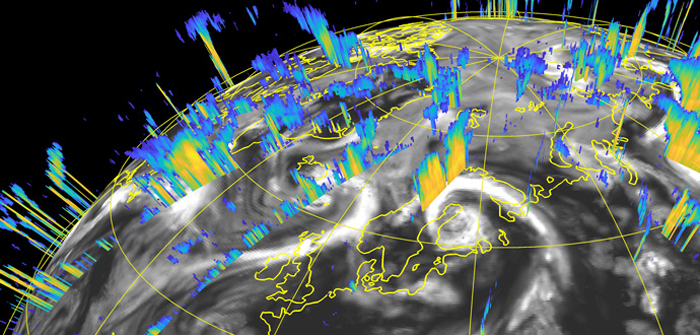
Scientists from the European Centre for Medium-Range Weather Forecasts (ECMWF) have demonstrated that cloud radar and lidar data in operational global numerical weather prediction improves forecasts.

The research by Marta Janiskova and Martin Fielding is being demonstrated at the joint NWP SAF/ECMWF/JCSDA workshop on assimilating satellite cloud and precipitation observations, taking place at the center from February 3 to 6.

Janiskova said: “There were doubts whether assimilating 3-D cloud profile data covering a very narrow band along the satellite’s path would even be possible. That is why we are extremely pleased to see that our tests show signs of improvement in forecasts even before extensive tuning has taken place.”

Data assimilation is the process of combining Earth system observations with model information to produce the best possible estimate of the current state of Earth. The estimate, called the analysis, is used as the starting point for forecasts.

One of the main difficulties in satellite data assimilation is that the instruments used do not directly measure the quantities predicted by forecasting systems.

Cloud radar and lidar equipment are an example of this, beaming radio waves and laser light down into the atmosphere and measuring the radar reflectivity and lidar backscatter. The radar signal penetrates clouds and its reflection can provide profile information.

The lidar signal quickly weakens inside clouds so the backscatter mainly provides information on cloud top height. To be able to compare such data with model data, the latter need to be transformed into simulated satellite data using an ‘observation operator’.

Developing and optimizing the observation operator for cloud radar and lidar was a major part of the preparatory work.

Fielding commented: “One of the greatest challenges was to accurately estimate observation operator errors as well as representativeness errors. For example, how representative is the satellite data given their small footprint?”

The work complements existing ECMWF work to better exploit observations of clouds and precipitation in the ‘all-sky’ system.

Janiskova commented: “Radar and lidar are active instruments that measure vertical profiles. There was little previous work to go by because most satellite instruments do not measure such profiles.”

Fielding and Janiskova say their work is not finished, as the test results were obtained using a previous version of ECMWF’s Integrated Forecasting System IFS Cycle 43r1.

The next step will be to transfer the code they developed to the current version, IFS Cycle 46r1.

*This is an edited version of a longer article published on the ECMWF website on February 3.

Previous ArticleSSTL and NOC monitor polar sea ice with GNSS signals
Next Article Chinese meteorologists track coronavirus

Read Similar Stories

Data

Atmospheric G2 secures Japan weather forecasting license

April 21, 20262 Mins Read
Climate Measurement

China completes Antarctic meteorological research mission with Xuelong icebreaker

April 21, 20262 Mins Read
Radar

EWR Radar Systems wins US Air Force contract for portable Doppler radar support

April 20, 20262 Mins Read
Latest News

Extreme heat posing significant risks to ecosystems and agriculture, FAO-WMO report warns

April 22, 2026

Atmospheric G2 secures Japan weather forecasting license

April 21, 2026

China completes Antarctic meteorological research mission with Xuelong icebreaker

April 21, 2026

Receive breaking stories and features in your inbox each week, for free


Enter your email address:


Supplier Spotlights
  • Meteomatics AG
Getting in Touch
  • Contact Us / Advertise
  • Meet the Editors
  • Media Pack
  • Free Weekly E-Newsletter
Our Social Channels
  • Facebook
  • LinkedIn
© 2026 UKi Media & Events a division of UKIP Media & Events Ltd
  • Cookie Policy
  • Privacy Policy
  • Terms and Conditions
  • Notice and Takedown Policy

Type above and press Enter to search. Press Esc to cancel.