


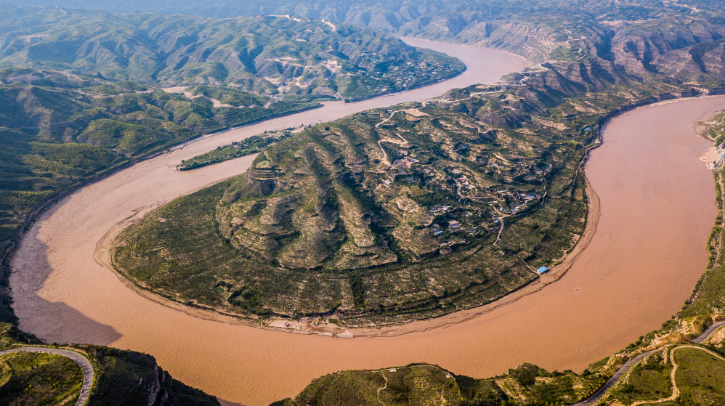
A study, published in Engineering, has presented an integrated model that evaluates flood risks to people’s lives and property in the Lower Yellow River (LYR) under various floodplain management modes. The paper, named Modelling of Flood Risks to People’s Life and Property in the Lower Yellow River Under Different Floodplain Management Modes, was authored by Yifei Cheng, Junqiang Xia, Hongwei Fang, Meirong Zhou, Zuhao Zhou, Jun Lu, Dongyang Li, Roger A Falconer and Yuchuan Bai.
Key modules
The integrated model developed by the research team consists of two modules. The 2D morphodynamic module uses modified hydrodynamic governing equations to account for sediment-laden flows and bed deformation. It is solved using the finite volume method on unstructured meshes.
The flood risk evaluation module calculates the hazard degrees of people, buildings and crops on the floodplains. For example, the flood hazard degree of people is calculated based on an improved formula considering body buoyancy and flow velocity, while that of buildings and crops is determined through mechanical analysis and field surveys.
The model was validated using two real-world flood events in the LYR – the 2004 hyperconcentrated flood and the 2003 dike-breach-induced flood. In the 2004 flood simulation, the model showed good accuracy in predicting sediment concentration, with a maximum underestimation of 9%. The 2003 dike-breach flood simulation also matched well with the field record in terms of inundation depth.
The researchers then applied the model to assess flood risks under three common floodplain management modes: the original mode (Scheme I), the construction of protection embankment mode (Scheme II) and the floodplain partition harnessing mode (Scheme III). They identified the vulnerable reach between Jiahetan (JHT) and Gaocun (GC) under a 1,000-year return period extreme flood.
Accurate flood risk assessment
The results indicate that under Scheme I, most of the floodplains would be in medium and heavy inundation degrees. Scheme II alleviates the inundation extent, with more areas in slight inundation. Scheme III leads to most areas being in medium inundation. The high-risk area for people’s lives and property reduces by 21%–49% under Scheme II and 35%–93% under Scheme III compared with Scheme I.
This study is expected to provide a valuable tool for flood risk assessment in the LYR. Although it doesn’t consider all socio-economic factors like infrastructure support and exact costs, it offers a starting point for further research and decision-making in floodplain management.
In related news, a team of researchers from Rice University, the University of Texas at Austin and Texas A&M University recently received a National Science Foundation (NSF) grant for their proposed work to develop and introduce a stakeholder-centered framework to reform flood management for rural Texas communities. Click here to read the full story.