


Close Menu
Meteorological Technology International
  • News
    • A-E
      • Agriculture
      • Automated Weather Stations
      • Aviation
      • Climate Measurement
      • Data
      • Developing Countries
      • Digital Applications
      • Early Warning Systems
      • Extreme Weather
    • G-P
      • Hydrology
      • Lidar
      • Lightning Detection
      • New Appointments
      • Nowcasting
      • Numerical Weather Prediction
      • Polar Weather
    • R-S
      • Radar
      • Rainfall
      • Remote Sensing
      • Renewable Energy
      • Satellites
      • Solar
      • Space Weather
      • Supercomputers
    • T-Z
      • Training
      • Transport
      • Weather Instruments
      • Wind
      • World Meteorological Organization
      • Meteorological Technology World Expo
  • Features
  • Online Magazines
    • January 2026
    • April 2025
    • January 2025
    • September 2024
    • April 2024
    • Archive Issues
    • Subscribe Free!
  • Opinion
  • Videos
  • Supplier Spotlight
  • Expo
LinkedIn X (Twitter) Facebook
  • Sign-up for Free Weekly E-Newsletter
  • Meet the Editors
  • Contact Us
  • Media Pack
LinkedIn Facebook
Subscribe
Meteorological Technology International
  • News
      • Agriculture
      • Automated Weather Stations
      • Aviation
      • Climate Measurement
      • Data
      • Developing Countries
      • Digital Applications
      • Early Warning Systems
      • Extreme Weather
      • Hydrology
      • Lidar
      • Lightning Detection
      • New Appointments
      • Nowcasting
      • Numerical Weather Prediction
      • Polar Weather
      • Radar
      • Rainfall
      • Remote Sensing
      • Renewable Energy
      • Satellites
      • Solar
      • Space Weather
      • Supercomputers
      • Training
      • Transport
      • Weather Instruments
      • Wind
      • World Meteorological Organization
      • Meteorological Technology World Expo
  • Features
  • Online Magazines
    1. January 2026
    2. September 2025
    3. April 2025
    4. January 2025
    5. September 2024
    6. April 2024
    7. January 2024
    8. September 2023
    9. April 2023
    10. Archive Issues
    11. Subscribe Free!
    Featured
    November 27, 2025

    In this Issue – January 2026

    By Hazel KingNovember 27, 2025
    Recent

    In this Issue – January 2026

    November 27, 2025

    In this Issue – September 2025

    August 11, 2025

    In this Issue – April 2025

    April 15, 2025
  • Opinion
  • Videos
  • Supplier Spotlight
  • Expo
Facebook LinkedIn
Subscribe
Meteorological Technology International
Digital Applications

Penn State uses AI to improve computational efficiency in weather models

Helen NormanBy Helen NormanSeptember 5, 20193 Mins Read
Share LinkedIn Facebook Twitter Email
Share
LinkedIn Facebook Twitter Email

Researchers at Penn State University, Pennsylvania, are using artificial intelligence to pinpoint areas susceptible to swift-changing weather conditions, helping meteorologists to produce more accurate forecasts without wasting computational power.

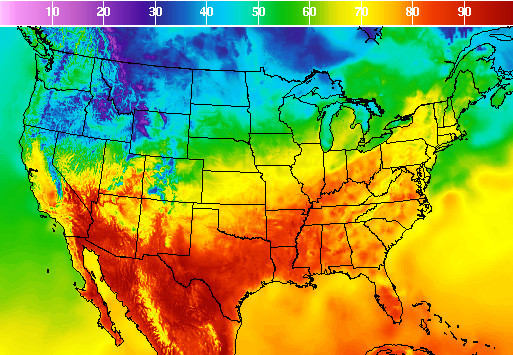
In a study, the researchers used an AI model based on natural selection to find areas of the continental USA where temperature changes are harder to predict and variable, so that computational resources can be focused there, rather than places were the weather is less apt to change. The resulting temperature prediction algorithm was equal to or better than the current model, but used less computational power.

Guido Cervone, professor of geography, meteorology and atmospheric science, Penn State, said, “Our methodology helps focus the available computational resources toward areas that are harder to predict, which in turn should help generate better short-term forecasts. Numerical weather prediction is one of the most computationally demanding problems, and its use for society is far reaching.”

Weiming Hu, a doctoral student in geography, said that the current weather maps are divided up into a simple mesh of about 200,000 grid points in the USA. When weather forecasters use computers to analyze weather patterns in those areas, the computational power is spread equally among those grid points, which each represent about 11km (7 miles) in diameter. They do not take into consideration topography, elevation, the proximity of water, and a myriad of other factors that can disrupt weather patterns, making certain areas much more difficult to predict.

“If you think about Iowa, let’s say, it rarely experiences huge changes in the weather regimes across dozens of kilometers, compared to some other places, because the topography is relatively simple and you can use some very easy interpolation – or estimates – to give you some good ideas about, in this case, what the temperature will be in the future,” said Hu. “But, in the Rocky Mountains, you can go from the plains to the peak of a mountain in just a few kilometers and that changes things dramatically when you’re trying to predict weather regimes. What we want to address is how can we figure out what are the more important or more interesting areas where we need either to have a higher resolution or a more accurate weather prediction for that specific region.”

The researchers, who published their findings in the Journal of Computers & Geosciences, used genetic algorithms to help create a more flexible mesh to focus computational analysis on grids with complex, rapidly changing weather patterns. The mesh in other areas of the country, where the weather is steadier, can be expanded.

“Genetic algorithms do not guarantee the best solution, but they do guarantee finding better solutions faster,” said Hu. “In a case like predicting temperature changes, you might not care about finding the ultimate solution because it might be the difference between 29.56°C degrees and 29.55°C. That’s probably not going to matter for the regular person.”

While the researchers’ study looked specifically at temperature change, Hu said that in the future the model could be tested on other weather conditions, such as precipitation and cloud cover.

To read the original story on Penn State News, click here.

Previous ArticleNOAA Ronald H Brown’s eight-month voyage
Next Article NOAA invests more than US$40m in hurricane tracking Gulfstream G550

Read Similar Stories

Extreme Weather

AI model improves real-time prediction of wildfire spread

April 16, 20263 Mins Read
Climate Measurement

New tool speeds up climate model evaluation

April 13, 20262 Mins Read
Data

NASA tests high-resolution weather model for launch operations

April 7, 20262 Mins Read
Latest News

WMO signals increasing likelihood of El Niño developing in 2026

April 24, 2026

Alabama partners with Climavision to expand weather radar coverage statewide

April 24, 2026

Extreme heat posing significant risks to ecosystems and agriculture, FAO-WMO report warns

April 22, 2026

Receive breaking stories and features in your inbox each week, for free


Enter your email address:


Supplier Spotlights
  • Adolf Thies GmbH & Co. KG
Getting in Touch
  • Contact Us / Advertise
  • Meet the Editors
  • Media Pack
  • Free Weekly E-Newsletter
Our Social Channels
  • Facebook
  • LinkedIn
© 2026 UKi Media & Events a division of UKIP Media & Events Ltd
  • Cookie Policy
  • Privacy Policy
  • Terms and Conditions
  • Notice and Takedown Policy

Type above and press Enter to search. Press Esc to cancel.