


Close Menu
Meteorological Technology International
  • News
    • A-E
      • Agriculture
      • Automated Weather Stations
      • Aviation
      • Climate Measurement
      • Data
      • Developing Countries
      • Digital Applications
      • Early Warning Systems
      • Extreme Weather
    • G-P
      • Hydrology
      • Lidar
      • Lightning Detection
      • New Appointments
      • Nowcasting
      • Numerical Weather Prediction
      • Polar Weather
    • R-S
      • Radar
      • Rainfall
      • Remote Sensing
      • Renewable Energy
      • Satellites
      • Solar
      • Space Weather
      • Supercomputers
    • T-Z
      • Training
      • Transport
      • Weather Instruments
      • Wind
      • World Meteorological Organization
      • Meteorological Technology World Expo
  • Features
  • Online Magazines
    • January 2026
    • April 2025
    • January 2025
    • September 2024
    • April 2024
    • Archive Issues
    • Subscribe Free!
  • Opinion
  • Videos
  • Supplier Spotlight
  • Expo
LinkedIn X (Twitter) Facebook
  • Sign-up for Free Weekly E-Newsletter
  • Meet the Editors
  • Contact Us
  • Media Pack
LinkedIn Facebook
Subscribe
Meteorological Technology International
  • News
      • Agriculture
      • Automated Weather Stations
      • Aviation
      • Climate Measurement
      • Data
      • Developing Countries
      • Digital Applications
      • Early Warning Systems
      • Extreme Weather
      • Hydrology
      • Lidar
      • Lightning Detection
      • New Appointments
      • Nowcasting
      • Numerical Weather Prediction
      • Polar Weather
      • Radar
      • Rainfall
      • Remote Sensing
      • Renewable Energy
      • Satellites
      • Solar
      • Space Weather
      • Supercomputers
      • Training
      • Transport
      • Weather Instruments
      • Wind
      • World Meteorological Organization
      • Meteorological Technology World Expo
  • Features
  • Online Magazines
    1. January 2026
    2. September 2025
    3. April 2025
    4. January 2025
    5. September 2024
    6. April 2024
    7. January 2024
    8. September 2023
    9. April 2023
    10. Archive Issues
    11. Subscribe Free!
    Featured
    November 27, 2025

    In this Issue – January 2026

    By Hazel KingNovember 27, 2025
    Recent

    In this Issue – January 2026

    November 27, 2025

    In this Issue – September 2025

    August 11, 2025

    In this Issue – April 2025

    April 15, 2025
  • Opinion
  • Videos
  • Supplier Spotlight
  • Expo
Facebook LinkedIn
Subscribe
Meteorological Technology International
Lightning Detection

Record eclipsed for longest distance covered by a single lightning flash

Dan SymondsBy Dan SymondsFebruary 1, 20223 Mins Read
Share LinkedIn Facebook Twitter Email
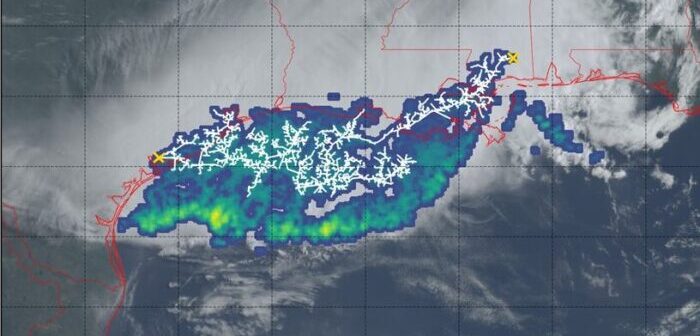
GOES 16 satellite image of record extent of lightning flash over the southern United States on 29 April 2020 - credit: WMO
Share
LinkedIn Facebook Twitter Email

The World Meteorological Organization (WMO) has established two new world records for lightning megaflashes, occurring in notorious hotspots in North and South America.

Aided by the latest satellite technology, WMO’s Committee on Weather and Climate Extremes (CWCE), which maintains official records of global, hemispheric and regional extremes, recognized the longest single flash that covered a horizontal distance of 768km (± 8km) (477 miles) across parts of the southern USA on April 29, 2020.

The new record is 60km more than the previous record of 709km (± 8km) (440.6 miles) across parts of southern Brazil on October 31, 2018. Both the previous and new record used the same maximum great circle distance methodology to measure flash extent.

A new record has also been set for the greatest duration for a single lightning flash at 17.102 (± 0.002) seconds from a flash that developed continuously through a thunderstorm over Uruguay and northern Argentina on June 18, 2020.

The longest duration megaflash had a previous duration of 16.73 seconds which was derived from a flash that developed continuously over northern Argentina on March 4, 2019, 0.37 seconds shorter than the new record.

The findings were published in the Bulletin of the American Meteorological Society.

Professor Randall Cerveny, rapporteur of weather and climate extremes for WMO, said, “These are extraordinary records from single lightning flash events. Environmental extremes are living measurements of the power of nature, as well as scientific progress in being able to make such assessments. It is likely that even greater extremes still exist, and that we will be able to observe them as lightning detection technology improves.”

Professor Petteri Taalas, WMO secretary-general, said, “Lightning is a major hazard that claims many lives every year. The findings highlight important public lightning safety concerns for electrified clouds where flashes can travel extremely large distances.”

The new record strikes occurred in hotspots for Mesoscale Convective System (MCS) thunderstorms, whose dynamics permit extraordinary megaflashes to occur – namely, the Great Plains in North America, and the La Plata basin in South America.

Recent advances in space-based lightning mapping offer the ability to measure flash extent and duration continuously over broad geospatial domains. These new instruments include the Geostationary Lightning Mappers (GLMs) on the R-series Geostationary Operational Environmental Satellites (GOES-16 and 17) that recorded the new lighting records, and their orbiting counterparts from Europe (the Meteosat Third Generation (MTG) Lightning Imager) and China (FY-4 Lightning Mapping Imager).

Michael J Peterson, lead author and CWCE evaluation member from the Space and Remote Sensing Group (ISR-2) of Los Alamos National Laboratory, said, “Lightning is a surprisingly elusive and complex natural phenomenon for the impact that it has on our daily lives. We are now at a place where we have excellent measurements of its many facets, which allow us to discover surprising new aspects of its behavior. Now that we have a robust record of these monster flashes, we can begin to understand how they occur and appreciate the disproportionate impact that they have. There is still a lot that we do not know about these monsters, but as an early career scientist, it is a privilege to stand among my colleagues at the forefront of this new and exciting area of research and to push the boundaries of our understanding of what lightning is capable of.”

Previous ArticleStudy improves understanding of intense winter rains in Southern California
Next Article NASA launches second deployment of Atlantic coast snowstorm study

Read Similar Stories

Data

Atmospheric G2 secures Japan weather forecasting license

April 21, 20262 Mins Read
Climate Measurement

China completes Antarctic meteorological research mission with Xuelong icebreaker

April 21, 20262 Mins Read
Space Weather

Northumbria University secures £4m to study Earth’s radiation belts

April 16, 20262 Mins Read
Latest News

Extreme heat posing significant risks to ecosystems and agriculture, FAO-WMO report warns

April 22, 2026

Atmospheric G2 secures Japan weather forecasting license

April 21, 2026

China completes Antarctic meteorological research mission with Xuelong icebreaker

April 21, 2026

Receive breaking stories and features in your inbox each week, for free


Enter your email address:


Supplier Spotlights
  • AIRMAR Technology Corporation
Getting in Touch
  • Contact Us / Advertise
  • Meet the Editors
  • Media Pack
  • Free Weekly E-Newsletter
Our Social Channels
  • Facebook
  • LinkedIn
© 2026 UKi Media & Events a division of UKIP Media & Events Ltd
  • Cookie Policy
  • Privacy Policy
  • Terms and Conditions
  • Notice and Takedown Policy

Type above and press Enter to search. Press Esc to cancel.