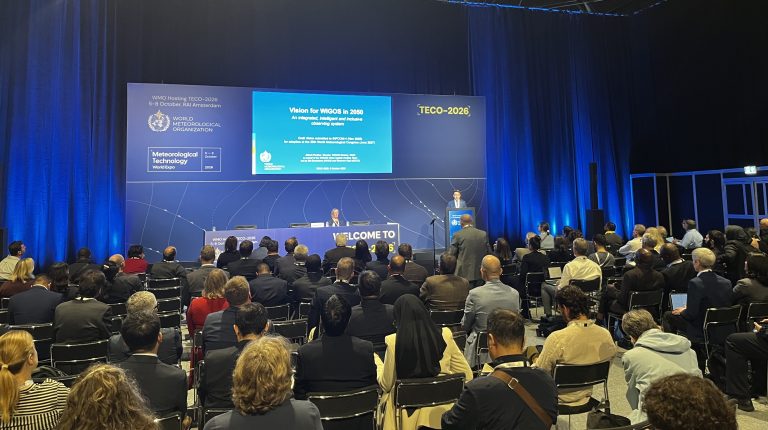
Albert Fischer presented the World Meteorological Organization (WMO) Integrated Global Observing System (WIGOS) 2050 Vision in a session at WMO TECO-2026, held at Meteorological Technology World Expo 2026 in Amsterdam this week.
The vision is a 25-year scenario of how user requirements for observational data will evolve. It outlines a roadmap, described as technically and economically feasible, for an integrated observing system supporting all WMO activities across weather, climate and water.
Fischer is the director of WMO’s WIGOS branch. His presentation identified persistent gaps in coverage and measurement depth across geographic regions, operational domains and vertical profiles, and he pointed out that essential networks need sustained operations, maintenance and targeted investment.
He also noted that contributions now come from public, commercial, academic and community providers, with more miniaturized instruments and autonomous platforms. AI, automation and digital platforms are changing how observations are processed and used. Adding data sources brings varying uncertainty, differing formats and distinct stewardship arrangements.
“More data does not automatically mean more confidence,” Fischer said. The presentation’s takeaway was that trust needs evidence and sustained capability.
Earth-based observations are organized into four network types. Reference networks provide standard-setting, high-accuracy, traceable benchmarks for calibration and long-term measurement quality. Backbone networks provide sustained observations for core services. Pathfinding complementarity networks test innovations and establish a path into operational use. Opportunistic and emerging networks, such as citizen science and IoT sensors, broaden coverage but require characterization of fitness for purpose.
For the space-based component, the vision describes a coordinated, multiprovider framework covering Earth observation and space weather. It has three implementation tiers: a specified backbone with a fixed orbital configuration and defined measurement approaches; a flexible backbone with an open orbital configuration; and pathfinder and technology demonstrator missions for new sensors and platforms.
The presentation also set out a measurement-to-impact value chain: measurement, availability, integration and use. Fischer said the primary bottlenecks occur across delivery, interoperability and uptake.
He outlined directives for three groups. National meteorological and hydrological services should identify priority gaps and sustain reference and backbone networks. Instrument manufacturers should characterize measurement uncertainty, demonstrate traceability and interoperability, and design for maintainability. Service providers should deliver timely, usable products with transparent quality information.
Fischer said the three main takeaways were the need to design observing systems to work together across space, Earth, domains and public and private providers; to sustain the trusted foundation while enabling innovation; and to judge innovation by whether it delivers better services and decisions.
Meteorological Technology World Expo continues on Wednesday and Thursday, October 7 & 8. Click here to register for your free expo pass