

Close Menu
Meteorological Technology International
  • News
    • A-E
      • Agriculture
      • Automated Weather Stations
      • Aviation
      • Climate Measurement
      • Data
      • Developing Countries
      • Digital Applications
      • Early Warning Systems
      • Extreme Weather
    • G-P
      • Hydrology
      • Lidar
      • Lightning Detection
      • New Appointments
      • Nowcasting
      • Numerical Weather Prediction
      • Polar Weather
    • R-S
      • Radar
      • Rainfall
      • Remote Sensing
      • Renewable Energy
      • Satellites
      • Solar
      • Space Weather
      • Supercomputers
    • T-Z
      • Training
      • Transport
      • Weather Instruments
      • Wind
      • World Meteorological Organization
      • Meteorological Technology World Expo
  • Features
  • Online Magazines
    • January 2026
    • April 2025
    • January 2025
    • September 2024
    • April 2024
    • Archive Issues
    • Subscribe Free!
  • Opinion
  • Videos
  • Supplier Spotlight
  • Expo
LinkedIn X (Twitter) Facebook
  • Sign-up for Free Weekly E-Newsletter
  • Meet the Editors
  • Contact Us
  • Media Pack
LinkedIn Facebook
Subscribe
Meteorological Technology International
  • News
      • Agriculture
      • Automated Weather Stations
      • Aviation
      • Climate Measurement
      • Data
      • Developing Countries
      • Digital Applications
      • Early Warning Systems
      • Extreme Weather
      • Hydrology
      • Lidar
      • Lightning Detection
      • New Appointments
      • Nowcasting
      • Numerical Weather Prediction
      • Polar Weather
      • Radar
      • Rainfall
      • Remote Sensing
      • Renewable Energy
      • Satellites
      • Solar
      • Space Weather
      • Supercomputers
      • Training
      • Transport
      • Weather Instruments
      • Wind
      • World Meteorological Organization
      • Meteorological Technology World Expo
  • Features
  • Online Magazines
    1. January 2026
    2. September 2025
    3. April 2025
    4. January 2025
    5. September 2024
    6. April 2024
    7. January 2024
    8. September 2023
    9. April 2023
    10. Archive Issues
    11. Subscribe Free!
    Featured
    November 27, 2025

    In this Issue – January 2026

    By Hazel KingNovember 27, 2025
    Recent

    In this Issue – January 2026

    November 27, 2025

    In this Issue – September 2025

    August 11, 2025

    In this Issue – April 2025

    April 15, 2025
  • Opinion
  • Videos
  • Supplier Spotlight
  • Expo
Facebook LinkedIn
Subscribe
Meteorological Technology International
Climate Measurement

NRL measures Arctic with Acoustic Buoys

James MuirBy James MuirFebruary 21, 20202 Mins Read
Share LinkedIn Facebook Twitter Email
Share
LinkedIn Facebook Twitter Email

Scientists at the US Naval Research Laboratory (NRL) have developed Acoustic Buoys to monitor the changing environment in the Arctic.

The buoys provide oceanographic data to improve prediction capabilities of ocean and climate models. They validated sound propagation theories from Arctic researchers and will continue to guide theoretical studies in the Beaufort Sea from March 2020 to March 2021.

Altan Turgut, research physicist at the NRL, said, “Our job, in real time, does the tomography in the ocean with buoys. Every four hours they assimilate data into the ocean models.”

Ocean acoustic tomography uses soundwaves to image sections of ocean temperature and current. The buoys provide real-time monitoring and operational capability, and enable under-ice acoustic communication and navigation capability for mobile platforms such as ocean gliders and underwater autonomous vehicle.

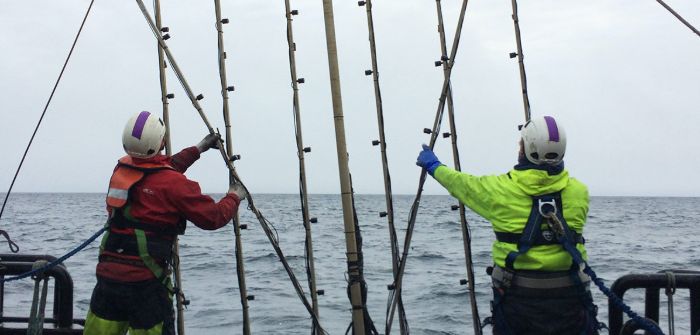
The buoys were deployed in the Beaufort and Chukchi seas on the shores of Alaska with two source moorings transmitting mid-frequency signals every four hours for 40 minutes and one Billboard Array recording acoustic data during the year-long experiment.

The Billboard Array is equipped with 64 receiver elements lying in a 7 x 4m vertical plane.

Turgut said, “Results from CANAPE (Canadian Basin Acoustic Prorogation Experiment) showed favorable sound transmissions are possible within a cold and fresher water layer at 100m to 200m depths. The sounds were bounded by warm Pacific summer water from above and warm Atlantic water from below.”

Scientific evidence indicates that sea ice has declined 13% in the summer and 3% in the winter per decade.

Turgut said, “Interaction between the ocean and atmosphere is increasing and becoming similar to those at lower latitudes with more open ocean and fragile thin ice conditions. Therefore, acoustic measurements of new ice composition and near-surface hydrography would be essential for accurate ocean and climate model predictions in the Arctic.”

Previous ArticleVocus doubles Bureau of Meteorology contract
Next Article Shetland satellites receive US$2.6m boost

Read Similar Stories

Climate Measurement

China completes Antarctic meteorological research mission with Xuelong icebreaker

April 21, 20262 Mins Read
Extreme Weather

AI model improves real-time prediction of wildfire spread

April 16, 20263 Mins Read
Climate Measurement

Study identifies atmospheric trigger behind flash droughts in Puerto Rico

April 15, 20263 Mins Read
Latest News

Extreme heat posing significant risks to ecosystems and agriculture, FAO-WMO report warns

April 22, 2026

Atmospheric G2 secures Japan weather forecasting license

April 21, 2026

China completes Antarctic meteorological research mission with Xuelong icebreaker

April 21, 2026

Receive breaking stories and features in your inbox each week, for free


Enter your email address:


Supplier Spotlights
  • Reuniwatt
Getting in Touch
  • Contact Us / Advertise
  • Meet the Editors
  • Media Pack
  • Free Weekly E-Newsletter
Our Social Channels
  • Facebook
  • LinkedIn
© 2026 UKi Media & Events a division of UKIP Media & Events Ltd
  • Cookie Policy
  • Privacy Policy
  • Terms and Conditions
  • Notice and Takedown Policy

Type above and press Enter to search. Press Esc to cancel.