


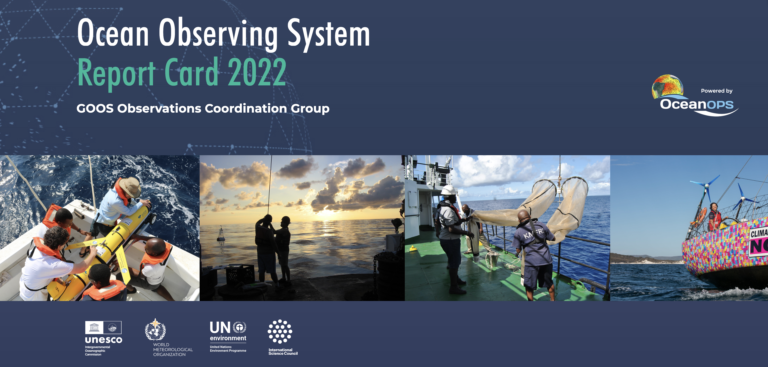
The WMO has released the latest Ocean Observing System Report Card – an annual report providing insight into the state, capacity and value of the Global Ocean Observing System (GOOS).
The report card is prepared in collaboration with the Intergovernmental Oceanographic Commission of UNESCO (IOC-UNESCO) and other GOOS partners and experts, and produced by GOOS’s OceanOPS operational center.
The report card focuses on how an integrated observing network adds value to society across three delivery areas of climate, operational services and ocean health. It highlights physical, biogeochemical and, for the first time, biological observations, providing a global view of the state of ocean observations and identifying progress, key challenges and opportunities to enhance the system.
The 2022 report card includes several key areas:
- Global view of the state of the Global Ocean Observing System
- Monitoring ocean carbon uptake to allow more accurate climate model projections
- Advancing coastal inundation forecasts and early warnings
- Phytoplankton observations – vital for understanding changes in food webs and shifts in marine life
- Involvement of new communities through the GOOS Ocean Decade programs
- State-of-the-ocean observing network
GOOS stakeholders said that despite the long-term impacts of the pandemic and the unforeseen market changes leading to increased costs to implement and maintain the observing network, most activities were slowly returning to normal, and automation is supporting increased data delivery. However, a few regions and networks remain affected, and GOOS is catalyzing discussions to address these needs.
David Legler, chair of the GOOS Observations Coordination Group, said, “Continued and new targeted investment in ocean observing is vital to ensure we characterize how our ocean is changing, what changes are likely in the future, and how we can mitigate and adapt to our changing Earth system.”
Vladimir Ryabinin, IOC executive secretary, said, “I hope the ocean observing system will be able to recover from the pandemic, withstand the inflation and keep delivering new bioecological and biogeochemical data, observations in the polar ocean, with the full output of the Argo network. International cooperation is the cornerstone of that capacity and IOC, capitalizing on the opportunities offered by the UN Ocean Decade and the 2022 UN Ocean Conference, stands ready to facilitate continuous efforts around ocean observing.”
Ocean carbon monitoring
In the past 20 years, GOOS has developed the capability to observe some aspects of the global ocean carbon, and the number of surface and ocean interior carbon observations is growing. However, according to Mathieu Belbéoch, OceanOPS manager, the carbon network is still immature and only 5% of the platforms at sea carry biogeochemical sensors, including carbon dioxide sensors.
Lars Peter Riishojgaard, director of the WMO Integrated Global Observing System (WIGOS), added, “To help improve our understanding of the carbon cycle, reduce uncertainties about greenhouse gas sources and sinks, thus supporting Paris Agreement mitigation action, WMO is seeking to establish a Global Greenhouse Gas Monitoring System, strengthening the international observing infrastructure and related modeling and assimilation efforts.”
Forecasting and early warnings
Recently, several wave buoys were deployed on the south coast of Fiji to enhance forecasts and warnings of coastal inundation. Jone Usamate, the Fiji Minister for Infrastructure, Disaster Management, Land and Mineral Resources and Meteorological Services declared that work done by the Fiji Meteorological Service had enabled better planning and sound decisions before and during the advent of severe tropical cyclone Harold in April 2020.
According to the report card, “GOOS in situ and satellite observations are essential contributions to advance weather and flood warnings for coastal zones and communities, which are increasingly at risk from rising sea levels and more frequent and intense storm surges.”
To view the complete Ocean Observing System Report Card, click here.