


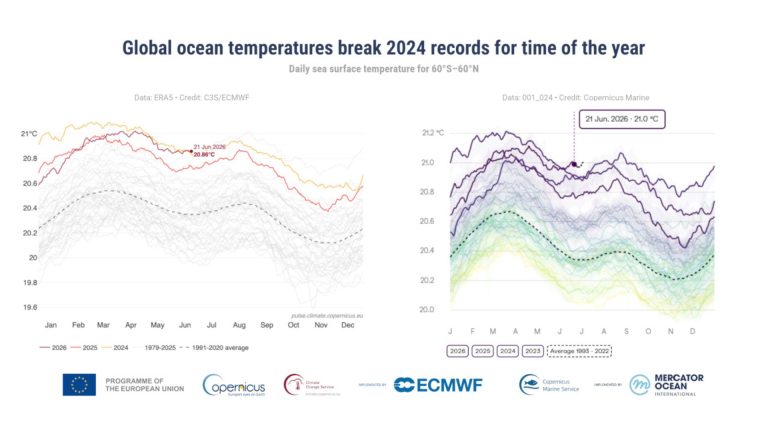
The Copernicus Climate Change Service (C3S) and the Copernicus Marine Service (CMEMS) have confirmed that global sea surface temperatures (SST) have exceeded the record levels for the time of year that were observed in 2023 and 2024.
C3S daily SST data exceeded 2024 levels on June 21, reaching 20.86ºC, marginally above the 20.83ºC recorded in 2023 and 2024. Copernicus Marine daily SST data also showed a record for June 21, reaching 21.0°C, beating the previous 2023-24 records by 0.1°C.
The new record was expected following the onset of El Niño conditions in the Equatorial Pacific, announced by the World Meteorological Organization (WMO) on June 2, 2026, alongside unusually high SST observed in several ocean regions in recent months. Over the past three years, the global ocean outside the polar regions (60°N to 60°S) has been between 0.35ºC and 0.73ºC warmer than the long-term average, with June anomalies now reaching record-high levels for the time of year.
Carlo Buontempo, C3S director at ECMWF, said, “Current conditions could indicate the beginning of a new phase, leading, once more, to uncharted territory. With ocean temperatures at these levels and El Niño on the horizon, we are likely to see more temperature records fall in the coming months. That Copernicus Marine data reaches the same conclusion through independent methods speaks to the strength of European science – and to why open, robust data matters now more than ever.”
Pierre-Yves Le Traon, scientific director of the Copernicus Marine Service at Mercator Ocean International, said, “Continuous monitoring of the ocean by the Copernicus Marine Service helps public authorities, scientists and decision‑makers understand how the ocean is changing and supports policies to protect the marine environment. One of the key strengths of the EU Copernicus program is the close cooperation between the Copernicus Climate Change Service and the Copernicus Marine Service.”
The record was observed independently in both the C3S ERA5 reanalysis, produced by ECMWF, and the Copernicus Marine GLO12 dataset, produced by Mercator Ocean International. ERA5’s SST data can be monitored via the Climate Pulse application, and GLO12’s via the MyOceanHealth platform.
Copernicus scientists said they are continuing to monitor whether the exceedance is temporary or persistent, but noted that with forecasts pointing to a likely strong El Niño, further records are anticipated in both ocean and surface atmosphere temperatures in the coming months.
Related news, Copernicus report finds European air quality improving despite pollution episodes