


Close Menu
Meteorological Technology International
  • News
    • A-E
      • Agriculture
      • Automated Weather Stations
      • Aviation
      • Climate Measurement
      • Data
      • Developing Countries
      • Digital Applications
      • Early Warning Systems
      • Extreme Weather
    • G-P
      • Hydrology
      • Lidar
      • Lightning Detection
      • New Appointments
      • Nowcasting
      • Numerical Weather Prediction
      • Polar Weather
    • R-S
      • Radar
      • Rainfall
      • Remote Sensing
      • Renewable Energy
      • Satellites
      • Solar
      • Space Weather
      • Supercomputers
    • T-Z
      • Training
      • Transport
      • Weather Instruments
      • Wind
      • World Meteorological Organization
      • Meteorological Technology World Expo
  • Features
  • Online Magazines
    • January 2026
    • April 2025
    • January 2025
    • September 2024
    • April 2024
    • Archive Issues
    • Subscribe Free!
  • Opinion
  • Videos
  • Supplier Spotlight
  • Expo
LinkedIn X (Twitter) Facebook
  • Sign-up for Free Weekly E-Newsletter
  • Meet the Editors
  • Contact Us
  • Media Pack
LinkedIn Facebook
Subscribe
Meteorological Technology International
  • News
      • Agriculture
      • Automated Weather Stations
      • Aviation
      • Climate Measurement
      • Data
      • Developing Countries
      • Digital Applications
      • Early Warning Systems
      • Extreme Weather
      • Hydrology
      • Lidar
      • Lightning Detection
      • New Appointments
      • Nowcasting
      • Numerical Weather Prediction
      • Polar Weather
      • Radar
      • Rainfall
      • Remote Sensing
      • Renewable Energy
      • Satellites
      • Solar
      • Space Weather
      • Supercomputers
      • Training
      • Transport
      • Weather Instruments
      • Wind
      • World Meteorological Organization
      • Meteorological Technology World Expo
  • Features
  • Online Magazines
    1. January 2026
    2. September 2025
    3. April 2025
    4. January 2025
    5. September 2024
    6. April 2024
    7. January 2024
    8. September 2023
    9. April 2023
    10. Archive Issues
    11. Subscribe Free!
    Featured
    November 27, 2025

    In this Issue – January 2026

    By Hazel KingNovember 27, 2025
    Recent

    In this Issue – January 2026

    November 27, 2025

    In this Issue – September 2025

    August 11, 2025

    In this Issue – April 2025

    April 15, 2025
  • Opinion
  • Videos
  • Supplier Spotlight
  • Expo
Facebook LinkedIn
Subscribe
Meteorological Technology International
News

APPLICATE project to have lasting effects on polar forecasting, notes ECMWF

Helen NormanBy Helen NormanAugust 3, 20213 Mins Read
Share LinkedIn Facebook Twitter Email
Image: Gonzalo Solari/iStock/Getty Images Plus
Share
LinkedIn Facebook Twitter Email

ECMWF’s participation in the EU’s Horizon 2020 project APPLICATE has led to a concerted effort to examine the challenges that limit the skill of ECMWF forecasts in Arctic regions.

To improve weather forecasts in the Arctic and beyond, advances have been made at ECMWF in the areas of coupled modelling, process-based diagnostics, and the effective use of observations and data assimilation.

APPLICATE (Advanced Prediction in Polar regions and beyond: modelling, observing system design and LInkages associated with a Changing Arctic climaTE) is a €8m (US$9.5m) project, financed by EU Horizon  2020 Research and Innovation program and involves 16 partners from nine countries in Europe. APPLICATE was coordinated by Professor Thomas Jung from the Alfred Wegener Institute in Germany. The four-year project ended in April 2021.

In terms of coupled modelling, the APPLICATE focus at ECMWF was on the representation of snow and the coupling of the atmosphere, the ocean, snow and sea ice. One of the main sources of forecast errors over snow-covered surfaces is the use of a bulk snow scheme in the current version of ECMWF’s Integrated Forecasting System (IFS).

Representing the snowpack with a single layer of snow leads to an overestimation of the thermal inertia of the snowpack, particularly for deep snowpacks. As a result, the snow depth tends to be too large, the near-surface air temperature too high, and its diurnal cycle is underestimated.

To address these errors, a multi-layer snow scheme was developed and evaluated in APPLICATE using supersite observations and novel process-based diagnostics. This scheme represents the snowpack with up to five layers. It is planned to be implemented in IFS Cycle 48r1 in 2022/23.
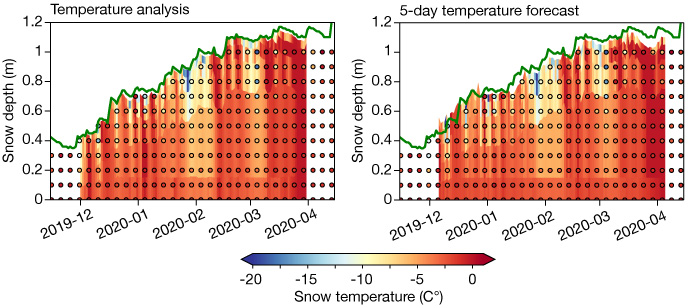
Time–height plots showing the analysis and five-day forecasts of snow temperature at Sodankylä in Finland with the multi-layer snow model (background colors) and observations (colored dots) for the 2019/2020 season. The snow depth from observations is superimposed (green line). Observational data are courtesy of Anna Kontu, Finnish Meteorological Institute

APPLICATE demonstrated that all Arctic observing systems have complementary positive impacts on forecast skill, both in the Arctic and in the mid-latitudes. The impact in the mid-latitudes was shown to be primarily associated with certain flow regimes, like Scandinavian blocking, which favor the propagation of air masses from the Arctic toward the mid-latitudes.

Observing system experiments performed at ECMWF showed that conventional in-situ observations play the most important role during winter. The same experiments showed that satellite microwave observations play the most important role during summer.

The strong positive impact of microwave observations on predictive skill in summer suggests that improving their use over snow and sea ice, which is currently not optimal, is likely to further improve forecasts in the Arctic and mid-latitudes.

For more details, see the ECMWF Newsletter article on how APPLICATE contributed to ECMWF’s core activities.

Previous ArticleNASA ECOSTRESS data incorporated into new wildfire response tool
Next Article Research reveals the role of boreal forest emissions on cirrus clouds formation

Read Similar Stories

Climate Measurement

Windracers ULTRA drones to be deployed in Greenland on glacier surveying mission

March 12, 20263 Mins Read
Climate Measurement

Unmanned Antarctica atmospheric observation experiment advances in China

February 10, 20262 Mins Read
Climate Measurement

Robotic Argo float sends back first ocean transect beneath East Antarctic ice shelf

December 11, 20252 Mins Read
Latest News

China expands MAZU early warning system for developing countries

April 30, 2026

Météo-France begins construction of France’s tallest weather radar tower in Sembadel

April 29, 2026

ForecastWatch expands with launch of new independent platform for weather forecast verification

April 28, 2026

Receive breaking stories and features in your inbox each week, for free


Enter your email address:


Supplier Spotlights
  • Geolux d.o.o.
Getting in Touch
  • Contact Us / Advertise
  • Meet the Editors
  • Media Pack
  • Free Weekly E-Newsletter
Our Social Channels
  • Facebook
  • LinkedIn
© 2026 UKi Media & Events a division of UKIP Media & Events Ltd
  • Cookie Policy
  • Privacy Policy
  • Terms and Conditions
  • Notice and Takedown Policy

Type above and press Enter to search. Press Esc to cancel.