


Close Menu
Meteorological Technology International
  • News
    • A-E
      • Agriculture
      • Automated Weather Stations
      • Aviation
      • Climate Measurement
      • Data
      • Developing Countries
      • Digital Applications
      • Early Warning Systems
      • Extreme Weather
    • G-P
      • Hydrology
      • Lidar
      • Lightning Detection
      • New Appointments
      • Nowcasting
      • Numerical Weather Prediction
      • Polar Weather
    • R-S
      • Radar
      • Rainfall
      • Remote Sensing
      • Renewable Energy
      • Satellites
      • Solar
      • Space Weather
      • Supercomputers
    • T-Z
      • Training
      • Transport
      • Weather Instruments
      • Wind
      • World Meteorological Organization
      • Meteorological Technology World Expo
  • Features
  • Online Magazines
    • January 2026
    • April 2025
    • January 2025
    • September 2024
    • April 2024
    • Archive Issues
    • Subscribe Free!
  • Opinion
  • Videos
  • Supplier Spotlight
  • Expo
LinkedIn X (Twitter) Facebook
  • Sign-up for Free Weekly E-Newsletter
  • Meet the Editors
  • Contact Us
  • Media Pack
LinkedIn Facebook
Subscribe
Meteorological Technology International
  • News
      • Agriculture
      • Automated Weather Stations
      • Aviation
      • Climate Measurement
      • Data
      • Developing Countries
      • Digital Applications
      • Early Warning Systems
      • Extreme Weather
      • Hydrology
      • Lidar
      • Lightning Detection
      • New Appointments
      • Nowcasting
      • Numerical Weather Prediction
      • Polar Weather
      • Radar
      • Rainfall
      • Remote Sensing
      • Renewable Energy
      • Satellites
      • Solar
      • Space Weather
      • Supercomputers
      • Training
      • Transport
      • Weather Instruments
      • Wind
      • World Meteorological Organization
      • Meteorological Technology World Expo
  • Features
  • Online Magazines
    1. April 2026
    2. January 2026
    3. September 2025
    4. April 2025
    5. January 2025
    6. September 2024
    7. April 2024
    8. January 2024
    9. Archive Issues
    10. Subscribe Free!
    Featured
    May 5, 2026

    In this Issue – April 2026

    By Web TeamMay 5, 2026
    Recent

    In this Issue – April 2026

    May 5, 2026

    In this Issue – January 2026

    November 27, 2025

    In this Issue – September 2025

    August 11, 2025
  • Opinion
  • Videos
  • Supplier Spotlight
  • Expo
Facebook LinkedIn
Subscribe
Meteorological Technology International
Polar Weather

Modified drones key to expanding data acquisition in polar regions, claims research

Dan SymondsBy Dan SymondsJanuary 12, 20223 Mins Read
Share LinkedIn Facebook Twitter Email
Share
LinkedIn Facebook Twitter Email

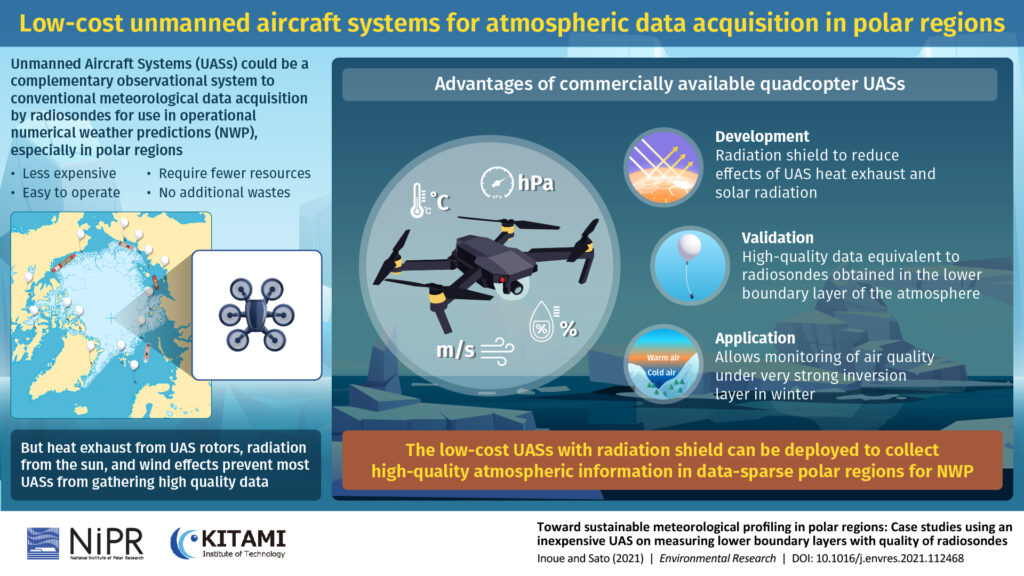
Japanese researchers have conducted an experiment to demonstrate how a modified commercial drone could gather high-quality meteorological data comparable to multiple radiosonde observations from polar environments.

While the daily vertical state of the atmosphere is often collected using radiosondes, these networks are limited in polar regions due to the environmental conditions and high operating costs in terms of sensors, energy and human resources. Additionally, downed radiosondes can leave waste over the land and oceans. With this in mind, the research team looked to find a complementary way to strengthen the observing network with high-quality meteorological data for numerical weather prediction (NWPs) models.

While unmanned aircraft systems (UAS) or drones could potentially fit the bill, the quality of data collected by such systems can be impacted by radiation effects (from the sun and the drone body), the deposition of precipitation and cloud droplets, and the position of the sensors relative to wind direction.

Dr Jun Inoue from Japan’s National Institute of Polar Research (NIPR), and assistant professor Kazutoshi Sato from Kitami Institute of Technology (KIT), investigated the possibility of collecting high-quality atmospheric data using a conventional low-cost UAS equipped with a radiation shield.

Commenting on the experiment, Dr Inoue said, “Sustainable observing networks for NWPs are essential for preparing for weather disasters under the warming climate. Since the number of radiosonde observations have hardly increased in a long time because of the costs of resources, continuous observations with a UAS are a highly desirable alternative to achieve sustainable development as well as meet the needs of ordinary people with improved forecasts.”

In their study, the duo focused on a commercially available drone, the DJI Mavic 2 Enterprise Dual UAS (M2ED). They performed laboratory experiments to determine the horizontal distribution of wind and heat exhaust below the M2ED as a way to gauge the ideal location for the sensors. Then using 3D printing and a heat-reflecting coating, they developed a radiation shield for the sensors that maintained ventilation simultaneously. The shield additionally prevented the deposition of precipitation on the sensor.

Next, they performed field experiments on the M2ED drone and compared its performance with two other meteorologically customized UASs – the ACSL-PF2- R-SWM and Meteodrone MM-670. This was followed by field tests on the three UASs launched concurrently with radiosondes and a comparison of their performances. The results showed that not only did the M2ED provide high-quality data equivalent to that of the two other drones, its accuracy was comparable to radiosondes.

“Our findings demonstrate that it is possible to make the existing polar observational networks sustainable with UASs. This could significantly boost their observation frequencies and spatial coverage through citizen science programs,” said Dr Inoue.

The study is set to be published in the April 2022 edition of the journal Environmental Research.

Previous ArticleSummer 2021 warmest on record for Europe
Next Article NASA analysis places 2021 as sixth warmest year on record

Read Similar Stories

Weather Instruments

R.M. Young Company reengineers SNOdar snow-depth sensor

May 21, 20262 Mins Read
Climate Measurement

Cloud measurement campaign targets improved climate model accuracy

May 20, 20263 Mins Read
Automated Weather Stations

University of Vermont launches first station in statewide weather monitoring network

May 8, 20262 Mins Read
Latest News

Tropical cyclones threaten energy security in Bangladesh, study finds

May 29, 2026

Fiji launches $15.4m initiative to expand early warning systems to vulnerable communities

May 28, 2026

Record-level global temperatures expected to persist over next five years

May 28, 2026

Receive breaking stories and features in your inbox each week, for free


Enter your email address:


Supplier Spotlights
  • LCJ Capteurs
Getting in Touch
  • Contact Us / Advertise
  • Meet the Editors
  • Media Pack
  • Free Weekly E-Newsletter
Our Social Channels
  • Facebook
  • LinkedIn
© 2026 UKi Media & Events a division of UKIP Media & Events Ltd
  • Cookie Policy
  • Privacy Policy
  • Terms and Conditions
  • Notice and Takedown Policy

Type above and press Enter to search. Press Esc to cancel.