


Close Menu
Meteorological Technology International
  • News
    • A-E
      • Agriculture
      • Automated Weather Stations
      • Aviation
      • Climate Measurement
      • Data
      • Developing Countries
      • Digital Applications
      • Early Warning Systems
      • Extreme Weather
    • G-P
      • Hydrology
      • Lidar
      • Lightning Detection
      • New Appointments
      • Nowcasting
      • Numerical Weather Prediction
      • Polar Weather
    • R-S
      • Radar
      • Rainfall
      • Remote Sensing
      • Renewable Energy
      • Satellites
      • Solar
      • Space Weather
      • Supercomputers
    • T-Z
      • Training
      • Transport
      • Weather Instruments
      • Wind
      • World Meteorological Organization
      • Meteorological Technology World Expo
  • Features
  • Online Magazines
    • January 2026
    • April 2025
    • January 2025
    • September 2024
    • April 2024
    • Archive Issues
    • Subscribe Free!
  • Opinion
  • Videos
  • Supplier Spotlight
  • Expo
LinkedIn X (Twitter) Facebook
  • Sign-up for Free Weekly E-Newsletter
  • Meet the Editors
  • Contact Us
  • Media Pack
LinkedIn Facebook
Subscribe
Meteorological Technology International
  • News
      • Agriculture
      • Automated Weather Stations
      • Aviation
      • Climate Measurement
      • Data
      • Developing Countries
      • Digital Applications
      • Early Warning Systems
      • Extreme Weather
      • Hydrology
      • Lidar
      • Lightning Detection
      • New Appointments
      • Nowcasting
      • Numerical Weather Prediction
      • Polar Weather
      • Radar
      • Rainfall
      • Remote Sensing
      • Renewable Energy
      • Satellites
      • Solar
      • Space Weather
      • Supercomputers
      • Training
      • Transport
      • Weather Instruments
      • Wind
      • World Meteorological Organization
      • Meteorological Technology World Expo
  • Features
  • Online Magazines
    1. April 2026
    2. January 2026
    3. September 2025
    4. April 2025
    5. January 2025
    6. September 2024
    7. April 2024
    8. January 2024
    9. Archive Issues
    10. Subscribe Free!
    Featured
    May 5, 2026

    In this Issue – April 2026

    By Web TeamMay 5, 2026
    Recent

    In this Issue – April 2026

    May 5, 2026

    In this Issue – January 2026

    November 27, 2025

    In this Issue – September 2025

    August 11, 2025
  • Opinion
  • Videos
  • Supplier Spotlight
  • Expo
Facebook LinkedIn
Subscribe
Meteorological Technology International
Climate Measurement

NASA analysis places 2021 as sixth warmest year on record

Dan SymondsBy Dan SymondsJanuary 14, 20223 Mins Read
Share LinkedIn Facebook Twitter Email
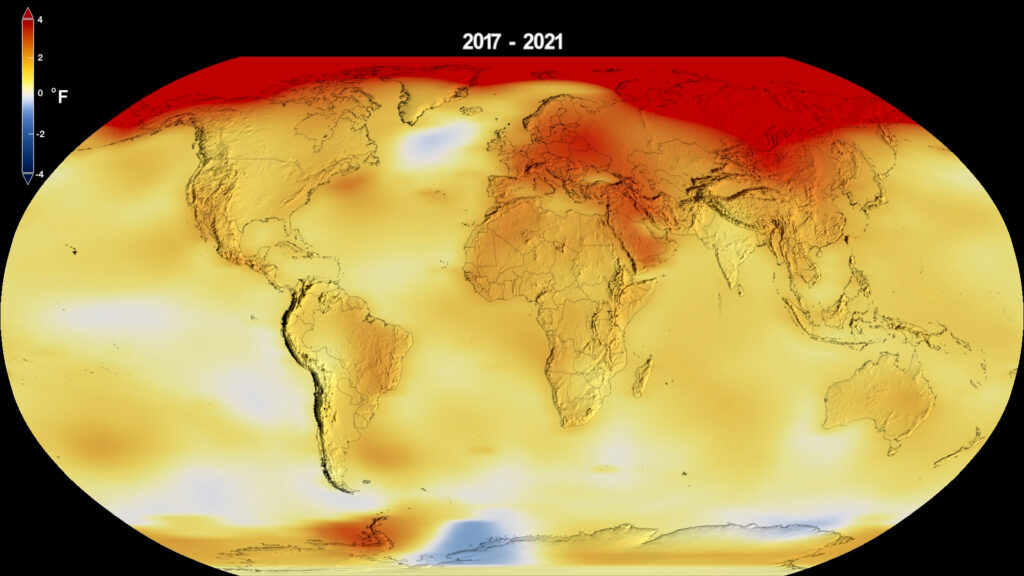
The image shows global surface temperature anomalies for 2021. Higher than normal temperatures, shown in red, can be seen in regions such as the Arctic. Lower than normal temperatures are shown in blue - credit: NASA
Share
LinkedIn Facebook Twitter Email

Earth’s global average surface temperature in 2021 tied with 2018 as the sixth warmest on record, according to analysis by NASA and the National Oceanic and Atmospheric Administration (NOAA).

Global temperatures in 2021 were 1.5°F (0.85°C) above the average for NASA’s baseline period, according to scientists at NASA’s Goddard Institute for Space Studies (GISS) in New York. NASA uses the period from 1951-1980 as a baseline to see how global temperature changes over time.

Collectively, the past eight years are the warmest years since modern record-keeping began in 1880. According to NASA’s temperature record, Earth in 2021 was about 1.9°F (or about 1.1°C) warmer than the late 19th century average, the start of the industrial revolution.

Bill Nelson, NASA administrator, said, “Science leaves no room for doubt: Climate change is the existential threat of our time. Eight of the top 10 warmest years on our planet occurred in the last decade, an indisputable fact that underscores the need for bold action to safeguard the future of our country – and all of humanity. NASA’s scientific research about how Earth is changing and getting warmer will guide communities throughout the world, helping humanity confront climate and mitigate its devastating effects.”

Weather stations, ships and ocean buoys around the globe record the temperature at Earth’s surface throughout the year. These ground-based measurements of surface temperature are validated with satellite data from the Atmospheric Infrared Sounder (AIRS) on NASA’s Aqua satellite. Scientists analyze these measurements using computer algorithms to deal with uncertainties in the data and quality control to calculate the global average surface temperature difference for every year. NASA compares that global mean temperature to its baseline period of 1951-1980. That baseline includes climate patterns and unusually hot or cold years due to other factors, ensuring that it encompasses natural variations in Earth’s temperature.

Many factors affect the average temperature any given year, such as La Nina and El Nino climate patterns in the tropical Pacific. For example, 2021 was a La Nina year and NASA scientists estimate that it may have cooled global temperatures by about 0.06°F (0.03°C) from what the average would have been.

A separate, independent analysis by NOAA also concluded that the global surface temperature for 2021 was the sixth highest since record keeping began in 1880. NOAA scientists use much of the same raw temperature data in their analysis and have a different baseline period (1901-2000) and methodology.

The Copernicus Climate Change Service (C3S), implemented by the European Centre for Medium-Range Weather Forecasts (ECMWF), also released new data this week showing that the last seven years globally were the seven warmest on record by a clear margin.

Gavin Schmidt, director of GISS, NASA’s leading center for climate modeling and climate change research, said, “The complexity of the various analyses doesn’t matter because the signals are so strong. The trends are all the same because the trends are so large.”

NASA’s full data set of global surface temperatures for 2021, as well as details of how NASA scientists conducted the analysis, are publicly available from GISS – a NASA laboratory managed by the Earth Sciences Division of the agency’s Goddard Space Flight Center in Greenbelt, Maryland. The laboratory is affiliated with Columbia University’s Earth Institute and School of Engineering and Applied Science in New York.

Previous ArticleModified drones key to expanding data acquisition in polar regions, claims research
Next Article VIDEO: How does NASA maintain its global temperature record?

Read Similar Stories

Climate Measurement

Record-level global temperatures expected to persist over next five years

May 28, 20263 Mins Read
Weather Instruments

R.M. Young Company reengineers SNOdar snow-depth sensor

May 21, 20262 Mins Read
Satellites

SMILE mission launches to study Earth’s magnetic shield and space weather

May 20, 20263 Mins Read
Latest News

Tropical cyclones threaten energy security in Bangladesh, study finds

May 29, 2026

Fiji launches $15.4m initiative to expand early warning systems to vulnerable communities

May 28, 2026

Record-level global temperatures expected to persist over next five years

May 28, 2026

Receive breaking stories and features in your inbox each week, for free


Enter your email address:


Supplier Spotlights
  • ROTRONIC AG
Getting in Touch
  • Contact Us / Advertise
  • Meet the Editors
  • Media Pack
  • Free Weekly E-Newsletter
Our Social Channels
  • Facebook
  • LinkedIn
© 2026 UKi Media & Events a division of UKIP Media & Events Ltd
  • Cookie Policy
  • Privacy Policy
  • Terms and Conditions
  • Notice and Takedown Policy

Type above and press Enter to search. Press Esc to cancel.