


Close Menu
Meteorological Technology International
  • News
    • A-E
      • Agriculture
      • Automated Weather Stations
      • Aviation
      • Climate Measurement
      • Data
      • Developing Countries
      • Digital Applications
      • Early Warning Systems
      • Extreme Weather
    • G-P
      • Hydrology
      • Lidar
      • Lightning Detection
      • New Appointments
      • Nowcasting
      • Numerical Weather Prediction
      • Polar Weather
    • R-S
      • Radar
      • Rainfall
      • Remote Sensing
      • Renewable Energy
      • Satellites
      • Solar
      • Space Weather
      • Supercomputers
    • T-Z
      • Training
      • Transport
      • Weather Instruments
      • Wind
      • World Meteorological Organization
      • Meteorological Technology World Expo
  • Features
  • Online Magazines
    • January 2026
    • April 2025
    • January 2025
    • September 2024
    • April 2024
    • Archive Issues
    • Subscribe Free!
  • Opinion
  • Videos
  • Supplier Spotlight
  • Expo
LinkedIn X (Twitter) Facebook
  • Sign-up for Free Weekly E-Newsletter
  • Meet the Editors
  • Contact Us
  • Media Pack
LinkedIn Facebook
Subscribe
Meteorological Technology International
  • News
      • Agriculture
      • Automated Weather Stations
      • Aviation
      • Climate Measurement
      • Data
      • Developing Countries
      • Digital Applications
      • Early Warning Systems
      • Extreme Weather
      • Hydrology
      • Lidar
      • Lightning Detection
      • New Appointments
      • Nowcasting
      • Numerical Weather Prediction
      • Polar Weather
      • Radar
      • Rainfall
      • Remote Sensing
      • Renewable Energy
      • Satellites
      • Solar
      • Space Weather
      • Supercomputers
      • Training
      • Transport
      • Weather Instruments
      • Wind
      • World Meteorological Organization
      • Meteorological Technology World Expo
  • Features
  • Online Magazines
    1. April 2026
    2. January 2026
    3. September 2025
    4. April 2025
    5. January 2025
    6. September 2024
    7. April 2024
    8. January 2024
    9. Archive Issues
    10. Subscribe Free!
    Featured
    May 5, 2026

    In this Issue – April 2026

    By Web TeamMay 5, 2026
    Recent

    In this Issue – April 2026

    May 5, 2026

    In this Issue – January 2026

    November 27, 2025

    In this Issue – September 2025

    August 11, 2025
  • Opinion
  • Videos
  • Supplier Spotlight
  • Expo
Facebook LinkedIn
Subscribe
Meteorological Technology International
Satellites

L3Harris to develop imager for NOAA’s next-gen GeoXO satellites

Dan SymondsBy Dan SymondsMarch 14, 20232 Mins Read
Share LinkedIn Facebook Twitter Email
Share
LinkedIn Facebook Twitter Email

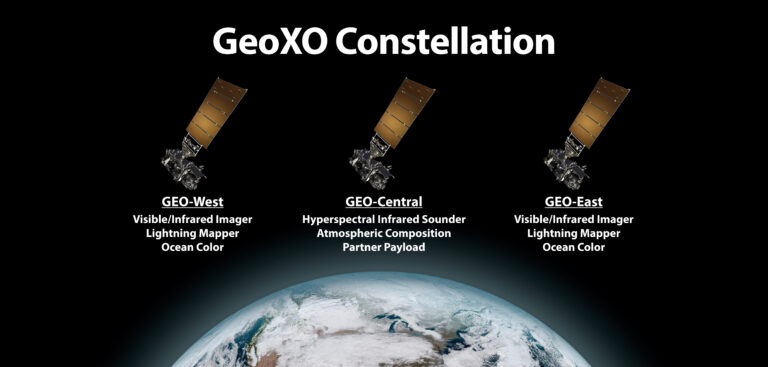
US space agency NASA has selected L3Harris Technologies to develop the imager for the National Oceanic and Atmospheric Administration’s (NOAA) next-generation Geostationary Extended Observations (GeoXO) satellite program.

Valued at around US$765.5m, the contract includes the development of two flight instruments as well as options for additional units. The anticipated period of performance includes support for 10 years of on-orbit operations and five years of on-orbit storage, for a total of 15 years for each flight model. The work will be completed at L3Harris facilities; NASA’s Goddard Space Flight Center in Greenbelt, Maryland; and the agency’s Kennedy Space Center in Florida.

The GeoXO Imager (GXI) is the primary instrument for the GeoXO mission, which will eventually replace NOAA’s Geostationary Operational Environmental Satellites (GOES-R Series) program in the 2030s. GXI is a multichannel, passive imaging radiometer used to measure environmental data. The instrument will provide real-time, high-resolution visible and infrared imagery for monitoring the Western Hemisphere’s weather, ocean and environment. GXI will be used for a wide range of applications related to severe storms, hurricanes, aviation, natural hazards, the atmosphere and ocean. GXI will monitor cloud formation, atmospheric motion, convection, land surface temperature, fire, smoke, dust, volcanic ash plumes, aerosols, air quality, vegetative health and more.

The contract scope includes the tasks and deliverables necessary to design, analyze, develop, fabricate, integrate, test, verify, evaluate, support launch, supply and maintain the instrument ground support equipment, and support mission operations at the NOAA Satellite Operations Facility.

Together, NOAA and NASA will oversee the development, launch, testing and operation of all the satellites in the GeoXO program. NOAA funds and manages the program, operations and data products. On behalf of NOAA, NASA and commercial partners develop and build the instruments, spacecraft and ground system, and launch the satellites.

Click here for the latest GeoXO news.

Previous ArticleUK launches Earth Observation Climate Information Service
Next Article Vanda Grubišić named director of NOAA Global Monitoring Laboratory

Read Similar Stories

Satellites

SMILE mission launches to study Earth’s magnetic shield and space weather

May 20, 20263 Mins Read
Videos

VIDEO: Meteosat-12 imagery over Europe and Africa made available via YouTube streams

May 19, 20262 Mins Read
Extreme Weather

Wildfires can create ‘burn scar heat islands’ that alter weather patterns, study finds

May 6, 20263 Mins Read
Latest News

R.M. Young Company reengineers SNOdar snow-depth sensor

May 21, 2026

SMILE mission launches to study Earth’s magnetic shield and space weather

May 20, 2026

Cloud measurement campaign targets improved climate model accuracy

May 20, 2026

Receive breaking stories and features in your inbox each week, for free


Enter your email address:


Supplier Spotlights
  • Reuniwatt
Getting in Touch
  • Contact Us / Advertise
  • Meet the Editors
  • Media Pack
  • Free Weekly E-Newsletter
Our Social Channels
  • Facebook
  • LinkedIn
© 2026 UKi Media & Events a division of UKIP Media & Events Ltd
  • Cookie Policy
  • Privacy Policy
  • Terms and Conditions
  • Notice and Takedown Policy

Type above and press Enter to search. Press Esc to cancel.