


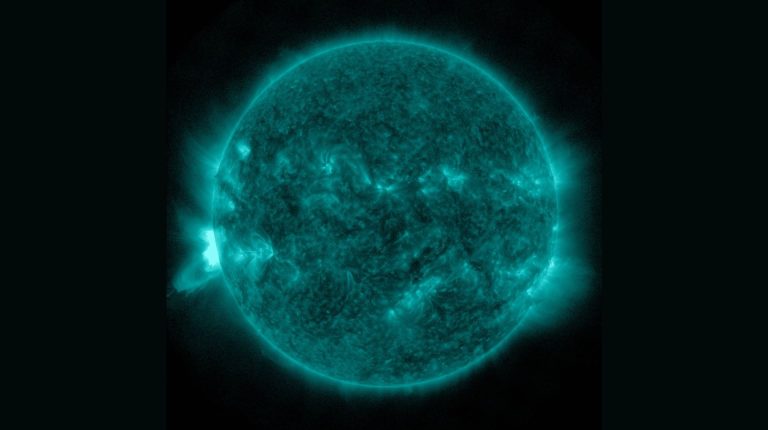
A team from the US National Science Foundation National Solar Observatory (NSF NSO), NorthWest Research Associates (NWRA), and the Southwest Research Institute (SwRI) has developed a forecasting framework designed to improve prediction of solar flares occurring near or beyond the visible edges of the sun.
Solar flares pose a recognized threat to satellites, communications systems and power grids, but operational forecasting has long struggled when the source region lies near the sun’s edges (limbs) or on its hidden side, out of Earth’s line of sight. The new “4π” framework is intended to address that blind spot by tracking active regions across the sun’s entire surface.
The system combines the Advective Flux Transport (AFT) model, developed by Dr Lisa Upton of SwRI, with far-side helioseismic maps produced from NSF-NOAA Global Oscillations Network Group (GONG) data, provided by Dr Kiran Jain of NSO. Far-side helioseismology is a technique that detects magnetically active regions on the sun’s far hemisphere without direct imaging. The resulting magnetic field maps are used by a statistical framework that generates flare predictions across the entire solar surface, including the eastern limb, before the underlying active region rotates to become visible.
When evaluated for limb flares, the approach produced modest overall skill improvements but significantly reduced the number of missed flare events, particularly near the eastern limb.
The framework also has potential applications beyond Earth-directed space weather, with the possibility of forecasting solar energetic events that could affect other locations in the solar system, such as Mars.
Dr K D Leka of NWRA, who led the project, said, “As part of the 2019 team that first identified this systematic limb-flare shortcoming in operational forecasts, it was immediately clear to me that flux-transport models and, especially, far-side helioseismology could help. Substantial infrastructure was developed, including enhancements to AFT to incorporate the information from the GONG far-side helioseismology, and the needed methodology to evaluate improvements in limb-flare prediction.”
Dr Jain added, “Since far-side active regions are critical for forecasting flares near both limbs, and without their direct observations, the helioseismic mapping is particularly crucial when new active regions emerge on the far side.”
The research was supported by NASA grants to NWRA and SwRI. The paper, titled “Addressing Known Challenges in Solar Flare Forecasting I: Limb-Flare Prediction With a 4π Full-Heliosphere Framework,” has been published in Space Weather.
Related, SMILE mission launches to study Earth’s magnetic shield and space weather