


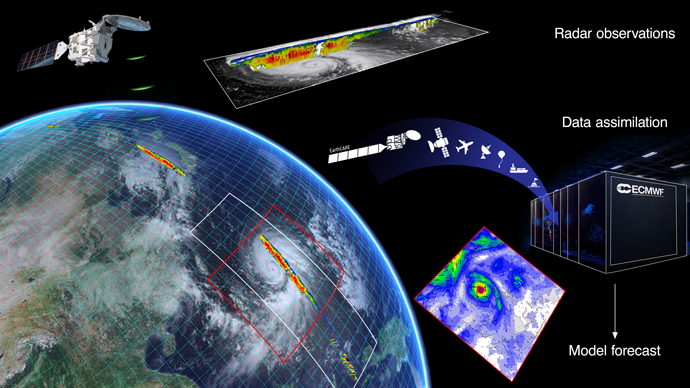
ECMWF is assimilating new cloud radar data from the ESA–JAXA EarthCARE (Earth Clouds, Aerosols and Radiation Explorer) satellite mission it its global forecasting system – the first time any operational forecasting center has assimilated this type of data.
The new observations, from the cloud profiling radar (CPR) on board EarthCARE, provide an unprecedented view of the vertical structure of clouds and precipitation around the world. Incorporating this information into the Integrated Forecasting System (IFS) will help to improve its forecasts, according to ECMWF.
Although some information on the structure of clouds has been included for several years from microwave imagers and sounders, the activation of EarthCARE earlier this month marks the first operational use of cloud radar observations directly within ECMWF’s data assimilation system.
Florian Pappenberger, ECMWF director-general, said, “This is the first operational assimilation of cloud radar observations by any weather forecasting center.
“The new data from the Cloud Profiling Radar on the joint ESA-JAXA EarthCARE mission is a crucial step for reducing uncertainties in how clouds influence the weather, and as ever, international collaboration has been at the heart of EarthCARE.
“Scientists at ECMWF have been working with ESA and JAXA engineers to ensure the best data quality and we also have our partners at the Dutch national meteorological service KNMI and McGill University in Canada to thank, along with the many others involved in bringing EarthCARE to fruition.”
Providing a unique view
EarthCARE was launched in May 2024 as ESA’s eighth Earth Explorer mission, in collaboration with JAXA (the Japan Aerospace Exploration Agency). The satellite carries four instruments designed to work together, including the CPR, a high-spectral-resolution lidar, a multispectral imager and a broadband radiometer.
Together, these instruments provide a unique view of not only the vertical structure of clouds and aerosols, but also how much they reflect sunlight and absorb heat emitted from the Earth.
Mark Fielding, who leads the EarthCARE assimilation project at ECMWF, said, “Bringing cloud radar observations that reveal the vertical profiles of cloud and rain into the IFS is an exciting new development for weather forecasting.
“EarthCARE was not originally designed for operational forecasting, so realizing this additional benefit is a real bonus on top of the scientific understanding that the new observations are giving us.”
Improving forecasts by better representing clouds
The new observations from EarthCARE provide detailed constraints on cloud processes, such as whether a cloud is composed of ice or liquid, the amount of water it contains, the size of particles and how quickly they fall. These insights are helping scientists refine how clouds are represented in the forecasting model.
Nine months of testing have shown a modest positive effect on short- to medium-range forecasts, particularly for humidity and wind fields, with improvements most noticeable in the southern hemisphere.
According to ECMWF, the strongest forecast impact is seen in winds. This is linked to the so-called ‘tracer effect’, whereby cloud-related observations help position air masses more accurately in the model, improving the large-scale atmospheric dynamics that underpin forecasts.
New insights into extreme weather
EarthCARE is already providing unique case studies. In September 2025, the satellite flew directly over the eye of Hurricane Humberto, capturing a space-based view of the vertical motion of wind, rain and snow within the eyewall – something not previously observed.
These insights are helping ECMWF scientists to improve how cloud processes are represented in our weather model and ultimately how realistic weather forecasts are.
Rebecca Murray-Watson, a scientist at ECMWF who works with the EarthCARE data in the IFS, said, “As a cloud physicist, what excites me the most about EarthCARE is the Doppler radar – for the first time we have a satellite that can tell us not just where the ice is, but how fast it’s falling.
“That kind of information is exactly what drives improvements in the next generation of weather models. Being able to sit down with the EarthCARE data and compare it directly against our model simulations tells us where we’re getting things right, and where there’s still work to do. Furthermore, improved understanding of physical processes can also ultimately help to inform climate projections carried out by the wider weather and climate community.”
Preparing for the next generation of observations
The operational use of EarthCARE marks a milestone in the use of active satellite observations in numerical weather prediction.
Unlike conventional satellite data, cloud radar and lidar provide direct information on the vertical structure of clouds and precipitation, which is especially important in dynamically active – and often high-impact – weather systems where clouds strongly influence atmospheric heating, radiation and precipitation processes.
The new capability complements ECMWF’s existing use of all-sky assimilation of microwave observations and opens the way for future use of advanced cloud-profiling operations in operational forecasting systems.
Related news, Cambridge AI tool converts satellite archives into accessible Earth intelligence