

Close Menu
Meteorological Technology International
  • News
    • A-E
      • Agriculture
      • Automated Weather Stations
      • Aviation
      • Climate Measurement
      • Data
      • Developing Countries
      • Digital Applications
      • Early Warning Systems
      • Extreme Weather
    • G-P
      • Hydrology
      • Lidar
      • Lightning Detection
      • New Appointments
      • Nowcasting
      • Numerical Weather Prediction
      • Polar Weather
    • R-S
      • Radar
      • Rainfall
      • Remote Sensing
      • Renewable Energy
      • Satellites
      • Solar
      • Space Weather
      • Supercomputers
    • T-Z
      • Training
      • Transport
      • Weather Instruments
      • Wind
      • World Meteorological Organization
      • Meteorological Technology World Expo
  • Features
  • Online Magazines
    • January 2026
    • April 2025
    • January 2025
    • September 2024
    • April 2024
    • Archive Issues
    • Subscribe Free!
  • Opinion
  • Videos
  • Supplier Spotlight
  • Expo
LinkedIn X (Twitter) Facebook
  • Sign-up for Free Weekly E-Newsletter
  • Meet the Editors
  • Contact Us
  • Media Pack
LinkedIn Facebook
Subscribe
Meteorological Technology International
  • News
      • Agriculture
      • Automated Weather Stations
      • Aviation
      • Climate Measurement
      • Data
      • Developing Countries
      • Digital Applications
      • Early Warning Systems
      • Extreme Weather
      • Hydrology
      • Lidar
      • Lightning Detection
      • New Appointments
      • Nowcasting
      • Numerical Weather Prediction
      • Polar Weather
      • Radar
      • Rainfall
      • Remote Sensing
      • Renewable Energy
      • Satellites
      • Solar
      • Space Weather
      • Supercomputers
      • Training
      • Transport
      • Weather Instruments
      • Wind
      • World Meteorological Organization
      • Meteorological Technology World Expo
  • Features
  • Online Magazines
    1. April 2026
    2. January 2026
    3. September 2025
    4. April 2025
    5. January 2025
    6. September 2024
    7. April 2024
    8. January 2024
    9. Archive Issues
    10. Subscribe Free!
    Featured
    May 5, 2026

    In this Issue – April 2026

    By Web TeamMay 5, 2026
    Recent

    In this Issue – April 2026

    May 5, 2026

    In this Issue – January 2026

    November 27, 2025

    In this Issue – September 2025

    August 11, 2025
  • Opinion
  • Videos
  • Supplier Spotlight
  • Expo
Facebook LinkedIn
Subscribe
Meteorological Technology International
Space Weather

NASA and Amazon collaborate on app to predict solar superstorms

Paul WillisBy Paul WillisJanuary 21, 20202 Mins Read
Share LinkedIn Facebook Twitter Email
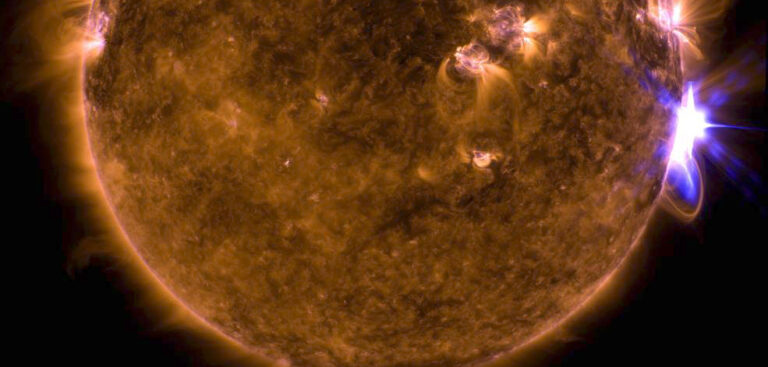
Credit: NASA/SDO/Goddard
Share
LinkedIn Facebook Twitter Email

Amazon announced that it is working with NASA on a new app that it is hoped will help better predict solar superstorms.

The joint venture is a collaboration between the space agency and Amazon Web Services (AWS) Professional Services and Machine-Learning (ML) Solutions Lab. The AWS lab is using machine-learning to spot anomalies – identified by NASA – that could be predictive of these rare solar events.

The lab’s technology is capable of examining as many as 1,000 data sets simultaneously to find patterns unique to superstorms. In a blogpost, Amazon explained the complexity of the task ahead.

“Given just how rare superstorms are, there are very few historical examples that can be used to train algorithms. This makes common machine-learning approaches like supervised learning woefully inadequate for predicting superstorms,” it said.

“Additionally, with dozens of past and current satellites gathering space weather information from different key vantage points around Earth, the amount of data is prodigious – and the attempt to find correlations laborious when searched conventionally.”

Though rare, solar superstorms can cause significant damage to vital infrastructure such as power lines and satellites. A superstorm in 1989, for example, knocked out power for thousands of residents living in Quebec, Canada.

The storms are caused by eruptions on the surface of the sun known as solar flares. The flares are accompanied by a burst of radiative particles called coronal mass ejections. Usually the Earth’s magnetic field stops this radiation from reaching us but occasionally the volume of particles is so high that they break through, causing damage on Earth.

Eventually NASA and Amazon plan to create a repository of publicly available data that researchers can use to improve the forecasting of superstorms.

NASA heliophysicist and lead researcher on the project Janet Kozyra said, “With Amazon, we can take every single piece of data that we have on superstorms and use anomalies we have detected to improve the models that predict and classify superstorms effectively.”

Previous ArticleSpace weather causes electrical surge on Earth’s surface, say astronomers
Next Article Research reveals how cracks in sea ice affect weather

Read Similar Stories

Satellites

SMILE mission launches to study Earth’s magnetic shield and space weather

May 20, 20263 Mins Read
Space Weather

Northumbria University secures £4m to study Earth’s radiation belts

April 16, 20262 Mins Read
Solar

Mauna Loa Solar Observatory reopens to support Artemis II mission

April 8, 20262 Mins Read
Latest News

Fiji launches $15.4m initiative to expand early warning systems to vulnerable communities

May 28, 2026

Record-level global temperatures expected to persist over next five years

May 28, 2026

FEATURE: Turning contrail science into flight plans

May 27, 2026

Receive breaking stories and features in your inbox each week, for free


Enter your email address:


Supplier Spotlights
  • EUMETSAT
Getting in Touch
  • Contact Us / Advertise
  • Meet the Editors
  • Media Pack
  • Free Weekly E-Newsletter
Our Social Channels
  • Facebook
  • LinkedIn
© 2026 UKi Media & Events a division of UKIP Media & Events Ltd
  • Cookie Policy
  • Privacy Policy
  • Terms and Conditions
  • Notice and Takedown Policy

Type above and press Enter to search. Press Esc to cancel.