


The Woods Hole Oceanographic Institution (WHOI) is participating in a new research initiative aimed at enhancing the understanding of extreme weather, such as hurricanes, using ocean data.
The Study on Air-Sea Coupling with Waves, Turbulence and Clouds at High Winds (SASCWATCH), funded by the Office of Naval Research, will see the deployment of a grid of ocean sensors ahead of hurricanes over the next three years and will use combination of in-situ observations, satellites and high-resolution models to enable researchers to fill gaps in the knowledge of air-sea interactions.
The transfer of momentum, heat and moisture between the ocean and atmosphere plays a critical role in shaping when, where and how intensely extreme weather events develop. Despite increasing recognition that these interactions are deeply interconnected, they’ve often been studied in isolation, according to WHOI.
“This fragmented approach has led to an incomplete picture of how key factors, such as surface waves, ocean currents and atmospheric turbulence, modulate fluxes under high-wind conditions,” said WHOI physical oceanographer Steven Jayne. “With the SASCWATCH program, we will be able to capture the full picture in real time.”
The project will use two types of ocean monitoring tools – Argo and Air-Launched Autonomous Micro Observer (ALAMO) – to gather real-time water temperature and salinity data.
Argo floats are deployed in the ocean from ships and take a profile of temperature and salinity every 10 days. As of this month, there are more than 4,000 floating robots taking inventory of the upper 2,000m of the ocean, transmitting data back to shore every 10 days. During peak hurricane season, data transmission is more frequent, so near-real-time data is available to improve hurricane forecasts.
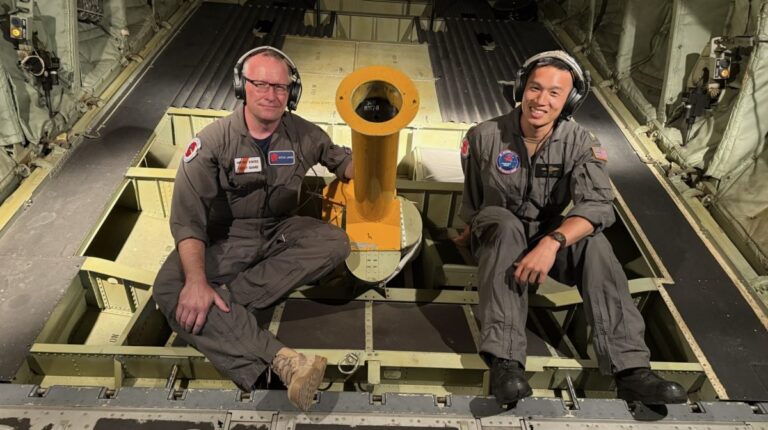
The ALAMO is a smaller Argo-style profiling float that can be deployed through the chute installed in the back of a plane and communicate through satellite networks. Their size enables them to be more easily deployed out of aircraft, making ALAMO floats ideal for the rapid-response deployments necessary for studying shorter-term phenomena like hurricanes and other storms.
In related news, a CU Boulder-led study has revealed that some of the rainiest places on Earth, including the Amazon rainforest, could see their annual precipitation nearly halved if climate change continues to alter the Atlantic Ocean’s current. Read the full story here