


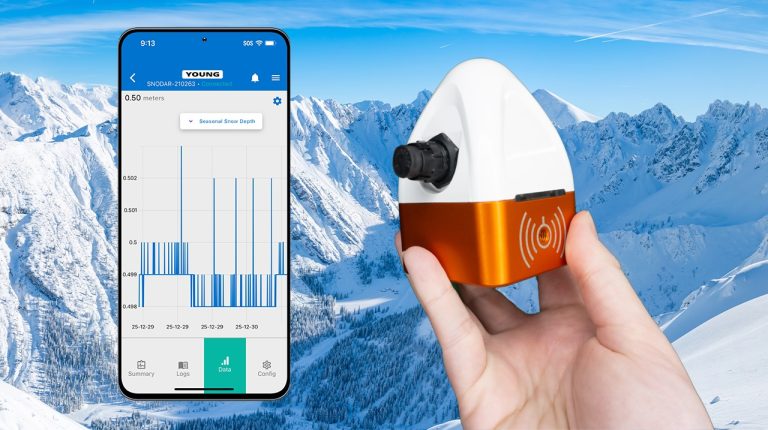
R.M. Young Company has launched a reengineered version of its SNOdar snow depth sensor (Model 54000), a lidar-based instrument designed to deliver accurate, real-time snow-depth measurements during active snowfall.
Most snow-depth sensors use ultrasonic technology, which can suffer signal degradation in falling snow. The SNOdar instead uses lidar (light detection and ranging) to maintain continuous, accurate measurement even during storm conditions – addressing a longstanding challenge in snow monitoring.
The Michigan-based company, which has manufactured professional meteorological instruments since 1964, acquired the SNOdar technology and undertook a full reengineering effort. Updates include a major overhaul of the companion mobile app, enhanced SDI-12 firmware reliability, refined data visualization and a redesigned mounting clamp with improved thermal isolation.
The sensor features an internal non-volatile datalogger capable of storing a full season of measurements, removing the need for a separate logger at each deployment site. Data is output via SDI-12 and RS-232, allowing integration with existing hydrological and meteorological monitoring networks.
Weighing 265g and smaller than a baseball, the SNOdar is among the most compact laser-based snow-depth sensors available. With an average power draw of 0.5W, it is suited for solar- and battery-powered deployment at remote sites. Field configuration, calibration and data access are managed through a free iOS and Android app via Bluetooth Low Energy, with no cable or on-site computer required. Most installations take under 30 minutes.
“Snow professionals trusted us with their feedback, and that meant something to our team,” said Conor Byrne, engineering manager at R.M. Young Company. “We poured an enormous amount of engineering work into this product, listening carefully, addressing every concern and holding ourselves to the standard that R.M. Young has stood for over six decades. The SNOdar that exists today is a direct result of that process.”
Related: FEATURE – How the Arctic oscillation fueled widespread winter storms