
Close Menu
Meteorological Technology International
  • News
    • A-E
      • Agriculture
      • Automated Weather Stations
      • Aviation
      • Climate Measurement
      • Data
      • Developing Countries
      • Digital Applications
      • Early Warning Systems
      • Extreme Weather
    • G-P
      • Hydrology
      • Lidar
      • Lightning Detection
      • New Appointments
      • Nowcasting
      • Numerical Weather Prediction
      • Polar Weather
    • R-S
      • Radar
      • Rainfall
      • Remote Sensing
      • Renewable Energy
      • Satellites
      • Solar
      • Space Weather
      • Supercomputers
    • T-Z
      • Training
      • Transport
      • Weather Instruments
      • Wind
      • World Meteorological Organization
      • Meteorological Technology World Expo
  • Features
  • Online Magazines
    • January 2026
    • April 2025
    • January 2025
    • September 2024
    • April 2024
    • Archive Issues
    • Subscribe Free!
  • Opinion
  • Videos
  • Supplier Spotlight
  • Expo
LinkedIn X (Twitter) Facebook
  • Sign-up for Free Weekly E-Newsletter
  • Meet the Editors
  • Contact Us
  • Media Pack
LinkedIn Facebook
Subscribe
Meteorological Technology International
  • News
      • Agriculture
      • Automated Weather Stations
      • Aviation
      • Climate Measurement
      • Data
      • Developing Countries
      • Digital Applications
      • Early Warning Systems
      • Extreme Weather
      • Hydrology
      • Lidar
      • Lightning Detection
      • New Appointments
      • Nowcasting
      • Numerical Weather Prediction
      • Polar Weather
      • Radar
      • Rainfall
      • Remote Sensing
      • Renewable Energy
      • Satellites
      • Solar
      • Space Weather
      • Supercomputers
      • Training
      • Transport
      • Weather Instruments
      • Wind
      • World Meteorological Organization
      • Meteorological Technology World Expo
  • Features
  • Online Magazines
    1. April 2026
    2. January 2026
    3. September 2025
    4. April 2025
    5. January 2025
    6. September 2024
    7. April 2024
    8. January 2024
    9. Archive Issues
    10. Subscribe Free!
    Featured
    May 5, 2026

    In this Issue – April 2026

    By Web TeamMay 5, 2026
    Recent

    In this Issue – April 2026

    May 5, 2026

    In this Issue – January 2026

    November 27, 2025

    In this Issue – September 2025

    August 11, 2025
  • Opinion
  • Videos
  • Supplier Spotlight
  • Expo
Facebook LinkedIn
Subscribe
Meteorological Technology International
World Meteorological Organization

Congress approves WMO governance reforms

Helen NormanBy Helen NormanJune 18, 20193 Mins Read
Share LinkedIn Facebook Twitter Email
Share
LinkedIn Facebook Twitter Email

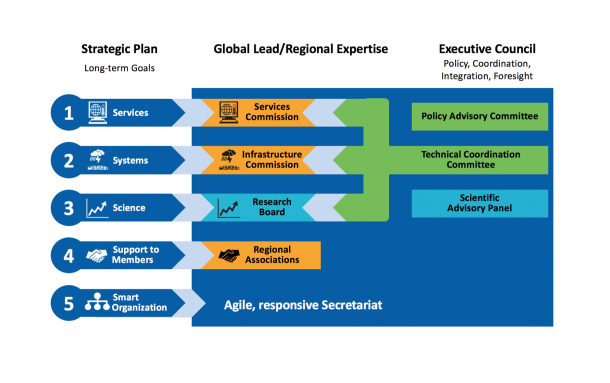
Sweeping reforms to the World Meteorological Organization (WMO) have been approved at the World Meteorological Congress, which took place in Geneva, Switzerland, from June 3 to June 14, in an attempt to embrace a more comprehensive Earth system approach. The reforms will reshape the WMO to provide a stronger focus on water resources, the ocean, coordinated climate activities and translating science into services for society. There will also be greater engagement with the private sector and more structured collaboration with development agencies. The governance structure of the WMO will be overhauled to ensure it is better equipped to tackle mounting challenges such as climate change, extreme weather, environmental degradation, and urbanization, while harnessing technological advances from satellites, supercomputing and big data. It seeks to narrow the growing capacity gap between rich and poor and to channel more resources to the WMO’s regional operations. “The WMO is needed more than ever,” said WMO secretary-general Petteri Taalas, who was re-appointed for an additional four-year term at the Congress. “WMO supports climate change mitigation by providing scientific facts based on measurements and model calculations for decision makers. “It also plays a major role in climate adaptation through multi-hazard early warning services and serves as a platform to transfer know-how from developed meteorological and hydrological services to less developed ones. Congress has endorsed a new concept for WMO and now it is our job to get it up and running,” he said. Elsewhere, Prof. Dr Gerhard Adrian, president of the German Weather Service (DWD), was elected as the new WMO president. The Executive Committee, led by Adrian, approved a 2% increase in the WMO’s regular budget, to CHF 271,544,400 (US$270m) for the four-year period 2020-2023. “The WMO sets the framework for the successful cooperation of its member states to accomplish their tasks for the well-being of societies,” said Adrian. “Fulfilling this important duty is based on the global meteorological infrastructure coordinated by WMO. My aim is that this infrastructure as well as the indispensable global exchange of data are improved even further and guaranteed into the future. It is our collective responsibility and my main interest to strengthen the WMO.” WMO governance reform The strategic plan sets out long-term goals and priorities including: – Enhancing preparedness for, and reducing losses of life and property from, hydrometeorological extremes; – Supporting climate-smart decision making to build resilience and adaptation to climate risk; – Enhancing the socioeconomic value of weather, climate, hydrological and related environmental services. The potential benefits of the WMO reform process include: – An Earth system approach embracing meteorology, climatology, hydrology, oceanography, seismology, volcanology, air quality, and greenhouse gases; – Multi-hazard and impact-based seamless services covering weather, climate, water, aviation, marine, agriculture, urban, energy, and health; – Wide climate perspective which coordinates observations, services, science, mitigation and adaptation; – Closer involvement of hydrological services in WMO activities and weather-water synergies; – Organized and controlled engagement of the private sector in WMO activities; – Optimal use of national meteorological and hydrological services and secretariat resources, thus providing more support for regional activities.

Previous ArticleCOSMIC-2 weather satellites ready for launch
Next Article Jim Anderson elected HMEI chair

Read Similar Stories

Climate Measurement

WMO warns El Niño is developing with 80% certainty, urges preparation

June 2, 20263 Mins Read
Climate Measurement

Record-level global temperatures expected to persist over next five years

May 28, 20263 Mins Read
Early Warning Systems

G7 countries pledge additional funding for CREWS early warning initiative

May 7, 20263 Mins Read
Latest News

Stephen Ettinger named UCAR CFO

June 8, 2026

IKEA uses 20 years of solar data to identify Sweden’s sunniest square meter

June 8, 2026

VIDEO: Sentinel-6 satellite detects El Niño precursor in Pacific

June 4, 2026

Receive breaking stories and features in your inbox each week, for free


Enter your email address:


Supplier Spotlights
  • EWR Radar Systems
Getting in Touch
  • Contact Us / Advertise
  • Meet the Editors
  • Media Pack
  • Free Weekly E-Newsletter
Our Social Channels
  • Facebook
  • LinkedIn
© 2026 UKi Media & Events a division of UKIP Media & Events Ltd
  • Cookie Policy
  • Privacy Policy
  • Terms and Conditions
  • Notice and Takedown Policy

Type above and press Enter to search. Press Esc to cancel.